

Most Match 3 developers do not fail because their game lacks content.
They fail because their game attracts players who never intended to pay. Studios spend months building levels, polishing visuals, and scaling installs, yet revenue remains unstable. Campaigns look healthy at first, then collapse once real data appears. CPI rises, ROAS drops, and growth becomes unpredictable.
This happens for one reason: paying players were never the focus from the beginning.
Top studios approach growth differently. They do not wait for players to decide whether spending feels acceptable. They shape that decision long before the first purchase screen appears.
From the first ad impression to the first failed level, every step is designed to attract players who already believe progress has value.
This is not aggressive monetisation. It is structured psychology.
When strategy, user acquisition, and monetisation operate as one system, paying players stop being rare. They become measurable, repeatable, and scalable.
This article breaks down a practical Match 3 monetisation strategy focused on targeting paying players instead of chasing cheap installs.
Why Paying Match 3 Players Are Not Random Users
Many studios assume paying players will appear naturally as installs grow, but this rarely works. This rarely works.
Paying players are filtered, shaped, and guided from the very first interaction. Top‑performing Match 3 studios do not chase installs; they attract behaviour patterns that indicate willingness to pay.
The moment a player opens the game, their actions reveal behavioural signals that predict spending. Understanding these signals allows studios to target paying players in Match 3 with precision, instead of relying on luck.
Whether you are launching your first puzzle game or scaling an established title, this understanding is critical. Beginners get a clear path to monetisation, and experts gain insights that most blogs never explain.
Paying Players in Match 3 Are Created Before the Install
A common mistake is thinking players decide to pay after playing long enough. In reality, the decision begins before the download.
High-value Match 3 players share one core trait. They already believe progress should not be free.
These players often come from:
- Other puzzle games where boosters are normal
- Mobile casino or casual hybrid titles
- Games where time pressure and limited moves feel acceptable
Strong studios design ads that quietly filter for this mindset.
Instead of promoting:
- “Relaxing puzzle fun”
- “Play offline anytime”
- “No stress gameplay”
They focus on:
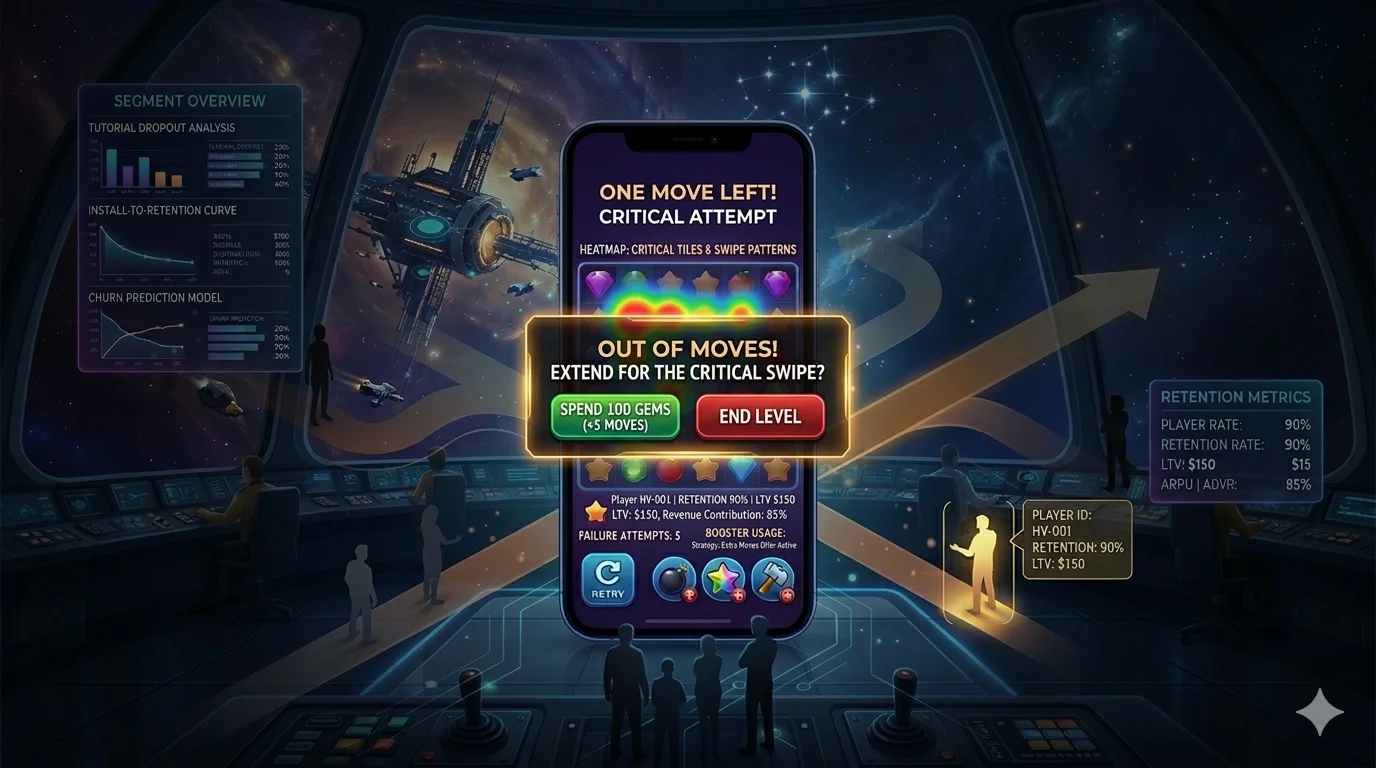
- High-stakes moments
- Near-fail scenarios
- One move left situations
- Emotional frustration followed by instant resolution
This filters out non-spenders automatically. Free-first players skip the ad. Paying-minded players click.
This is not creative design. This is behavioural screening.
Behavioural Signals That Predict Payers in Match 3
Optimising for installs produces fast numbers and poor revenue. Advanced studios rarely scale campaigns on CPI alone. They optimise based on early behavioural signals, usually within the first 24 to 48 hours.
Common payer indicators include:
- Booster usage before level 10
- Retrying failed levels instead of quitting
- Completing difficult levels in one session
- Accepting time-based friction rather than waiting
UA platforms allow event-based optimisation, but most teams feed them the wrong events.
They track:
- Level completion
- Tutorial finish
- Session start
Top studios track:
- Booster purchase intent
- Failure tolerance
- Frustration recovery behaviour
These signals allow ad platforms to find players who behave like spenders before the first purchase occurs, making scaling profitable while competitors burn budgets.
Mini-definition: Conversion confidence is the degree of comfort a player feels about paying, measured through behaviour on offer screens.
How Match 3 UA Teams Use Behavioural Signals Instead of Installs
Optimising campaigns for installs alone is a fast path to poor revenue; the real advantage comes from optimising for behavioural indicators that mimic how proven payers act in their first sessions.”
Key examples:
- Booster engagement before mandatory levels
- Retry and persistence rates
- Failure tolerance in critical early stages
By focusing on these behavioural signals, campaigns naturally attract high-value players, making UA a filtering tool rather than a traffic machine.
Optimal Timing for Match 3 IAPs
Most Match 3 games fail monetisation because offers appear at the wrong moment.
Price is rarely the problem.
Timing is.
Paying players do not buy boosters because they want items. They buy because the game places emotional pressure at exactly the right second.
High-performing studios design monetisation moments around:
- One move short failures
- Long level streaks
- Event countdown pressure
- Visible progress loss
But the key difference is restraint. They do not show offers too early. They allow frustration to build naturally. If frustration appears too fast, players quit. If it appears too late, players feel no urgency.
This balance is tested heavily before scaling UA. Marketing cannot compensate for broken monetisation timing. That is why studios that involve marketing teams in game economy decisions outperform others.
How Match 3 Studios Segment Players Without Making It Obvious
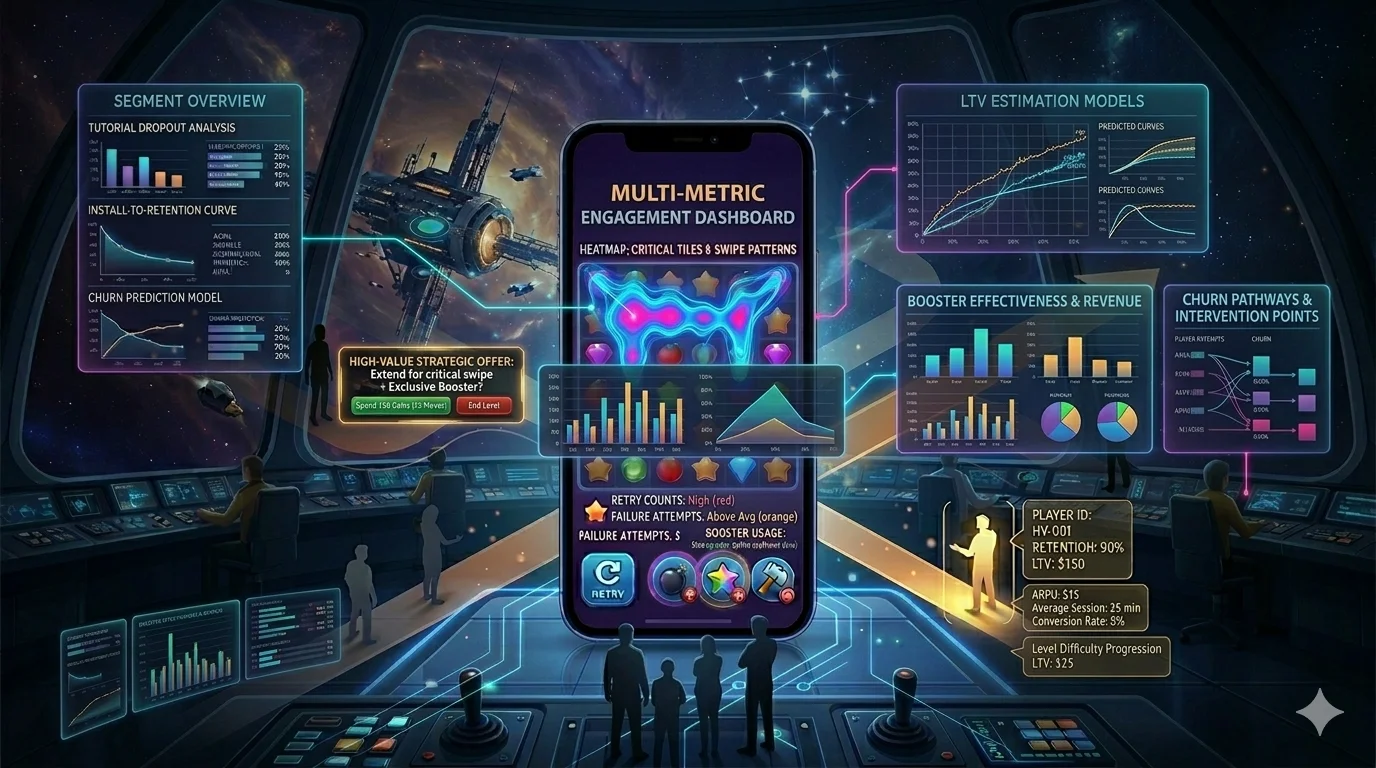
Not all players should see the same game. Strong studios silently segment users within the first hour.
Examples include:
- Fast progress players get harder levels earlier
- Hesitant players see fewer popups
- Aggressive players receive stronger booster suggestions
- Passive players are nudged toward events instead of purchases
This segmentation affects:
- Offer frequency
- Offer price tiers
- Event difficulty
- Failure tolerance
The player never knows this is happening. But the result is powerful. Paying players feel challenged but capable. Free players feel entertained without pressure. This protects reviews while increasing ARPU.
Why Creative Testing Matters More Than Game Features
Many studios spend months polishing features that players never notice. Meanwhile, top Match 3 publishers test hundreds of creatives monthly. Not for aesthetics. For psychology.
Winning creatives usually share:
- Clear fail states
- Human mistakes
- Emotional reactions
- One obvious solution
The goal is not realism. The goal is identification. If the viewer feels “I would fix that,” they are already emotionally invested. That emotional investment correlates strongly with spending later.
This is why creative testing should never be separated from monetisation logic. UA is not traffic acquisition. It is audience qualification.
How to Align UA and Monetisation for Paying Players
Practical 5-step guide for studios:
- Define your ideal paying player profile (genres, prior IAP behaviour).
- Map early behavioural signals (retries, booster use, friction tolerance).
- Configure event-based optimisation around proxy payer events, not completions.
- Align monetisation timing with high-frustration, high-intent moments; test and iterate.
- Monitor how comfortable players feel about paying at each step—through their offer screen behaviour—to catch revenue leaks early.
This stepwise approach helps beginners understand monetisation fundamentals, while giving experts a framework for optimising UA and game design together.
The Hidden Metric Most Studios Ignore
Most teams track ARPU, LTV, CPI, and ROAS. Very few track conversion confidence. Conversion confidence measures how comfortable a player feels paying.
Signals include:
- Time spent on offer screens
- Offer dismissal behaviour
- Return rate after a fail
- Engagement after rejecting a purchase
Studios that monitor this adjust their funnel before revenue drops.
This allows:
- Offer repositioning
- Better bundle framing
- Reduced early churn
By the time revenue declines, it is already too late. Confidence drops first.
Why Growth Requires a Unified System
Separating marketing from game design kills revenue potential. High-performing studios treat growth as a loop:
- UA influences player mindset
- Player mindset affects monetisation
- Monetisation feedback reshapes UA targeting
When this loop is aligned, scaling becomes predictable. When it is not, growth becomes gambling. This is where many studios hit a ceiling. They have installs. They have content. They do not have alignment.
Where The Game Marketer Fits Into This System
Most agencies focus only on ads. Serious growth requires more than ads.
At The Game Marketer, the focus is on understanding:
- Who should install the game
- Why they would ever pay
- What behaviour signals matter early
- How UA and monetisation reinforce each other
This approach allows studios to stop guessing and start scaling with control. When strategy, monetisation, and acquisition speak the same language, paying players stop being rare. They become predictable.
Final Thought for Studios and Publishers
If your Match 3 game has retention but weak revenue, the issue is not content. If your CPI looks healthy but ROAS collapses, the issue is not traffic. The issue is misalignment.
Paying players are not found by chance. They are filtered, shaped, and guided from the first impression. And studios that understand this always outgrow the rest.