

Launch Without Burning Your Budget
Most mobile games do not fail because they are poorly built. They fail because the launch is rushed, unfocused, and driven by spending instead of validation.
Studios often invest heavily in paid campaigns, only to realise later that their store page does not convert, their creatives do not stick, or their retention metrics are too weak to sustain growth. By that point, a large portion of the budget had gone “poof”.
A successful launch is not about spending more. It is about spending at the right time, on the right signals, with a structured approach. At The Game Marketer, our focus is simple. Help studios validate early, test intelligently, and scale only when the data supports it.
What a “Successful Mobile Game Launch” Actually Looks Like
Success is misunderstood.
A strong launch is one where acquisition cost, retention, and monetisation work together to support profitable scaling, not just initial growth.
A successful launch includes:
- Efficient CPI (Cost Per Install) that allows profitable growth
- Strong retention (D1, D7, D30) showing players return
- High store conversion rate (CVR) from visits to installs
- Early monetisation signals such as ARPDAU
- Reliable user acquisition channels that can scale
- Clear LTV trajectory
This is what separates random growth from a sustainable mobile game growth strategy.
The key idea is simple. You are not buying installs, you are validating a system that will scale profitably.

The Foundation of Budget Efficiency
Before you think about launch campaigns, you need proof that your game works.
Skipping validation is the fastest way to waste a budget.
1. MVP Validation
If players do not engage with the core experience early, adding features later will not fix the problem. Your early version should test one thing clearly: Do players enjoy the core experience?
Avoid overbuilding. Focus on gameplay clarity and engagement.
2. Audience Fit
Poor audience fit leads to high CPI and low retention, making scaling unsustainable.
Not every game fits every audience.
Identify:
- Who is most likely to install
- Who actually retains
- Who is willing to spend
Misaligned targeting leads to inflated CPI and poor retention.
3. Core Loop Strength
If the loop does not create repeat engagement, user acquisition will only accelerate drop-off.
Your gameplay loop should:
- Be easy to understand within seconds
- Deliver quick rewards
- Encourage repeat sessions
If users drop early, scaling user acquisition will only increase churn.
4. Monetisation Signals
Without early monetisation signals, scaling spend becomes a financial risk rather than a growth strategy.
You do not need full optimisation yet, but you need early indicators:
- Do players engage with ads or in-app purchases?
- Are they progressing far enough to monetise?
5. Retention Benchmarks
Weak retention means user acquisition spend simply accelerates churn instead of building growth.
Retention is one of the strongest predictors of success.
If your D1 and D7 retention are weak, your mobile game marketing budget will drain quickly during scaling.
Validation is not optional. It is what protects your budget from unnecessary losses.
Build a Soft Launch Strategy That De-Risks Your Budget
Soft launch is where your budget is protected, because it allows you to identify what works before scaling spend.
A soft launch mobile game strategy is where real learning happens.
It allows you to test performance in controlled environments before committing large budgets.
What You Should Test During Soft Launch
Discover New Creative Angles
Creative angles that test different player motivations such as competition, progression, or rewards
Test different:
- Hooks in the first few seconds
- Gameplay angles
- Messaging styles
Your goal is to identify what drives installs at the lowest CPI.
Store Conversion Rate
Store conversion performance based on different visuals, messaging, and positioning. Measure how well your store page converts traffic.
Even small improvements here can significantly reduce acquisition costs.
Onboarding Experience
Onboarding flow that determines whether users understand and stay within the first session
If users do not understand your game quickly, retention drops immediately.
Optimise:
- First-time user experience
- Tutorials
- Early progression
Retention Metrics
Retention trends across cohorts to evaluate long-term engagement potential
Track:
- D1 retention
- D3 retention
- D7 retention
These metrics determine whether scaling is viable.
Revenue Signals
Early ARPDAU and LTV signals to estimate scalability
Monitor:
- ARPDAU
- Early LTV estimates
This helps you understand how much you can afford to spend on acquisition.
Scaling Viability
Whether performance remains stable when traffic increases
Test multiple acquisition channels to identify where your audience responds best.
Soft launch is not a delay. It is where you reduce risk before scaling.
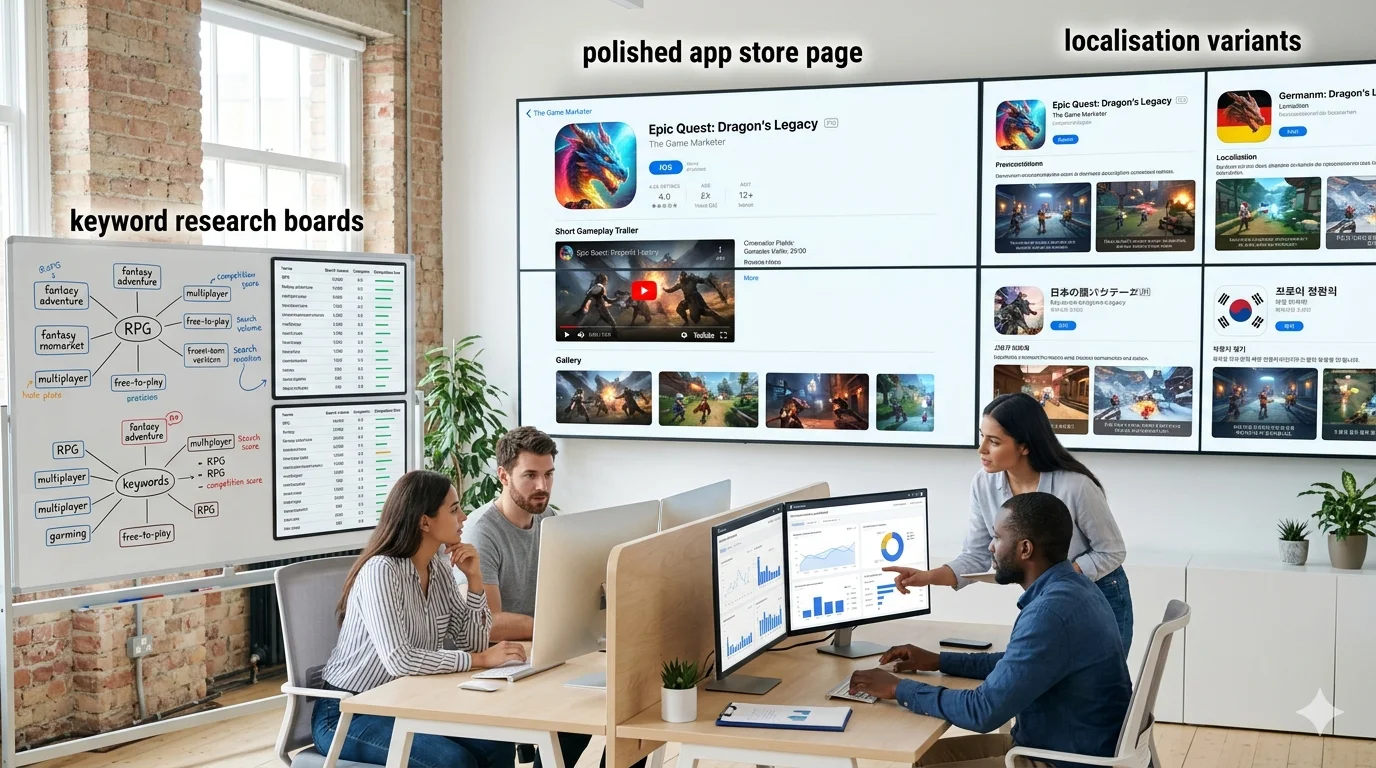
Fix Your ASO Before Spending on Paid Traffic
Your store page is the final conversion point before install, and its performance directly impacts paid user acquisition efficiency.
Running paid campaigns without a strong mobile game ASO is like pouring water into a leaking bucket.
Strong ASO improves keyword visibility, increases click-through rate, and maximises install intent from incoming traffic.
Key ASO Elements That Impact Performance
Title and Keywords
Use your primary keyword naturally while keeping the title readable and appealing.
Screenshots
Your screenshots should:
- Highlight gameplay immediately
- Show progression and rewards
- Communicate value clearly
Preview Video
Focus on gameplay within the first few seconds. Avoid long intros or branding-heavy content.
App Icon
Your icon should stand out in crowded categories and reflect the game’s core theme.
Localisation
Optimise your store page for key markets like:
- United Kingdom
- France
- Germany
Localised listings improve both conversion and organic reach.
To go deeper into store optimisation, you can check out this article for a complete mobile game ASO guide to improve visibility and conversion rates
Creative Testing: The Biggest Lever to Reduce CPI
In mobile game marketing, creative is often the single biggest driver of CPI performance.
If there is one area that directly impacts your budget, it is creative testing.
Strong creatives:
- Lower CPI
- Improve CTR
- Increase scalability
Weak creatives do the opposite.
What to Test Consistently
- Multiple hooks in the first 3 seconds
- Different gameplay moments
- Emotional vs competitive messaging
- Call-to-action variations
- Short-form vs longer creatives
Do not rely on one ad. Build a system that produces and tests creatives continuously. Relevant to this, you can read on mobile game ad creative strategies that reduce CPI and improve performance.
Paid User Acquisition: Test First, Scale Later
Paid user acquisition should be used to validate scalable growth, not just to buy traffic. Scaling before consistent performance signals often creates false confidence and leads to inefficient spend.
Scale only when performance is stable across multiple tests, not based on short-term results.
Smart Mobile Game User Acquisition Approach
- Start with small budgets
- Test across platforms such as Meta, TikTok, and ad networks
- Identify winning creatives and audiences
- Measure CPI alongside retention
- Scale only when metrics are stable
This is how you reduce risk and improve efficiency.
If you want a structured framework, see: mobile game user acquisition strategy for sustainable growth
KPI Framework: When to Scale Your Mobile Game
These metrics should never be evaluated in isolation, as performance depends on how they work together.
Scaling should only happen when your metrics confirm readiness.
Core KPIs to Monitor
- CPI (Cost Per Install)
- CTR (Click-Through Rate)
- CVR (Conversion Rate from store)
- D1 and D7 retention
- ROAS (Return on Ad Spend)
- Session length and engagement
- LTV trends
For example, a low CPI with weak retention is not a success, it indicates short-term efficiency without long-term value.
These metrics together determine whether your game can scale profitably. A strong CPI alone is not enough. It must align with retention and monetisation.
Mobile Game Launch Budget Allocation Model
A structured budget prevents overspending and improves decision-making.
Recommended Budget Split
This is a practical framework, not a fixed rule, and should be adjusted based on game genre, target markets, and monetisation model.
- 20 % for validation and setup
- 30 % for creative and store testing
- 30 % for channel testing
- 20 % reserved for scaling
This ensures your budget is used to generate insights before scaling.
Your allocation may vary depending on:
- Game genre
- Monetisation model
- Target markets
But the principle remains the same:
Test first, scale later.
Common Mobile Game Launch Mistakes That Waste Budget
These are the most common mistakes we see when studios rush the launch process:
- Launching with weak store assets and no keyword alignment
- Scaling before retention and monetisation signals are validated
- Relying on a single creative instead of continuous testing
- Ignoring performance by geography
- Spending heavily before testing monetisation
- Treating launch as a one-time event
A successful launch is an ongoing process, not a single milestone.
Frequently Asked Questions
What is the best way to launch a mobile game on a low budget?
Focus on validating gameplay, creatives, and store conversion first. Small test campaigns help identify what works before increasing spend.
How much budget should I allocate for a soft launch?
Typically, 20 to 30 percent of your total budget should be used for testing and validation before scaling.
What metrics matter most before scaling a mobile game?
Retention, CPI, and conversion rate are critical. These indicate whether your game can grow sustainably.
Should I run ads before my game is fully polished?
You can run limited campaigns to test early signals, but avoid scaling until your core experience is stable.
What makes a mobile game launch successful?
A combination of strong creatives, high store conversion, good retention, and validated acquisition channels.
How The Game Marketer Helps You Launch Smarter
Launching without a structured strategy leads to wasted budget and missed opportunities.
We help mobile game studios reduce wasted spend and improve launch efficiency through:
- Improve ASO conversion rates
- Increase creative performance and reduce CPI
- Build efficient user acquisition strategies
- Analyse retention and monetisation signals
- Plan launches with clear scaling frameworks
Get a launch strategy built around ASO, creative testing, and budget-efficient growth.
If you are planning your next launch, the right strategy can make the difference between wasted spend and sustainable growth.
Need a launch plan before you spend on user acquisition? We help mobile game studios validate, launch, and scale with less waste.