

The Psychology behind Mobile Game Ads: Your go-to strategy that reduces CPI but increases installs
User acquisition in mobile gaming has become more competitive and expensive. With thousands of games fighting for attention, the difference between a high CPI and a profitable campaign often comes down to one factor: mobile game ad psychology.
Top-performing mobile game ads are not random. They are carefully designed around how users think, react, and make quick decisions. When applied correctly, psychological triggers can significantly improve click-through rates, install rates, and CPI efficiency across user acquisition campaigns.
On The Game Marketer, we treat ad psychology as part of a broader user acquisition funnel, where small shifts in messaging can move install‑cost targets from “high” to “normal” or even “low” for your segment.
This guide explains the most effective psychological principles used in mobile game ads, along with practical ways to apply them.
Why Psychology Plays a Critical Role in Mobile Game Advertising
Most users decide whether to engage with a mobile game ad within seconds. At that moment, decisions are driven by emotion rather than logic, which is why mobile game ad creatives must be built around behavioural triggers rather than feature explanations.
A well-optimised mobile game ad does three things:
- Captures attention instantly in the first 1–3 seconds
- Creates an emotional or cognitive reaction that increases curiosity or urgency
- Pushes the user toward immediate install intent
This is the foundation of high-performing mobile game UA creatives on platforms like Meta, TikTok, and Google Ads.
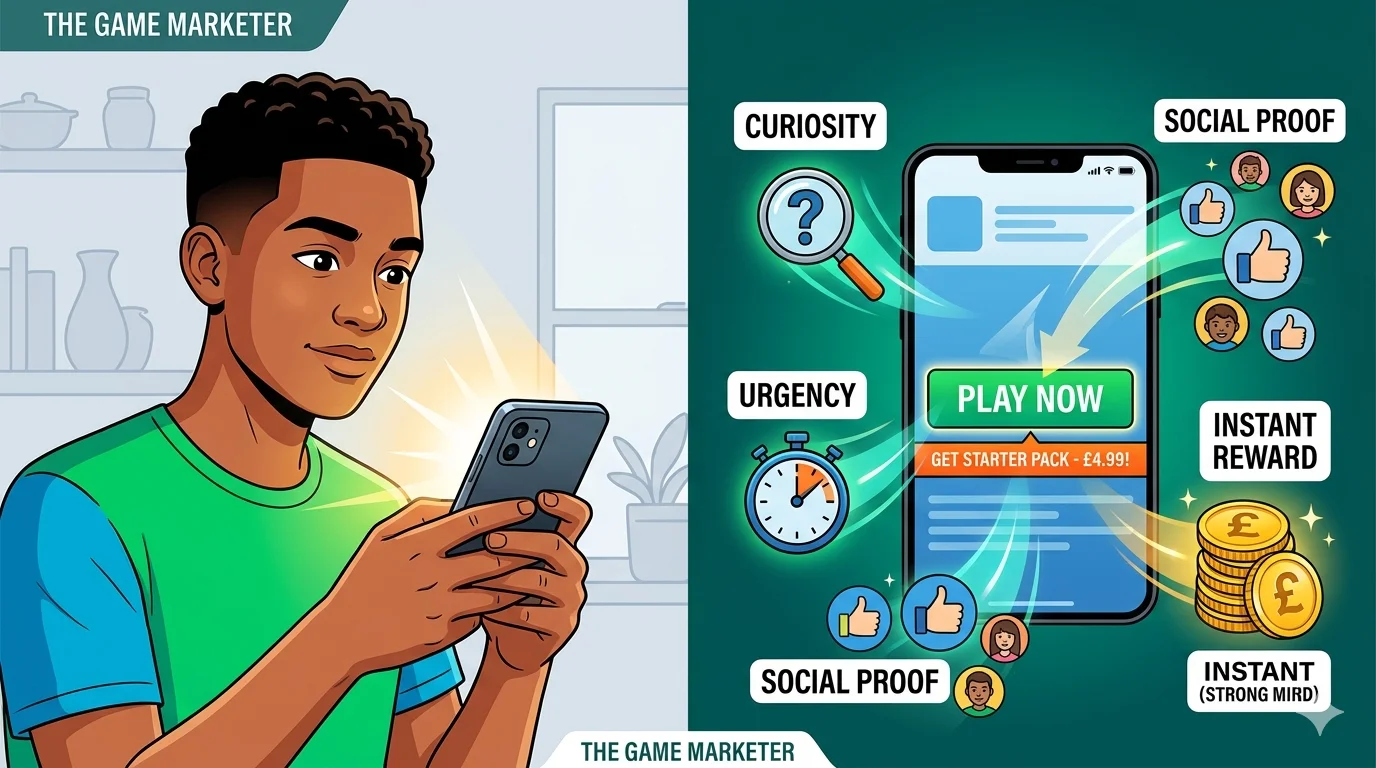
1. Curiosity Gap. Using incomplete outcomes as hooks
A curiosity gap works by showing an unresolved moment: a near-miss, a half-solved puzzle, or a level that almost beats the player.
This creates a mental itch where the viewer wants to see the resolution or finish what the ad “started,” which makes the install feel like continuing the experience instead of a cold step.
Examples that fit this pattern:
- “99% of players fail this level”
- “Can you escape this maze?”
- “Watch what happens when the dragon wakes up… and decide yourself”
How it works in mobile game ads
Curiosity gap is one of the strongest drivers in mobile game ad psychology for CPI reduction, especially in hyper-casual and puzzle UA campaigns. It works best when the ad is structured like a “broken moment” that demands completion.
From an EEAT perspective, this should always reflect real gameplay logic. If curiosity is built on fake mechanics, it may improve installs but harm retention and LTV.
2. Loss aversion and FOMO A.K.A the fear of missing out
Loss aversion reflects the fact that people feel the sting of losing something more strongly than the pleasure of gaining it. In mobile game advertising, this becomes urgency-based creative messaging that directly supports lower CPI through faster install decisions.
Common formats:
- “Limited-time event: 3 days left”
- “Save your hero before it’s too late”
- “Last chance to unlock this exclusive skin”
Why it drives installs
Loss aversion reduces hesitation, which is one of the biggest friction points in mobile game user acquisition funnels. When urgency is clear, users convert faster, improving CPI efficiency.
EEAT considerations
In mobile game ad psychology, FOMO should always align with real in-game systems such as:
- seasonal events
- live ops cycles
- time-limited rewards
3. Social proof and herd mentality
Social proof taps into the instinct to follow what others are doing, especially in uncertain decision-making environments. In mobile game marketing, this is a key driver of install rate optimisation and CPI reduction in cold traffic campaigns.
Typical social-proof signals:
- “Over 10 million players”
- “Join thousands of players in live events”
- TikTok-style reaction clips showing real engagement
Why it works in mobile game ads
Users associate popularity with quality. In mobile game user acquisition, this reduces perceived risk and improves install conversion rates.
EEAT best practice
Use only verifiable metrics such as:
- App store downloads
- DAU / MAU estimates
- Platform ratings
Avoid vague claims like “everyone loves this game,” which weaken credibility in both SEO and ad trust signals.
4. The power of interactivity in playable ads
Playable ads allow users to interact with a short version of the game before installing it. This is one of the strongest formats for reducing CPI in mobile game UA campaigns because it filters intent before install. You have to ensure your game ads don’t interrupt the gameplay.
Examples:
- “Try before you download” (mini playable level)
- “Beat this challenge in 10 seconds”
- “Match the pattern to unlock the next stage”
Why it works
Interactive mobile game ads create early ownership. When users engage physically with gameplay mechanics, install intent increases naturally.
Application guidance
Playable ads should:
- Focus on a single core mechanic
- Load instantly (critical for CPI performance)
- Provide immediate feedback loops
5. Underestimating difficulty (endowment-style effect)
By showing a simple task that the in-ad character fails at, you trigger a cognitive bias where users believe they can do better.
Examples:
- A character failing a very simple puzzle
- Incorrect moves in an obvious solution
- Near-complete success that gets ruined
Why it works in mobile game ad psychology
This is one of the most effective behavioural triggers in hyper-casual CPI optimisation, because it activates self-confidence and competitive instinct.
EEAT alignment
The difficulty curve shown in ads must match actual gameplay. Misalignment can increase churn and negatively impact LTV even if CPI is low.
6. Storytelling and emotional engagement
Short narrative hooks with survival, humour, or high stakes increase emotional involvement in mobile game ads.
Examples:
- “Help this farmer survive the winter”
- “Your kingdom is under attack - can you hold the line?”
- Humour-based meme clips with unexpected outcomes
Why it works
Emotional engagement reduces friction in the mobile game install decision process. In mobile game advertising, storytelling helps communicate genre and fantasy quickly.
EEAT framing
Storytelling should always represent the actual core fantasy of the game, not exaggerated or misleading mechanics.
7. Instant gratification and dopamine loops
Fast rewards such as coins, upgrades, and level progression make mobile games feel instantly satisfying.
Examples:
- Rapid coin collection sequences
- Quick level-up animations
- Fast unlock progression
Why it works
Instant feedback loops are a core part of mobile game engagement psychology. In advertising, they signal a rewarding gameplay loop that improves install intent.
EEAT-safe framing
All reward visuals should be in-game only and avoid external or financial implications.

Which combinations work best for CPI reduction
Different psychological triggers work better depending on genre and mobile game user acquisition strategy.
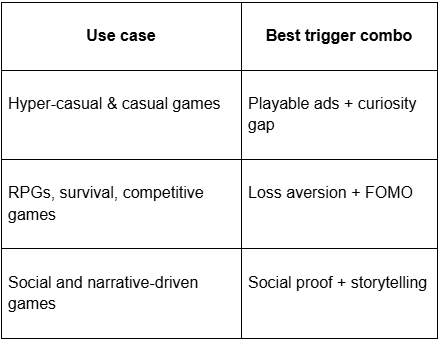
These combinations are widely used in performance marketing for mobile games because they stack multiple behavioural triggers in a single creative.
So what are we getting at?
Mobile game ad performance is strongly influenced by mobile game ad psychology, not just visual quality. The most effective UA campaigns consistently:
- Trigger emotion within the first seconds of exposure
- Align ad messaging with real gameplay experience
- Combine multiple behavioural biases strategically
- Optimise continuously based on CPI and install performance
When applied correctly, these principles lead to stronger engagement, higher install rates, and significantly improved CPI efficiency across mobile game user acquisition campaigns.
The Game Marketer is a gaming‑focused marketing team with hands‑on experience in user acquisition, creative optimisation, and ad‑to‑game alignment. We work with studios to reduce CPI, improve install quality, and design UA strategies that reflect real gameplay and long‑term player value.
FAQs
What is mobile game ad psychology?
Mobile game ad psychology is the use of behavioural triggers like curiosity, urgency, and social proof in ads to influence users to install a game. It improves click-through rates and lowers CPI in mobile game user acquisition.
How does mobile game ad psychology reduce CPI?
It reduces CPI by increasing ad engagement and install conversion rates. Psychological triggers make users more likely to click and install quickly, lowering acquisition costs in mobile game campaigns.
Which psychological triggers work best in mobile game ads?
The most effective triggers are:
- Curiosity gap (unfinished gameplay)
- FOMO and urgency
- Social proof (popularity signals)
- Playable interaction
- Instant rewards
These improve install rates by influencing fast decision-making.
What is the curiosity gap in mobile game ads?
The curiosity gap is when an ad shows an incomplete or unresolved gameplay moment. It creates curiosity, pushing users to install the game to see the outcome.
Why does FOMO improve installs?
FOMO improves installs because users act faster when they think they might miss limited-time rewards, events, or content. It reduces hesitation and increases conversion rates.
What is social proof in mobile game advertising?
Social proof shows that many other players are already playing the game. It builds trust and reduces risk, making users more likely to install.
Do playable ads reduce CPI?
Yes. Playable ads reduce CPI by letting users try a short version of the game before installing. This increases engagement and improves install quality.
How does storytelling affect mobile game ads?
Storytelling increases emotional engagement by showing short narratives like survival, rescue, or competition. This makes users more likely to install to continue the story.
What is instant gratification in mobile game ads?
Instant gratification is when ads show fast rewards like coins, upgrades, or level-ups. It signals fun and rewarding gameplay, increasing install intent.
What is the best mobile game ad strategy for low CPI?
The best strategy is combining triggers:
- Hyper-casual: curiosity + playable ads
- RPG: FOMO + loss aversion
- Social/narrative: storytelling + social proof
Testing combinations improves CPI performance.
Does mobile game ad psychology affect retention?
Yes. If ads match real gameplay, retention improves. If ads mislead users, installs may increase but retention and LTV drop.