

Augmented reality has introduced a new form of interaction in the gaming industry. Instead of placing players in a fully virtual environment, augmented reality games place digital elements into the real world through a smartphone or camera enabled device. This allows players to interact with both physical surroundings and digital characters at the same time.
The answer lies in the rapid improvement of mobile technology. Modern smartphones include powerful processors, cameras, GPS tracking, and motion sensors that make it possible to merge digital gameplay with real environments. As a result, game developers can create experiences where virtual objects appear directly in the player's surroundings.
AR gaming is not just a creative concept. It has become a fast growing segment of the gaming market. Industry estimates show that the augmented reality gaming market was valued at about $14.2 billion in 2024, grew to around $18.43 billion in 2025, and is expected to reach approximately $23.83 billion in 2026. If current growth continues, the market may exceed $66 billion by 2030.
For game studios and marketers, this technology opens new possibilities for player engagement, social interaction, and user acquisition. AR gameplay encourages movement, location based exploration, and community interaction. These elements often increase player activity compared with traditional mobile games.
This guide explains the fundamentals of AR gaming, how the technology works, major game examples, market growth, and the marketing opportunities it creates for studios and publishers.
1. What Is AR Gaming
AR gaming refers to video games that place digital characters or objects into the real world using a device camera and sensors.Players interact with these virtual elements while moving through real environments.
Unlike traditional games that run entirely on a screen, augmented reality games connect gameplay with the player's physical surroundings. When a player opens an AR game, the device camera captures the environment. The software then places digital content into that live camera view.
For example, a player walking through a park might see a virtual creature standing on the grass through their phone screen. The player can approach it, interact with it, or capture it depending on the game mechanics.
This type of gameplay creates a strong sense of immersion because the digital world appears to exist alongside the physical world.
2. Key Characteristics of AR Gaming
Several features define augmented reality games.
Real world interaction
Players move through actual locations while playing. Physical movement becomes part of the gameplay experience.
Camera based gameplay
The device camera serves as the main interface between the player and the game world.
Location awareness
Many AR games use GPS data to unlock content based on real world locations.
Shared environments
Some AR games allow multiple players to interact with the same digital objects within a physical space.
These features combine to create a gameplay style that blends digital entertainment with real world exploration.
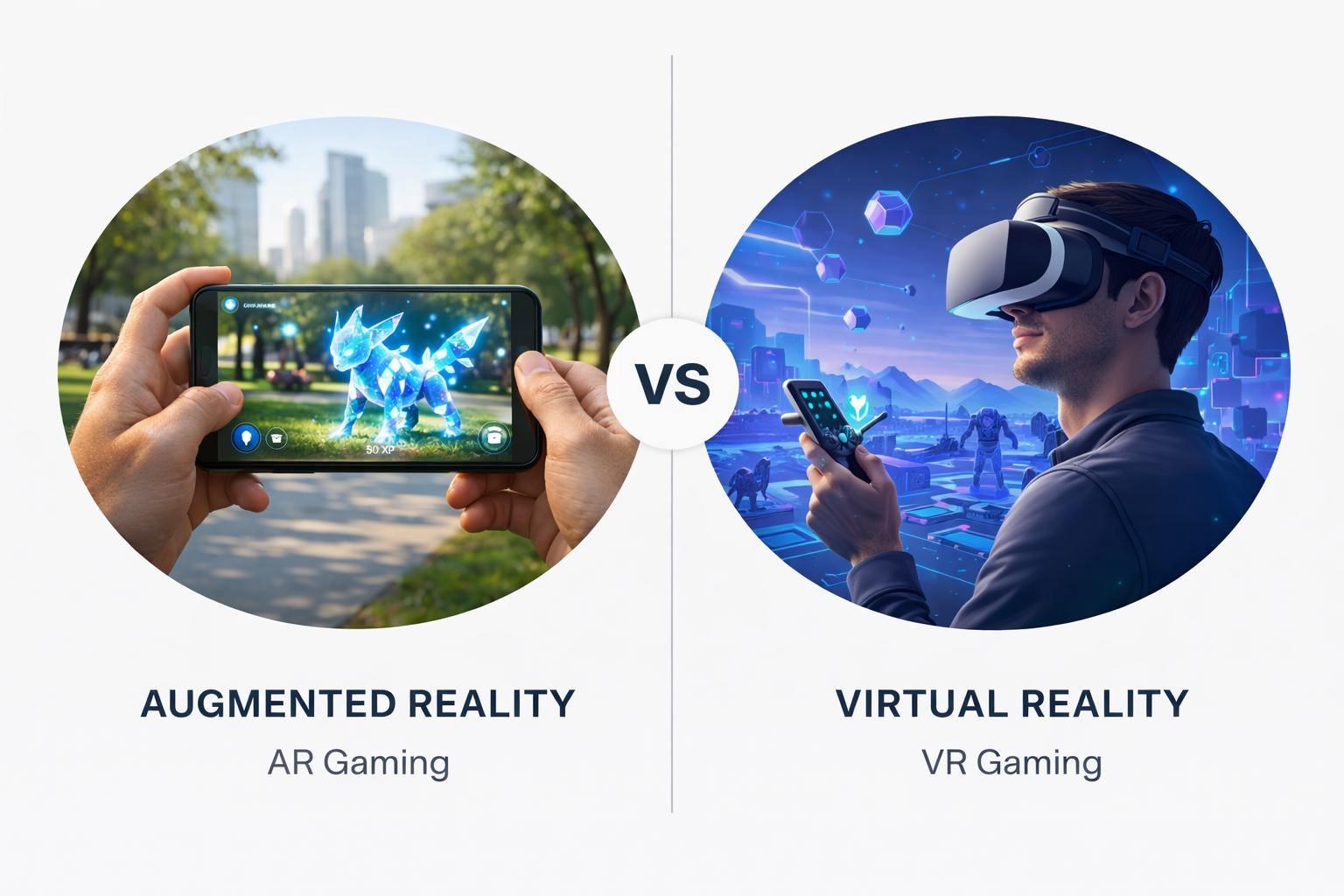
3. AR vs VR vs Mixed Reality
AR gaming is often compared with other immersive technologies.
Augmented Reality
Augmented reality places digital objects inside the real world. Players see both the physical environment and virtual content simultaneously.
Virtual Reality
Virtual reality places players inside a completely digital environment. VR headsets block the physical world and replace it with a simulated one.
Mixed Reality
Mixed reality allows digital objects to interact with physical objects in real time. This creates deeper interaction between virtual and physical environments.
Among these technologies, AR has gained the most traction in mobile gaming because it works with existing smartphones rather than requiring specialized headsets. For studios and marketers interested in the broader impact of immersive technologies, AR and VR together are shaping new gaming experiences in the metaverse, as explored in our AR and VR guide.
4. How AR Gaming Works
Several technologies work together to make augmented reality gameplay possible.
Camera Recognition
The smartphone camera captures the environment continuously while the game is running. The software analyzes the scene and identifies surfaces such as floors, walls, and tables.
Once the system detects these surfaces, it can place digital objects in realistic positions.
Motion Sensors
Smartphones include sensors that track movement and orientation.
These sensors include:
- gyroscope
- accelerometer
- compass
They help the game determine how the device moves through space. When a player turns the phone or walks forward, digital objects remain anchored in the correct position.
GPS Positioning
Location based AR games rely on GPS data. This allows developers to connect gameplay elements with real world locations.
For example, certain items or characters may appear only at specific places such as parks, landmarks, or city centers.
SLAM Technology
Simultaneous Localization and Mapping, commonly called SLAM, is a core component of AR systems.
SLAM allows the device to map the surrounding environment while tracking its position within that environment. This enables virtual objects to remain fixed in place even when the player moves.
Without SLAM technology, digital elements would drift or move incorrectly within the camera view.
AR Development Platforms
Game developers use specialized tools to build augmented reality experiences.
Common platforms include:
Unity
One of the most widely used game engines for mobile game development.
ARKit
Apple's framework for building AR applications on iOS devices.
ARCore
Google's platform for AR development on Android devices.
These tools provide features for surface detection, motion tracking, and realistic rendering of digital objects.
5. Evolution of AR Gaming
The concept of augmented reality has existed for decades.
Early Experiments
Research into augmented reality began in the 1990s with experimental head mounted displays that could overlay digital graphics onto real environments.
These early systems were large and expensive, which limited their use to research labs and universities.
Smartphone Expansion
The rise of smartphones created the foundation for consumer AR gaming. Devices began including cameras, sensors, and processing power capable of running AR software.
When Apple introduced ARKit and Google released ARCore, developers gained accessible tools for building AR experiences.
Breakthrough with Pokémon GO
A major turning point for AR gaming occurred in 2016 with the release of Pokémon GO.
The game encouraged players to travel through real locations to capture creatures placed within the environment. Parks, streets, and landmarks became part of the gameplay.
The success was remarkable. Pokémon GO has reached over 678 million downloads worldwide and generated more than $6 billion in player spending.
More importantly, it demonstrated that AR games could attract a global audience and generate substantial revenue.
6. Popular AR Gaming Examples
Several games highlight how augmented reality can create engaging experiences.
Pokémon GO
Pokémon GO remains the most recognizable AR game. Players travel through real environments to capture creatures, participate in battles, and attend community events.
The game combines location based gameplay with social interaction, encouraging players to explore cities and parks.
Jurassic World Alive
This game allows players to locate and collect dinosaurs that appear in real world environments. Players use their smartphone camera to interact with these creatures and add them to their collections.
The game combines exploration with creature battles and upgrades.
Pikmin Bloom
Pikmin Bloom focuses on walking activity. Players grow virtual plants and characters as they move through real environments.
The gameplay rewards physical movement and daily exploration.
These games demonstrate how AR mechanics can encourage real world movement and social engagement.
7. AR Gaming Market Size and Growth
The augmented reality gaming market has grown rapidly over the past decade.
Industry estimates suggest that the market reached about $14.2 billion in 2024, increased to around $18.43 billion in 2025, and is expected to reach approximately $23.83 billion in 2026.
If current trends continue, analysts project that the market may surpass $66 billion by 2030.
Several factors contribute to this growth.
Smartphone Hardware Improvements
Modern devices include better cameras, depth sensors, and graphics capabilities that support advanced AR experiences.
Faster Internet Connectivity
5G networks reduce latency and support real time multiplayer interactions.
Developer Investment
Game studios continue to experiment with AR mechanics to create new gameplay experiences.
Player Interest in Social Gameplay
Many players enjoy games that encourage movement and interaction with other players.
These trends continue to push AR gaming forward as an important segment of the gaming industry.
8. AR Gaming Trends for 2026 and Beyond
Several developments are shaping the future of AR gaming.
Shared Multiplayer AR
Future AR games will allow multiple players to interact with the same digital objects within a physical space.
Players standing in the same location may see identical virtual characters and collaborate on missions.
AI Driven Game Content
Artificial intelligence can help generate dynamic missions and adaptive gameplay events in AR environments.
This allows games to provide personalized experiences for different players.
Wearable AR Devices
Although smartphones dominate AR gaming today, wearable devices may become more common in the future.
Lightweight AR glasses could allow players to see digital elements directly in their environment without holding a phone.
Persistent Game Worlds
Some developers are experimenting with persistent AR worlds where digital objects remain in real locations over long periods of time. These innovations connect AR to broader immersive environments, including VR experiences that collectively contribute to the evolving metaverse.
Players may leave items, structures, or messages that others can interact with later.
Web Based AR Experiences
WebAR technology allows AR experiences to run inside mobile browsers. This reduces the need for app downloads and may make AR games easier to access.

9. Marketing Opportunities for AR Games
For game studios and publishers, AR gaming creates marketing opportunities that traditional mobile games cannot easily replicate.
Location Based Campaigns
Developers can host events tied to physical locations. Players travel to specific areas to participate in special challenges or obtain rare rewards.
These events often increase player engagement and community activity.
Influencer Gameplay Content
AR gameplay produces visually interesting moments. Content creators can show digital characters interacting with real environments, which attracts attention on social platforms.
Social Sharing Features
Allowing players to capture screenshots of AR moments encourages sharing on social media platforms. This type of user generated content often increases organic visibility.
Brand Partnerships
Retail and entertainment brands can collaborate with AR games to create location based experiences.
Examples include limited time quests at retail stores or branded characters appearing in specific locations.
Community Events
Large player gatherings organized around AR games can generate significant media attention and strengthen the player community.
For game marketers, AR provides a unique mix of digital promotion and real world engagement.
10. Challenges Facing AR Gaming
Despite its potential, AR gaming also faces several challenges.
Battery Consumption
AR applications require continuous camera use and sensor tracking. This can drain smartphone batteries quickly.
Environmental Conditions
Lighting conditions, surface textures, and crowded environments may affect how accurately AR systems detect surroundings.
Player Safety
Games that encourage movement must be designed carefully to reduce distractions that could lead to accidents.
Privacy and Data Protection
Location based AR games collect player location data. Developers must comply with privacy regulations such as GDPR when handling this information.
Development Complexity
Testing AR games across many devices and environments can be more complex than traditional mobile game development.
11. Frequently Asked Questions
What is the difference between AR gaming and VR gaming?
AR gaming overlays digitalcontent onto the real world through a phone or camera. VR gaming places theplayer inside a completely virtual environment using a headset. AR does notrequire special hardware beyond a smartphone.
What devices do you need to play AR games?
Most AR games run on smartphoneswith a camera, GPS, and motion sensors. iOS devices use Apple's ARKitframework. Android devices use Google's ARCore platform. No specialist headsets required for most consumer AR games.
Is Pokemon GO an AR game?
Yes. Pokemon GO is the mostwidely played AR game. It uses GPS and a phone camera to place virtualcreatures into real world environments. Players physically travel to locationsto interact with game content.
How big is the AR gaming market?
The AR gaming market was valuedat approximately $14.2 billion in 2024 and is projected to reach $23.83 billionin 2026. Analysts expect it to surpass $66 billion by 2030.
What marketing opportunities does AR gaming offer studios?
AR games support location-basedcampaigns, influencer content, brand partnerships, social sharing mechanics,and large-scale community events. These tools offer engagement opportunitiesthat standard mobile games cannot replicate.
Conclusion
AR gaming blends digital gameplay with real world environments, creating experiences that differ significantly from traditional mobile games.
Using cameras, sensors, and location data, augmented reality games place virtual objects directly into the player's surroundings. This encourages exploration, social interaction, and physical movement.
Successful titles such as Pokémon GO have shown that AR games can attract global audiences and generate billions in revenue.
At the same time, improvements in smartphone hardware, connectivity, and development tools continue to push the technology forward.
For game studios and marketers, AR gaming offers an opportunity to create highly engaging experiences while connecting digital gameplay with real world interaction.
Understanding the technology, market growth, and marketing strategies behind AR games is essential for anyone working in the modern gaming industry.
AR gaming is transforming the way players interact with games and real world spaces. Studios that understand these mechanics can create highly engaging experiences and drive measurable results. Partner with The Game Marketer to design AR campaigns that boost installs, maximise retention, and turn gameplay into growth, Schedule a free AR strategy audit today.