
Match 3 games are often seen as predictable revenue performers. Large audiences, repeat sessions, and familiar mechanics create the impression that strong earnings are almost guaranteed. In reality, many studios struggle to scale Match 3 revenue even when retention metrics look healthy. The issue is rarely player demand. It is monetisation design that fails to align with how players actually experience friction, progress, and reward.
At The Game Marketer, we consistently analyse mobile game monetisation systems across live Match 3 environments. A clear pattern appears: revenue limitations are usually caused by structural monetisation mistakes rather than pricing strategy alone. Boosters are offered without contextual urgency. Difficulty curves are tuned for completion instead of conversion. Rewarded ads are positioned in ways that reduce payer intent. Over time, these decisions quietly cap lifetime value and suppress purchase frequency.
Understanding why players spend in Match 3 games requires looking beyond store design and focusing on behavioural triggers inside the gameplay loop. Spending happens at moments of emotional investment, near-success tension, and perceived progress protection. When monetisation systems fail to support those moments, even highly engaged players choose not to purchase.
This article examines the most common monetisation mistakes that limit Match 3 revenue and explains how each one affects conversion behaviour, player trust, and long-term earnings potential.
Monetisation in Match 3 Is Driven by Emotional Timing
Spending in Match 3 games is rarely planned. It happens in response to tension.
Players purchase when three conditions align:
• They are close to completing a level
• They feel invested in the current attempt
• A clear solution is presented at the right moment
If monetisation is separated from this emotional timing, purchase intent weakens regardless of pricing.
Many studios treat monetisation as a store feature rather than a gameplay support system. This disconnect is the foundation of several revenue-limiting mistakes.
Mistake 1: Designing Monetisation Outside the Gameplay Loop
In high-performing Match 3 games, monetisation exists inside the attempt-fail-retry cycle. It supports resolution. In underperforming games, monetisation exists primarily in menus, stores, or static offers.
When players must leave the gameplay context to evaluate purchases, the emotional trigger disappears. What felt urgent becomes optional.
Why this suppresses revenue
• Players delay decisions
• Purchases feel unrelated to outcomes
• Spending shifts from reactive to deliberate
• Conversion becomes dependent on motivation rather than need
Revenue-positive structure
Monetisation should appear at moments of maximum relevance:
• Immediately after near-success failure
• During streak protection scenarios
• When progress risk is visible
• When time investment feels significant
When monetisation resolves an immediate problem, players interpret spending as assistance rather than cost.
Mistake 2: Difficulty Curves That Do Not Support Monetisation
Difficulty is not only a gameplay parameter. It is a monetisation pacing mechanism.
Two common tuning approaches limit revenue growth.
Overprotecting retention
Some teams reduce difficulty whenever failure rates increase. While this improves completion rates, it removes purchase necessity. Players progress without assistance and monetisation becomes secondary to gameplay.
Creating artificial frustration
Other teams increase difficulty sharply to push spending. This damages trust. Players interpret the challenge as unfair rather than motivating.
Effective difficulty monetisation design
Revenue-optimised Match 3 games use controlled friction cycles:
- Progress builds confidence
- Challenge increases investment
- Assistance appears at peak tension
- Relief reinforces value
Players must feel challenged but supported. When difficulty and support systems are aligned, monetisation feels natural.
Mistake 3: Booster Economies That Lack Situational Meaning
Boosters generate a large portion of Match 3 revenue, yet many games treat them as generic power tools instead of contextual solutions.
Players do not purchase power for its own sake. They purchase certainty when outcome risk is high.
Structural booster economy problems
• Identical pricing across progression stages
• Weak differentiation between booster types
• Offers not linked to specific level challenges
• Lack of explanation of outcome improvement
When boosters lack situational meaning, they feel optional rather than useful.
High-performing booster structure
An effective booster economy supports three player needs:
Preventive support
Used before a level to reduce uncertainty.
Recovery support
Offered after failure to resolve friction.
Efficiency support
Purchased to reduce time investment for habitual players.
This structure aligns booster value with player motivation rather than feature description.
Mistake 4: Store Design That Creates Decision Fatigue
Many Match 3 stores contain numerous bundles, currencies, and offers without clear hierarchy. More options do not increase conversion. They increase hesitation.
When players cannot quickly identify the most relevant purchase, they return to gameplay without spending.
Store architecture problems that reduce revenue
• Multiple bundles with similar value
• No recommendation based on player state
• Permanent offers that ignore progression stage
• Pricing tiers disconnected from player maturity
What high-converting stores do differently
Effective stores guide decisions rather than present choices. They answer three questions immediately:
• What helps me right now
• Why this offer matters now
• Why this is the best value available
Clear guidance reduces cognitive effort and increases purchase confidence.

Mistake 5: Rewarded Ads That Replace Spending Behaviour
Rewarded advertising is essential for retention, but it becomes harmful when it fully replaces paid assistance.
When players receive the same outcome through ads and purchases, economic value shifts toward waiting rather than spending.
Cannibalisation patterns
• Unlimited ad-based retries
• Ads granting full level resolution support
• Immediate ad availability after failure
• No difference between paid and free assistance
Over time, even paying users adapt to the free alternative.
Revenue-supportive ad positioning
Ads should support persistence, not replace purchases. Effective implementations provide limited assistance that helps players continue without removing the value of paid solutions.
Mistake 6: Ignoring Habit-Based Revenue Systems
Match 3 engagement is routine-driven. Many players return daily not for progression speed but for consistency and familiarity. Monetisation systems that focus only on challenge resolution fail to capture this behaviour.
Habit monetisation opportunities
• Streak protection systems
• Weekly progression passes
• Session milestone rewards with paid enhancement
• Loyalty pricing that improves over time
Habit-based systems increase purchase frequency and stabilise revenue across long player lifecycles.
Mistake 7: Static Monetisation in a Dynamic Player Lifecycle
Player motivation changes over time. Early players seek progress. Mid-stage players seek efficiency. Long-term players seek consistency and comfort.
Static monetisation systems fail to respond to these shifts.
Effects of non-adaptive monetisation
• Offers lose relevance
• High-value players receive generic treatment
• Reactivation opportunities are missed
• Pricing sensitivity remains untested
Revenue growth depends on continuous adjustment of offer timing, composition, and messaging based on behavioural signals.
Mistake 8: Messaging That Describes Features Instead of Outcomes
Many monetisation systems communicate what is sold rather than what is protected or resolved.
Players do not purchase extra moves. They purchase the chance to preserve effort.
Functional messaging example
“Buy extra moves”
Outcome-focused messaging example
“Save your winning run”
Outcome-focused messaging aligns with emotional investment and improves conversion reliability.
Mistake 9: Treating All Players as Identical Spenders
Match 3 audiences contain multiple spending motivations. Without segmentation, monetisation remains generic and inefficient.
Core spend motivations in Match 3
Progress acceleration
Players who want faster advancement.
Friction avoidance
Players who want smoother sessions.
Completion maintenance
Players who want to protect streaks and achievements.
Routine reinforcement
Players who spend to support daily habits.
Different motivations require different offer structures and timing.
Mistake 10: Underestimating Trust as a Revenue Multiplier
Trust directly influences lifetime value. Players spend more when they believe purchases reliably improve outcomes and gameplay remains fair.
Trust declines when:
• Difficulty changes unexpectedly after purchases
• Rewards feel inconsistent
• Offers appear excessively aggressive
• Progress seems artificially blocked
Sustained revenue growth requires predictability and fairness.
Industry Reference Point
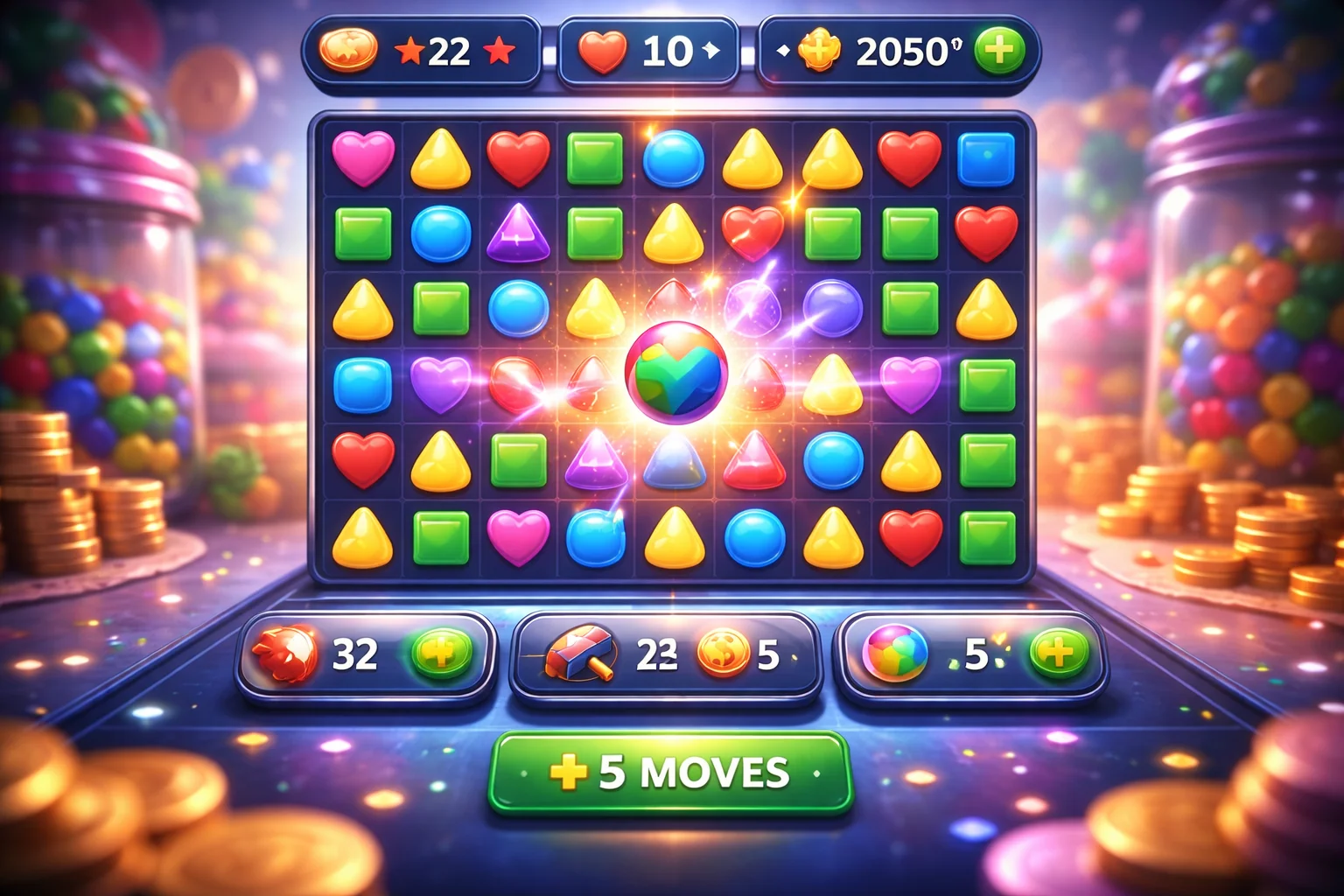
Titles such as Candy Crush Saga demonstrate how monetisation, difficulty pacing, and habit reinforcement function as a unified system. Their performance is not driven by aggressive pricing but by alignment between player emotion, challenge, and assistance timing.
Studios that replicate visible features without replicating behavioural structure rarely achieve similar revenue results.
Strategic Conclusion
Match 3 revenue limitations rarely stem from audience size, genre maturity, or pricing levels. They stem from structural misalignment between monetisation systems and player behaviour.
Revenue expands when monetisation:
• Appears at moments of emotional relevance
• Supports player intent rather than interrupting it
• Evolves with player lifecycle stages
• Reinforces habit and trust
• Converts friction into supported progress
For studios focused on long-term revenue growth, the path forward is not more offers, more currency packs, or more aggressive tactics. It is precise alignment between gameplay experience and monetisation architecture.
When monetisation supports the player journey instead of competing with it, Match 3 games reach their full economic potential.