

What Is a Good CPI for Mobile Games?
If you work in mobile games, you’ve probably asked this question more than once:
What is a good CPI for mobile games in 2026?
The honest answer is that there is no universal number. CPI depends on genre, platform, geo, creative quality, and most importantly, how your game monetises users after install. Learn more about our creative approach here.
That said, there is a clear rule that consistently holds across successful UA teams:
A good CPI is one that allows profitable scaling based on LTV.
In most cases, that means:
- CPI is typically targeted between 30 percent and 70 percent of LTV, depending on payback window and risk tolerance
- You should be able to scale without breaking ROAS
- User quality should remain stable as spend increases
For example:
If your game generates $6 LTV per user, a CPI around $1.50 to $2.00 is usually healthy. Once you go beyond that, scaling becomes more sensitive unless retention is very strong.
At The Game Marketer, we consistently see that winning campaigns are not the ones with the lowest CPI. They are the ones with the strongest alignment between creative strategy, targeting, and post install behaviour.
CPI Benchmarks for Mobile Games in 2026
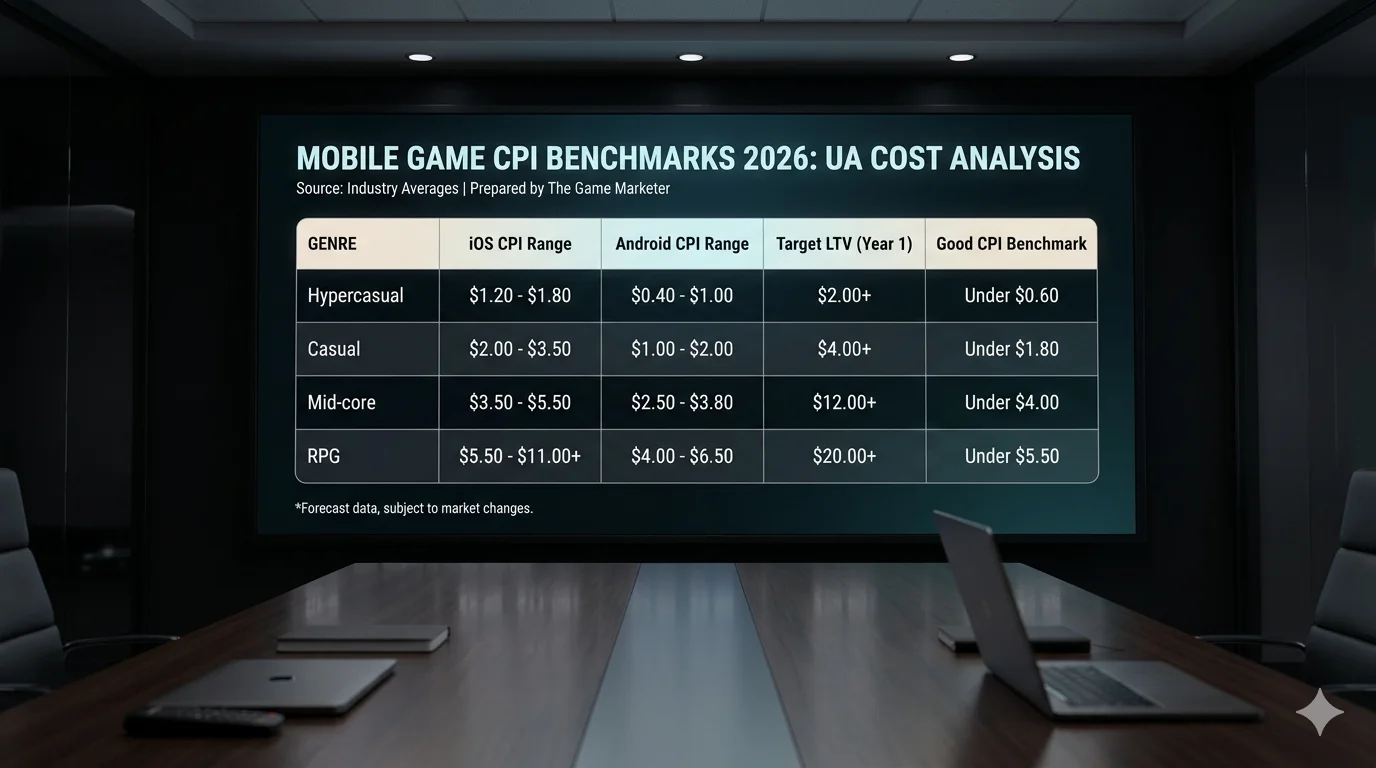
To understand whether your CPI is good, you need context. Benchmarks vary heavily by genre and platform.
These benchmarks are directional and based primarily on Tier 1 markets. Actual CPI can vary significantly depending on geo mix, ad network, creative quality, and seasonality.
Average CPI by Genre
What this actually means
Hypercasual games depend heavily on scale, so CPI has to stay extremely low to remain profitable. RPG and mid-core games can tolerate higher CPI because their users generate more long-term revenue.
Casual games sit in the middle and usually require careful balancing between volume and monetisation.
iOS vs Android CPI Differences
One of the most important patterns in 2026 is the gap between iOS and Android CPI.
In general:
- iOS CPI is 30 to 50 percent higher than Android
- Android delivers cheaper installs but often lower payer rates
- iOS users typically generate higher long-term value
This difference comes from privacy limitations, attribution changes, and stronger competition for premium users on iOS.
Geo Impact on CPI & Practical CPI Benchmarks
Geography also plays a major role in CPI performance.
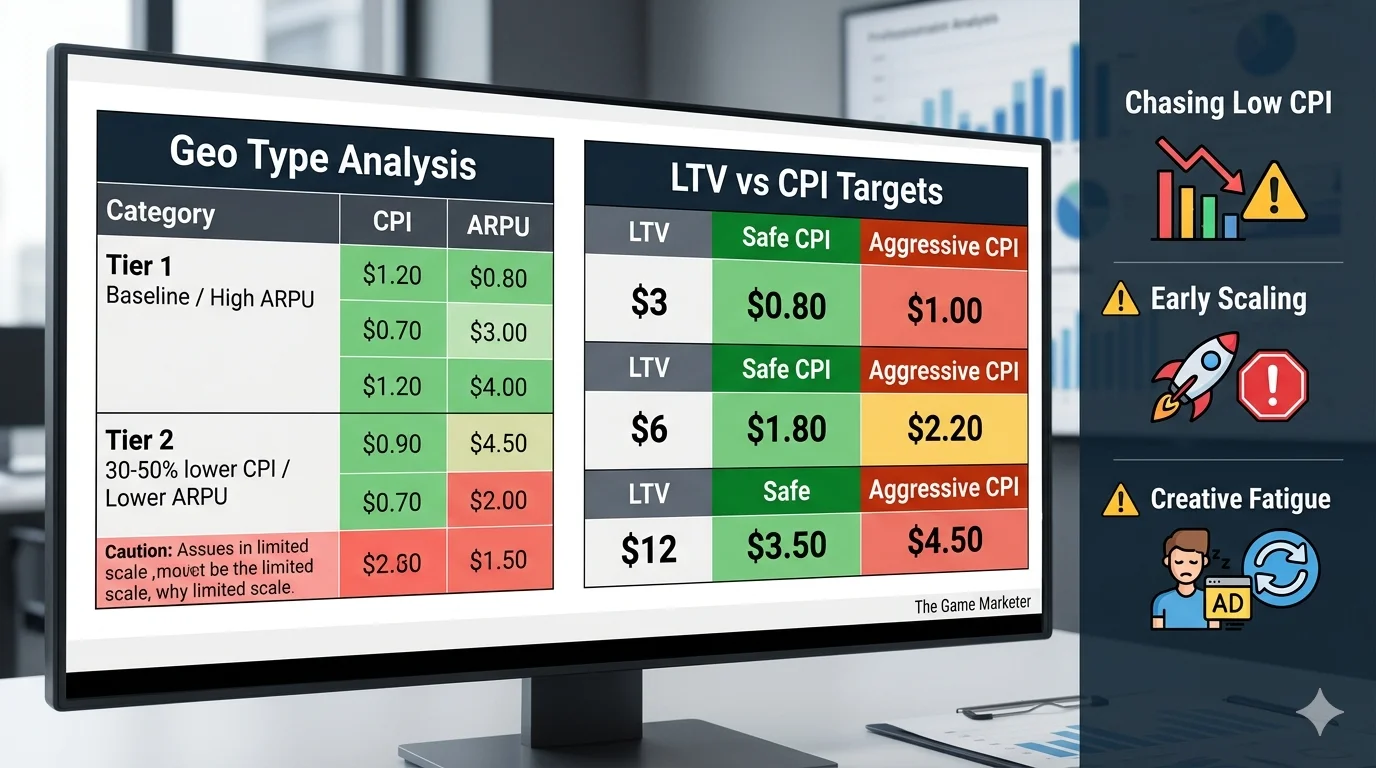
Expanding into Tier 2 markets like India, Southeast Asia, and LATAM can significantly reduce CPI. However, this often comes with lower average revenue per user and longer payback periods.
A strong UA strategy usually blends Tier 1 and Tier 2 traffic instead of relying on one segment.
What Is a Good CPI for Mobile Games?
The simplest way to define a good CPI is this:
Your CPI is good if your unit economics remain profitable at scale.
The Core Rule
CPI is typically evaluated as a percentage of LTV, often ranging between 30 % and 70 % depending on payback targets and growth strategy.
This ensures:
- You can scale spend without losing profitability
- You have room for optimisation
- Small performance drops do not break ROAS
CPI vs LTV: How to Calculate Your Target CPI
To understand CPI properly, you need to understand LTV.
LTV Formula
LTV is the cumulative revenue generated per user over time, not a single-point calculation. It is typically modelled using retention curves and ARPDAU.
Simplified model:
LTV ≈ Σ (ARPDAU × retention over time)
What this means in practice
- ARPDAU represents average revenue per daily active user across cohorts
- Retention represents how many users remain active over time
These two metrics together define how much a user is actually worth.
Example
If:
ARPDAU and retention combine to generate ~$2.00 cumulative LTV over time
Now interpret CPI:
$0.60 CPI is strong
$1.50 CPI is risky depending on payback timing
The key factor is not just total LTV, but how quickly that revenue is realised.
CPI vs Payback Window (Critical for 2026 UA)
What Is Payback?
Payback measures how quickly you recover your acquisition cost.
Common benchmarks:
- D1 payback (rare, mostly hypercasual)
- D7 payback (aggressive scaling)
- D30 payback (common for mid-core and casual)
Why Payback Matters More Than Total LTV
In practice:
- Faster payback reduces risk
- Improves cash flow
- Enables faster reinvestment
This means:
A higher CPI can still be “good” if payback is fast enough.
Example
- CPI = $2.00
- LTV = $4.00
Looks strong on paper.
But:
- If payback is 45 days → slow scaling
- If payback is 10 days → highly scalable
This is why experienced UA teams evaluate:
- CPI
- LTV
- Payback timing
Together, not separately.
5 Advanced CPI Optimisation Strategies for 2026
Reducing CPI is not about pushing bids lower. It is about improving efficiency across the entire acquisition funnel.
1. Psychology Driven Creative Strategy
Creative is still the biggest CPI lever in mobile UA.
High performing ads usually:
- Trigger emotion quickly
- Show gameplay in the first seconds
- Match user intent with mechanics
For example:
- Puzzle games perform well with failure based hooks
- Strategy games perform better with progression and power fantasy
This approach alone can reduce CPI by 20 to 30 percent in many cases.
2. Optimise for Behaviour, Not Installs
Installs are not the real goal.
Instead, optimise for:
- Tutorial completion
- Early session depth
- First purchase or ad engagement
This shifts traffic quality, even if CPI increases slightly in some cases.
3. Cross Network Budget Strategy
Each ad network plays a different role:
- Meta is strong for scaling volume
- TikTok is strong for creative testing and engagement
- Google UAC is strong for automation and reach
The key is not choosing one. It is rotating budgets based on performance signals like D7 ROAS.
4. Scale Only After Retention Stability
Scaling too early is one of the fastest ways to increase CPI and destroy ROAS.
Before scaling, ensure:
- Retention benchmarks should be evaluated relative to genre. The key is that D1 and early retention trends are strong enough to support stable D7 retention and payback.
If retention is weak, scaling will only amplify inefficiency.
5. First Party Data Targeting
With reduced tracking accuracy, first party data is now essential.
Strong UA teams:
- Build user segments based on in game behaviour
- Feed event data into ad platforms
- Create lookalikes from high LTV users
This improves both CPI stability and long term ROAS.
6. Creative Fatigue Monitoring
One of the most overlooked CPI drivers is creative decay.
We regularly monitor:
- CPI increases above 10 percent week over week
- CTR drops across variations
- Engagement decline patterns
When fatigue appears, creative refresh cycles are triggered immediately. This prevents CPI spikes and keeps performance stable.

Common CPI Mistakes in Mobile Game UA
1. Chasing the Lowest CPI
Low CPI does not mean good performance. It often leads to poor retention and weak monetisation.
Always evaluate CPI alongside LTV.
2. Scaling Too Early
Day 1 data is not enough.
Always wait for:
- D7 ROAS signals
- Stable retention patterns
3. Ignoring Creative Fatigue
Without regular updates:
- CPI increases
- CTR drops
- Efficiency declines
4. Using a Single Ad Network
Relying on one platform increases risk and reduces optimisation flexibility.
Final Thoughts
So, what is a good CPI for mobile games in 2026?
It is not a fixed benchmark. It is a balance between cost and lifetime value.
A strong CPI:
- Typically falls within a sustainable range relative to LTV, often between 30 percent and 70 percent depending on payback expectations
- Supports scalable ROAS
- Maintains stable user quality as spend increases
The real difference between average and top performing studios is not CPI alone. It is how well they connect:
- Creative strategy
- Audience targeting
- Retention and monetisation
At The Game Marketer, we consistently see that campaigns succeed when CPI is treated as a result of system quality, not a standalone goal. We’ve helped multiple titles achieve sub-$2 CPI in casual and hybrid genres through creative and targeting optimisation. Book your free UA audit today.
The real question is not just whether your CPI is low enough.
It is whether your CPI is working hard enough to support profitable growth.