
Influencer campaigns are great. They gather traffic, attention, and more gamers. However, in some cases, they do tend to underperform. Why? It’s because they are chosen for reach instead of relevance.
In gaming influencer marketing, results come from alignment. The creator’s audience, content style, platform behaviour, and campaign objective must all match. There is a ton to keep tabs on, and a mismatch in any one of these areas reduces performance, even if the creator has a large following. This then leads to a waste in budget, delay in launch momentum, and can distort performance data, affecting especially audience trust.
If you want a broader view of how brands typically approach this, it is useful to first understand how studios apply gaming influencer marketing strategies across different stages of a campaign.
If you want better outcomes from your gaming influencer campaign, the goal is not to find the biggest creators. It is to choose gaming influencers who can influence the right audience at the right stage, whether that is awareness, wishlists, installs, or long-term community growth.
Why Influencer Fit Beats Follower Count in Gaming
The most reliable way to improve results in gaming influencer marketing is to prioritise fit over reach.
1.1 Why Large Audiences Can Still Underperform
A large creator can deliver weak results if:
- Their audience is not interested in your game genre
- Their content style does not match your campaign
- Their audience does not trust sponsored content
A niche strategy creator, for example, can outperform a larger variety streamer when promoting a tactics game because the audience already understands the genre and values the creator’s opinion.
1.2 When Reach Matters and When It Does Not
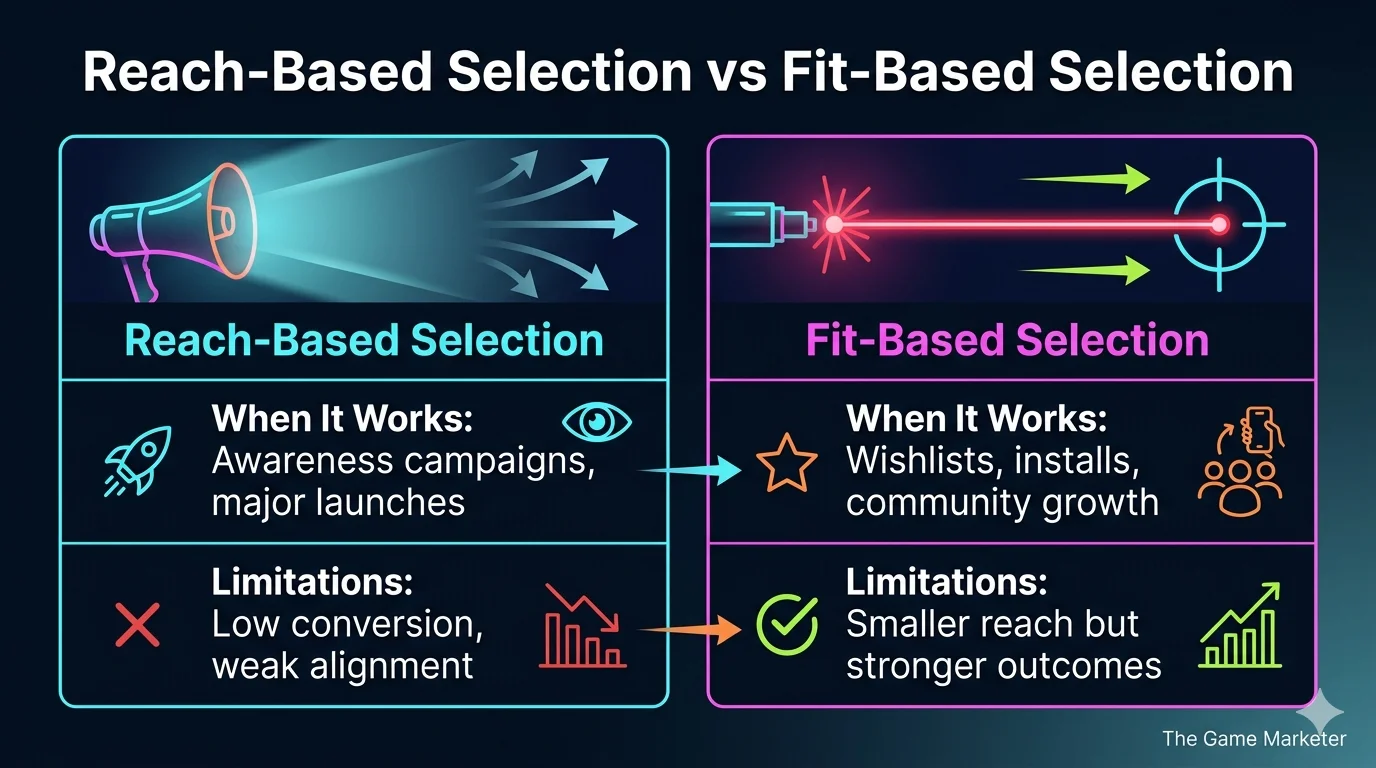
In most gaming influencer campaigns, fit-based selection delivers better results because it targets players with existing interest.
2. Start with the Campaign Objective
To choose gaming influencers effectively, define the campaign goal first. Each objective requires a different creator strategy. Before you choose gaming influencers, the campaign objective must be clearly defined. Without this, even well-matched creators can deliver unclear results.
For example, if your goal is pre-launch visibility, it is worth aligning your influencer strategy with broader game launch hype strategies, where timing, creator selection, and messaging all work together.
2.1 Awareness
- Goal: Maximise visibility
- Creators: Large or viral creators
- Example: Short-form creators pushing wide reach for a new mobile game
2.2 Wishlists
- Goal: Build pre-launch intent
- Creators: Genre-focused YouTube creators
- Example: Early gameplay preview driving wishlist clicks
2.3 Downloads
- Goal: Drive installs
- Creators: Mobile and short-form influencers
- Example: Quick gameplay clips with clear install CTA
2.4 Community Growth
- Goal: Build an engaged player base
- Creators: Community-driven influencers
- Example: Discord promotion through creators
2.5 Retention and Reactivation
- Goal: Maintain player activity
- Creators: Loyal audience builders
- Example: Ongoing content series covering updates
2.6 Pre-Launch Hype
- Goal: Build anticipation
- Creators: Mix of creator tiers
- Example: Teasers, countdowns, early access content
One creator type cannot effectively serve all these goals.
3. Build a Creator Scorecard Before Outreach
To make influencer marketing for games consistent, use a structured evaluation system.
The GAME Fit Framework
- G – Genre Relevance
- A – Audience Fit
- M – Media & Format Fit
- E – Engagement & Evidence
This framework ensures every creator is evaluated based on alignment, not assumptions.
Gaming Influencer Scorecard Template

How to Score Creators
- 9–10 → Strong match, prioritise
- 6–8 → Usable with monitoring
- 0–5 → Weak fit, avoid
Example:
A strategy YouTube creator scoring high on genre relevance and format fit will often outperform a larger general gaming creator with lower alignment.
4. Match Creator Type to Game Type
Different games require different creator strategies, and this is where many gaming influencer campaigns go wrong.
Creator selection is not only about platform or audience size, but also about how the game itself is structured. Game mechanics, pacing, and design choices all influence which creators will perform best.
For a deeper breakdown of how game structure influences marketing performance, you can also connect this to how game design choices impact marketing success, especially when selecting creators for niche or mechanic-heavy games.
4.1 Indie Games
- Require trust and niche audiences
- Best creators: Micro and mid-tier
- Why: Strong niche trust and engagement
4.2 Mobile Games
- Require reach and fast engagement
- Best creators: Short-form influencers
- Why: Fast discovery and install behaviour
4.3 AAA Games
- Require broad visibility
- Best creators: Large influencers and event coverage creators
- Why: These campaigns benefit from scale and hype
4.4 Strategy Games
- Require depth and explanation
- Best creators: Long-form YouTube creators
- Why: Players need to understand mechanics before committing
4.5 Live-Service and Multiplayer Games
- Require long-term engagement
- Best creators: Streamers and community builders
- Why: Ongoing interaction drives retention
A mismatch between game type and creator type is one of the biggest causes of campaign failure.
4.6 Game Type vs Creator Strategy Matrix
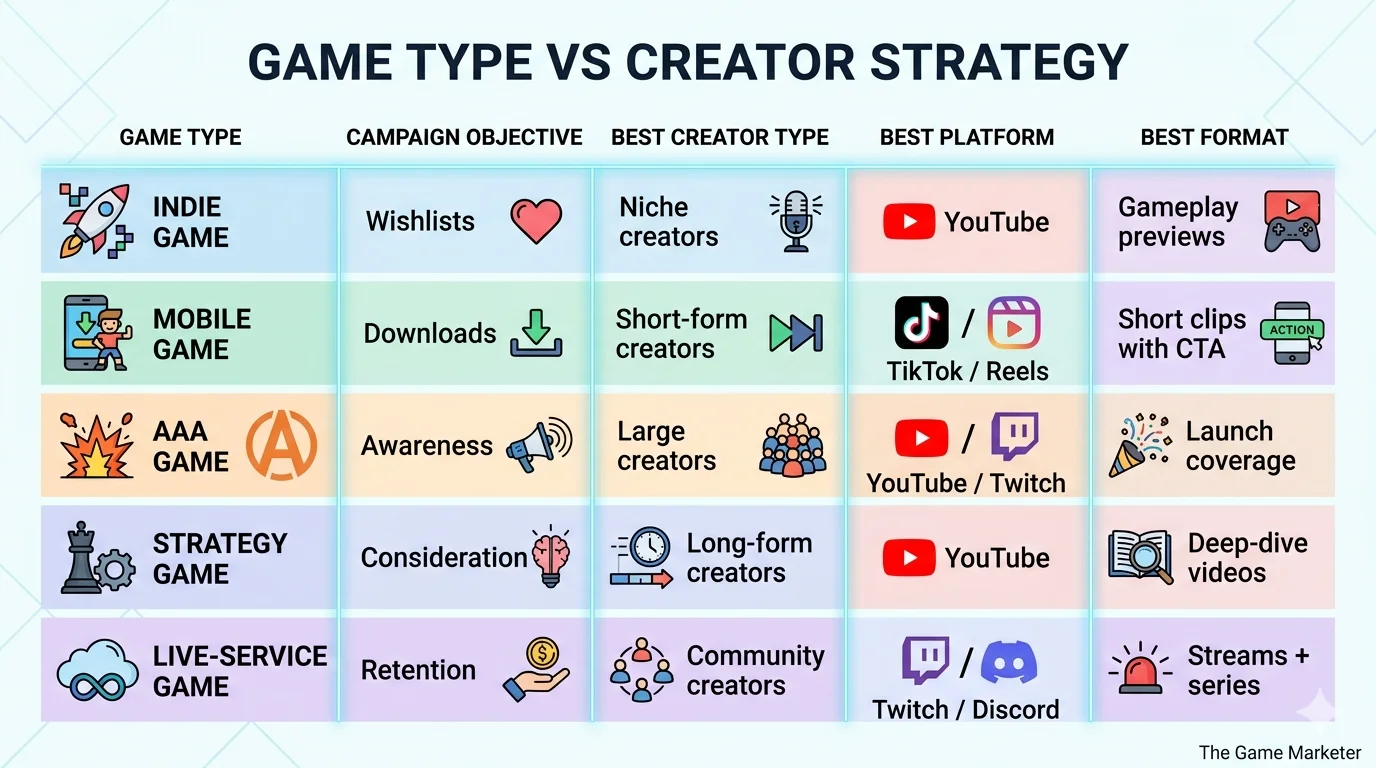
This matrix simplifies how to choose gaming influencers based on both game type and campaign goal.
5. Audit Audience Quality, Not Just Engagement
Audience quality is a stronger indicator than engagement rate.
Audience Audit Checklist
- Are comments discussing gameplay?
- Do followers ask relevant questions?
- Is there repeat interaction from users?
- Does the audience match your geography?
- Is the audience gaming-focused?
If a creator’s audience consistently discusses similar games, it signals a stronger intent compared to generic engagement.
6. Evaluate Content Format Against Campaign Intent
Content format directly impacts campaign performance.
Content Format vs Campaign Goal
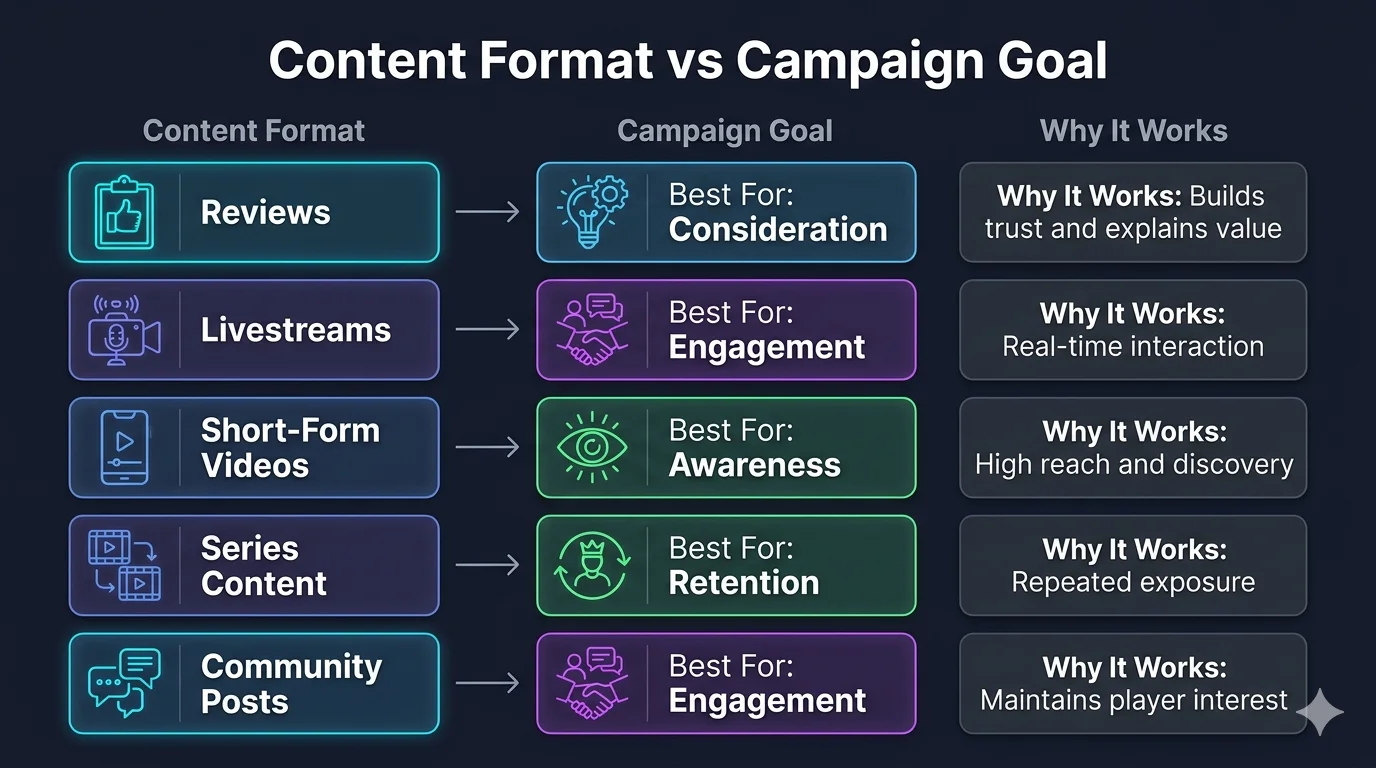
A detailed YouTube review can drive more conversions for a PC game than a viral short clip with no context.
7. Spot Weak-Fit or Low-Trust Creators
Avoid creators who show signs of weak alignment or low audience trust.
Red Flags
- Inconsistent gaming niche
- Sudden follower spikes
- Low-quality comments
- Generic sponsored content
- Weak audience relevance
- Brand safety concerns
Multiple red flags usually indicate poor campaign performance.
8. Write a Brief That Preserves Authenticity
Even when you choose the right gaming influencers, execution can fail if the brief is too restrictive or disconnected from creator style.
This is especially important for long-term collaborations where consistency and trust matter more than one-off promotions. In mobile and live-service campaigns, for example, creator relationships often perform better when treated as ongoing partnerships rather than single activations.
You can see this approach reflected in long-term mobile influencer engagement strategies, where creators are integrated into sustained gameplay and community cycles rather than isolated posts.
What to Include in a Creator Brief
- Campaign objective
- Target audience
- Key message
- Gameplay focus
- CTA
- Tracking method
- Restrictions if needed
Gaming audiences value authenticity. Overly scripted content reduces trust and engagement.
9. Measure the Right Results
Measure performance based on campaign stage.
Metrics by Funnel Stage

Tracking the wrong metrics leads to incorrect conclusions.
10. Final Gaming Influencer Checklist
Before finalising any creator, confirm the following:
- Does the creator consistently cover similar games?
- Is the audience relevant and authentic?
- Does the content format match your campaign goal?
- Is the creator safe and aligned with your brand?
- Can performance be tracked effectively?
If any of these answers are unclear, reassess before moving forward.
Choosing gaming influencers is a strategic process built on alignment, not scale.
The most effective gaming influencer campaigns succeed because they match the right creator with the right audience, format, and objective. Using a structured approach like the GAME Fit Framework ensures consistent, measurable results.
If you want to apply this at scale, it is often worth combining structured selection with a broader gaming marketing strategy approach to ensure influencer campaigns are aligned with your full go-to-market plan.
For studios that want hands-on support with planning, selecting, and managing creators, you can explore our game influencer marketing services where we help teams build and execute performance-driven influencer campaigns tailored to their game genre and launch stage.
FAQs
How to choose gaming influencers for your next game marketing campaign?
A: Use a structured framework like the GAME Fit Framework to evaluate genre relevance, audience fit, engagement quality, and content format instead of relying on follower count.
How to find the right gaming influencers for a game launch?
A: Use platform research, competitor analysis, and creator tools to identify relevant creators based on your game genre and audience.
What matters more: followers or engagement?
A: Engagement quality and audience relevance matter more than total followers.
How to evaluate gaming influencers before a campaign?
A: Use a creator scorecard, review audience quality, and analyse past performance.
How to spot fake gaming influencers?
A: Look for follower spikes, low-quality engagement, and inconsistent content patterns.
Which platform is best for gaming influencer marketing?
A: It depends on your campaign goal. Short-form platforms work for reach, while long-form and livestream platforms are better for engagement.