
Complete creative control, higher royalty percentages, and freedom to publish on your own terms. That is the “obvious” appeal of self-publishing.
The idea of self-publishing has transformed the creative landscape, giving game developers and authors the power to bring their visions to life and directly to their intended audience.
But beneath it all, self-publishing is not always the path it seems to be.
Many creators have the belief that self-publishing will save them money by cutting out the middleman. The reality though is this: costs can escalate quickly. It might even surpass those of traditional publishing. Now, if you’re considering self-publishing, it’s important to understand the expenses involved—even the hidden ones.
1. Marketing: The Engine That Drives Sales
Traditional publishers have entire teams dedicated to making sure your game is noticed. But as a self-publisher, you are your own marketing department – and that comes with a price tag.
What Does Effective Marketing Look Like?
- Paid Advertising: Ads aren’t free. Campaigns can go from a few hundred dollars to thousands, depending on your goals. But social media, e-commerce platforms like Google, and gaming platforms like Steam offer tools that help you target your ideal audience.
- Content Creation: Media, blog posts, and newsletters all require time and a little bit of money. Hiring professional marketers can make a huge difference between being taken a look or being overlooked.
- Influencer Outreach: Sending review copies and sponsoring streams, among other similar strategies, can extend your reach to a wide number of audiences. But of course as with any professional work, influencers, content creators, and the like will expect compensation.
- Events and Launches: This requires planning but can generate a good amount of buzz surrounding your game, whether it’s an online or in-person event.
Actionable Checklist: Marketing Budget
- Set a clear marketing budget
- Identify your target audience and where they spend time online.
- Plan at least three months of marketing activities before and after launch.
- Allocate funds for ads, content creation, and influencer outreach.
Question to Ask Yourself:
How much will I need to spend in order to get my work out there and make a profit?
%20copy.webp)
2. Localisation: Opening Doors to New Markets
If you want your game to reach a wide audience, you’ll need to invest in professional localisation. It’s about making your game/s reach players around the world, because it’s not just about translation, it’s about connection.
What’s Involved in Localisation?
- Professional Translation: Texts within your game are accurately translated for tone and cultural relevance. This can cost up to thousands of dollars, depending on the length of the game.
- Technical Adjustments: Depending on the platform, it’ll take an adjustment in formatting. This includes UI, voice-overs, subtitles, and even character names.
Actionable Checklist: Localisation Planning
- Decide which languages and regions will be in your game.
- Plan for cultural adaptation and technical integration.
- Budget for ongoing updates and support for localised versions.
Question to Ask Yourself:
How much of your audience are from a different culture? Is the potential increase in sales worth the cost of localisation?
3. Quality Assurance (QA): Protecting Your Reputation
A single typo, bug, or error can damage your game and your reputation. QA is your insurance policy against these obstacles.
What Does QA Cover?
- Editing and Proofreading: Editors ensure that the writing is consistent, typo-free, and understandable.
- Formatting: Hardware and operating system compatibility.
- Beta Testing: This includes meticulous playtests to make sure that there are no overlooked errors and bugs so that it can be addressed immediately before launch.
Actionable Checklist: QA Budget
- Allocating funds for professional editing and proofreading
- Schedule for beta testing and user feedback
- Budget for technical support and bug fixes after launch
- Final checks before release
Question to Ask Yourself:
Are you willing to sacrifice QA for an immediate game launch?
4. Platform Fees: The Price of Distribution
Platforms such as Epic, Steam, and itch.io help reach thousands of players, but they take a percentage off your sale. It is essential that you understand the fees involved to have realistic financial planning.
What Are Typical Platform Fees?
- Epic: 0% until you reach 1 million in revenue, then 12% after.
- Steam: 30%. $100 a game for listing.
- Itch.io: 10% (flexible)
Actionable Checklist: Platform Fee Planning
- Compare fees and features across platforms
- Calculate your net profit after platform fees and other deductions.
- Consider selling directly through your own website for higher margins (but factor in payment processing and hosting costs)
Question to Ask Yourself:
Are the costs worth paying? Is a cheaper fee better? How much of each sale will you get to keep? Are the platform’s terms and conditions agreeable to you?
%20copy.webp)
5. Support Costs: The Ongoing Commitment
You launched your game. Congratulations! Now what? Ongoing support is essential in keeping your audience happy and your game alive.
What Does Ongoing Support Include?
- Customer Service: Replying to emails, troubleshooting, and other concerns.
- Technical Support: Patching bugs, updating content, and managing servers.
- Community Management: Replying to fans on online platforms like social media, forums, and Discord.
- Website Maintenance: Keeping your site updated, smoothly running, and other website necessities.
Actionable Checklist: Support Planning
- Plan for at least a few months of post-launch support.
- Set up a system for tracking and responding to customer feedback.
- Budget for ongoing technical and community management.
- Regular updates and improvements.
Question to Ask Yourself:
How much time and money are you willing to spend for ongoing support?
Real-World Scenario: The Indie Creator’s Journey
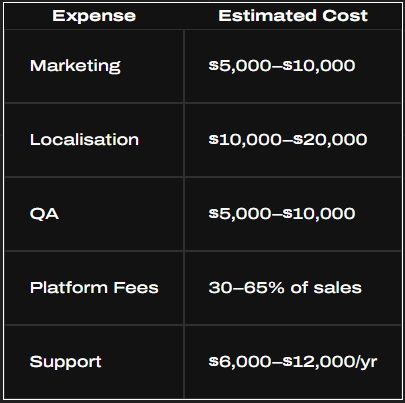
Let’s put it all together with a realistic example. Imagine you’re self-publishing a mid-sized indie game or novel. Here’s what your budget might look like:Total Out-of-Pocket Costs: $26,000–$52,000 (not including your time or development costs).
If you sell 10,000 copies at $20 each ($200,000 gross), after platform fees and expenses, you’re left with about $80,000–$120,000 before taxes. That’s a healthy return-but only if you invest in quality and reach.
To help you plan, here’s a simple formula you can use:
Total Cost = Marketing + Localisation + QA + Platform Fees + Support
Plug in your own numbers and see how they stack up against your expected sales.
Key Takeaways: The True Cost of Self-Publishing
- Self-publishing is not a shortcut to success. It requires a committed investment in marketing, localisation, QA, ongoing support, etc.
- Skimping on editing, testing, or support can hurt your game and you in more ways than one.
- Ongoing support and updates are essential for lasting success. Plan for the long term.
- Budget carefully, track expenses, and set realistic goals.
But don’t worry. In this world, co-op is the way to go. If it’s too much to handle, reach out to The Game Marketer. We can offer a hand in marketing, social media management, and other services so you can launch your game with confidence.
Final Checklist: Are You Ready to Self-Publish?
- Have you budgeted for all hidden costs?
- Do you have a marketing plan and timeline?
- Are you investing in quality editing, localisation, and QA?
- Have you compared platform fees and calculated your net profit?
- Are you prepared for ongoing support and customer service?
If you answered “yes” to most of these, you’re ready to take the next step. If not, use this guide to fill in the gaps and set yourself up for success.
Now, if you’re feeling overwhelmed or want personalised advice, reach out to The Game Marketer. We can help you plan your budget, connect with professionals, and launch your project with confidence.
Ready to turn your creative vision into a reality? Bookmark this post, share it with your team, and let’s make your self-publishing journey a success!