
TikTok has changed visibility on indie games.
A small studio can post a short gameplay clip and reach people who have never heard of the game, the developer, or the studio behind it. That makes TikTok one of the more interesting channels for indie game marketing, particularly for games with a strong visual hook or a mechanic that is easy to understand.
But there is an important difference between getting views and generating interest in a game.
I have seen videos get plenty of attention without producing the Steam activity the developer expected. The video performs well, comments come in, and the view count keeps climbing, but the wishlist graph barely moves.
That usually tells me that something is missing between watching the video and wanting the game.
Personally, that is the real purpose of TikTok marketing for indie games. It is not about chasing the biggest possible view count. It is about finding content that makes the right player stop, understand what makes the game interesting, remember its name, and then take the time to check out its Steam page.
The strongest journey looks something like this:
TikTok video → player interest → game search or Steam visit → Steam page → wishlist
Once you start looking at TikTok this way, the strategy becomes clearer.
What Makes TikTok Marketing Work for Indie Games?
The first question I would ask is not what is trending on TikTok.
It is what is interesting about your game.
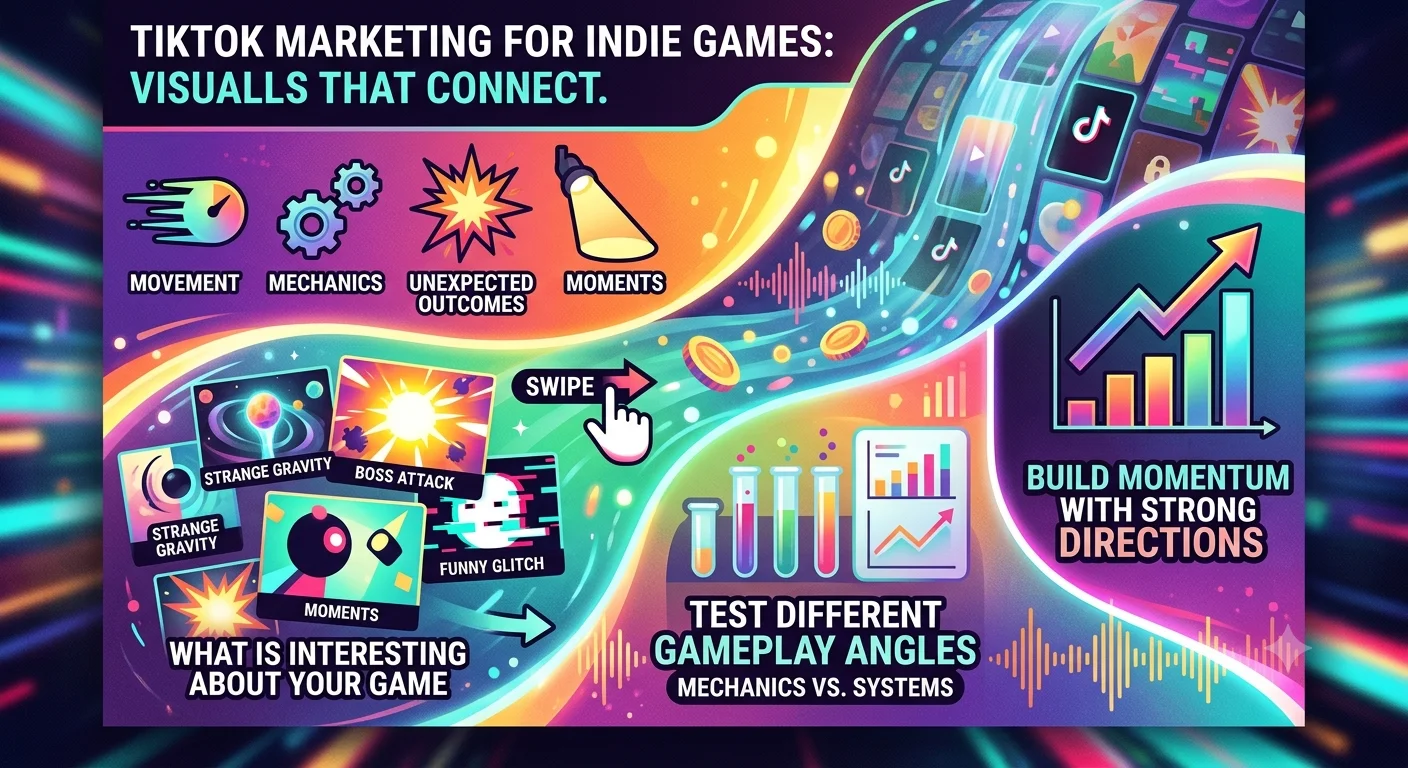
Games already have something that many other products struggle to create: movement, characters, mechanics, unexpected outcomes, and moments that can be shown rather than explained.
That gives indie developers a lot of material to work with.
A strange physics interaction can become a video. A difficult boss fight can become a video. A funny multiplayer moment can become a video. A development mistake can become a video. A before-and-after comparison can become a video.
The key is finding the parts of the game that are immediately understandable.
Recent indie marketing guidance also points towards short-form video being particularly suitable for games with strong visual concepts, clear mechanics and moments that can be communicated quickly.
That does not mean narrative games, strategy games or slower experiences cannot use TikTok.
It means the marketing has to find a way to communicate their appeal without asking the viewer to understand the entire game first.
Start With Gameplay Players Can Understand
A player scrolling through TikTok does not have much reason to stop for a development update that takes ten seconds to explain.
They might stop for something happening on screen.
If your game lets players manipulate gravity, show the mechanic.
If enemies react differently depending on what the player does, show that interaction.
If your horror game has a creature that only moves when the player looks away, show the moment the player realises what is happening.
The gameplay should do the explaining. Text and voiceover can add context, but they should not have to carry the entire idea.
This is also where your game genre matters. A co-op game can show a funny interaction between friends. A horror game can build tension around one moment. A simulator can show an unusual outcome. A strategy game can show a clever decision producing an unexpected result.
The format changes, but the principle stays the same.
Show the reason someone should care about the game.
Find the Part of the Game Players Want to Share
The feature that took your development team six months to build is not automatically the best marketing feature.
That is something worth remembering when planning an indie game TikTok strategy.
Developers naturally understand the depth behind their game. A new player does not have that context.
A complicated progression system may be important to the overall experience, but a small mechanic that creates an immediate reaction could make a much stronger TikTok.
That is why I prefer testing different gameplay angles instead of deciding in advance which feature should lead the campaign.
With ShantyTown, The Game Marketer worked across strategy, branding, Steam page optimisation, social management, PR, creative production and paid media. The campaign eventually generated more than 100,000 wishlists, 1.5 million Steam page visits and 70,000 demo downloads.
The useful lesson is not that every indie game needs to replicate those numbers.
It is that the campaign did not depend on one piece of content. Creative ideas were tested across different formats and audiences, with the strongest directions used to build further momentum.
That is a much more realistic way to approach TikTok game marketing.
Why TikTok Views Do Not Always Become Steam Wishlists
A video can be entertaining without making anyone want to play the game. That is one of the biggest problems with treating TikTok as a simple awareness channel.
You might create a funny video that gets hundreds of thousands of views because the situation is entertaining. People enjoy the clip, but they do not remember the game.
Or they might understand the game but have no idea where to find it. Or they might search for it and arrive at a Steam page that does not match what they saw in the video.
Every one of those problems creates a gap in the journey from TikTok to wishlist.
A documented indie campaign shows why this matters. One viral TikTok generated more than 571,000 views and around 2,900 wishlists, while the resulting Steam traffic also included search activity from people who had seen the game on TikTok and later searched for it on Steam.
That is important because TikTok and Steam are often used on different devices.
Someone can see your game on their phone, remember the name, sit down at their computer later, and search for it on Steam.
If you only look at direct referral traffic, you can miss part of that journey.
Give Players a Reason to Remember Your Game
Your game name needs to be easy to remember.
That sounds basic, but it becomes important when the viewer cannot immediately click through to Steam. If the name is difficult to spell, buried in tiny text, or only appears for half a second, you are making the next step harder.
I would make the game name clear in the video when it makes sense, particularly when the content is designed to generate awareness beyond your existing followers.
The same applies to the caption and pinned comment.
The objective is not to fill every piece of content with promotional messaging. It is simply to make sure someone who likes the video can work out what game they just watched.
Make Your Steam Page Match the TikTok
The Steam page needs to continue the same story.
If the TikTok shows a funny multiplayer mechanic, the Steam page should make the multiplayer experience clear.
If the TikTok focuses on a distinctive visual style, your screenshots and capsule should reinforce that identity.
If the TikTok shows a particular gameplay mechanic, the trailer should not spend most of its runtime on unrelated cinematic footage.
This is why I would never treat social media and Steam page optimisation as completely separate activities.
When The Game Marketer worked on ShantyTown, Steam page optimisation was part of the wider campaign rather than an isolated task. The page, creative, advertising and social content all worked around the same positioning.
The same principle applies whether the traffic comes from TikTok, creators, PR or paid media.
The message that gets the player interested needs to match the experience they find on Steam.
How to Create TikTok Content That Gets Indie Games Noticed
The strongest TikTok content usually gives the viewer a reason to keep watching before asking them to do anything.
That could be curiosity, humour, surprise, tension, or a satisfying piece of gameplay.
You do not need every video to follow the same formula. Avoid that. If every post is a trailer with a different clip, the account can quickly start feeling repetitive. Instead, build different types of content around the same game.
The game remains consistent, but the reason for watching changes.
Show the Gameplay Instead of Explaining the Game
One of the easiest mistakes is spending too much of the opening seconds explaining what the game is.
For example:
"Our new indie survival game is a unique experience where players..."
By the time the sentence finishes, the viewer has probably moved on.
Try showing the moment first.
Then explain it.
If the player can turn into an object, show it happening.
If two players can sabotage each other, show the sabotage.
If an enemy reacts unexpectedly, show the reaction.
The explanation becomes much easier once the viewer already has something interesting to look at.
Make the Hook About the Game
The hook should come from the game's actual appeal.
That gives you much more sustainable content than trying to attach a random viral trend to the game.
A developer might write:
"We accidentally made the boss fight impossible."
Then show what happened.
Or:
"This is what happens when two players ignore the objective."
Then show the result.
Or:
"We thought players would use this mechanic one way. They did something completely different."
The important part is that the video delivers on the promise.
A strong hook is not just an attention trick. It should lead into something the player actually wants to see.
How TikTok Drives Steam Wishlists
Once your TikTok content is getting the right people interested, the next question is what happens after the video.
This is where TikTok becomes part of Steam wishlist marketing rather than simply social media marketing.
The journey can happen in several ways.
Someone may click through directly.
Someone may visit your TikTok profile first.
Someone may remember the game name and search for it on Steam later.
Someone may send the video to a friend who then searches for the game.
And someone may see the game repeatedly across different creators before finally deciding to check it out.
That means you should not judge TikTok only by the number of people who click a link immediately.
The broader question is whether TikTok is creating more demand for the game.
Give Every TikTok a Clear Next Step
Not every video needs a hard sales CTA.
But when the game has a live Steam page, the audience should know what to do if they want more.
That might be:
Wishlist it on Steam
Play the demo
Follow the game
Join the Discord
The right CTA depends on where the game is in development.
Before the Steam page is live, you might be building awareness.
Once the Coming Soon page is available, wishlist growth becomes a more important objective.
When the demo launches, the CTA can change again.
This is why TikTok should be connected to your wider launch plan rather than managed as an isolated social account.
How TikTok Influencers Help Indie Games Reach More Players
Your own TikTok account is only one part of the opportunity.
Creators can introduce an indie game to an audience that already trusts their recommendations.
That is particularly useful when the creator's audience matches the game's genre.
A horror creator showing a horror game is immediately relevant.
A co-op creator showing a co-op game gives the content context.
A simulation creator demonstrating an unusual simulation mechanic already has an audience that understands why it might be interesting.
That is much more useful than simply paying the largest gaming account you can find.
The Game Marketer's video game influencer marketing service works across TikTok, Twitch, YouTube and other platforms, with creator selection based on factors such as genre relevance, audience behaviour, platform strength and campaign objectives.
Choose Creators Based on Genre and Audience
Follower count is only one part of the decision.
For an indie game, I would also look at:
- What games does the creator normally cover?
- Does their audience match your target player?
- Does their content style suit the game?
- Have they generated meaningful engagement around similar games?
- Can they show the game in a way that feels natural for their audience?
A smaller creator with a highly relevant audience can sometimes be a much better fit than a large general gaming account.
That is why creator campaigns should be built around audience fit, not simply reach.
Use TikTok Creators Alongside Your Own Content
Creators should not replace the studio's own TikTok content.
They can add another layer to it.
Your account can establish the game, test different messages and build a recognisable identity.
Creators can then show the game from their own perspective.
That creates more opportunities for players to encounter the game without seeing the exact same studio-produced message repeatedly.
The Game Marketer's wider influencer work reflects this approach. Our current creator programme spans more than 500 activated creators across 135 countries and multiple platforms, with campaign objectives including wishlists, installs and community growth rather than impressions alone.
When Should You Use TikTok in Your Steam Launch Strategy?
TikTok should not suddenly appear three weeks before launch.
If you have enough gameplay to create interesting content, you can start testing your messaging well before release.
That gives you time to understand what players respond to and gives the audience time to become familiar with the game.
This becomes particularly useful around major Steam milestones.
A Coming Soon page gives interested players somewhere to go.
A demo gives them something to play.
Steam Next Fest gives you a major event around which you can concentrate your content.
Launch gives you a reason to bring previous viewers back.
TikTok can support each of those moments.
Build TikTok Content Around Your Steam Milestones
The content should change as the game gets closer to release.
Early development can focus on interesting mechanics, development progress and the game's identity.
Once your Steam page is live, content can push players towards wishlisting.
Before a demo, you can start showing what players will actually be able to experience.
Around Steam Next Fest, creator content and short-form videos can help increase awareness while players are actively looking for upcoming games.
The Game Marketer's Steam Next Fest wishlist guide covers how the event can support wishlist growth when the Steam page, demo and wider campaign are properly prepared.
Our Steam game launch checklist also covers the wider launch timeline, including the Coming Soon page, Steam Next Fest, influencer outreach, demo pushes, launch week and post-launch activity.
The important point is that TikTok should support those milestones rather than exist separately from them.
How to Measure TikTok Marketing for an Indie Game
This is where I would move away from vanity metrics.
Views matter.
You need people to see the content before anything else can happen.
But views alone do not tell you whether your TikTok marketing for indie games is working.
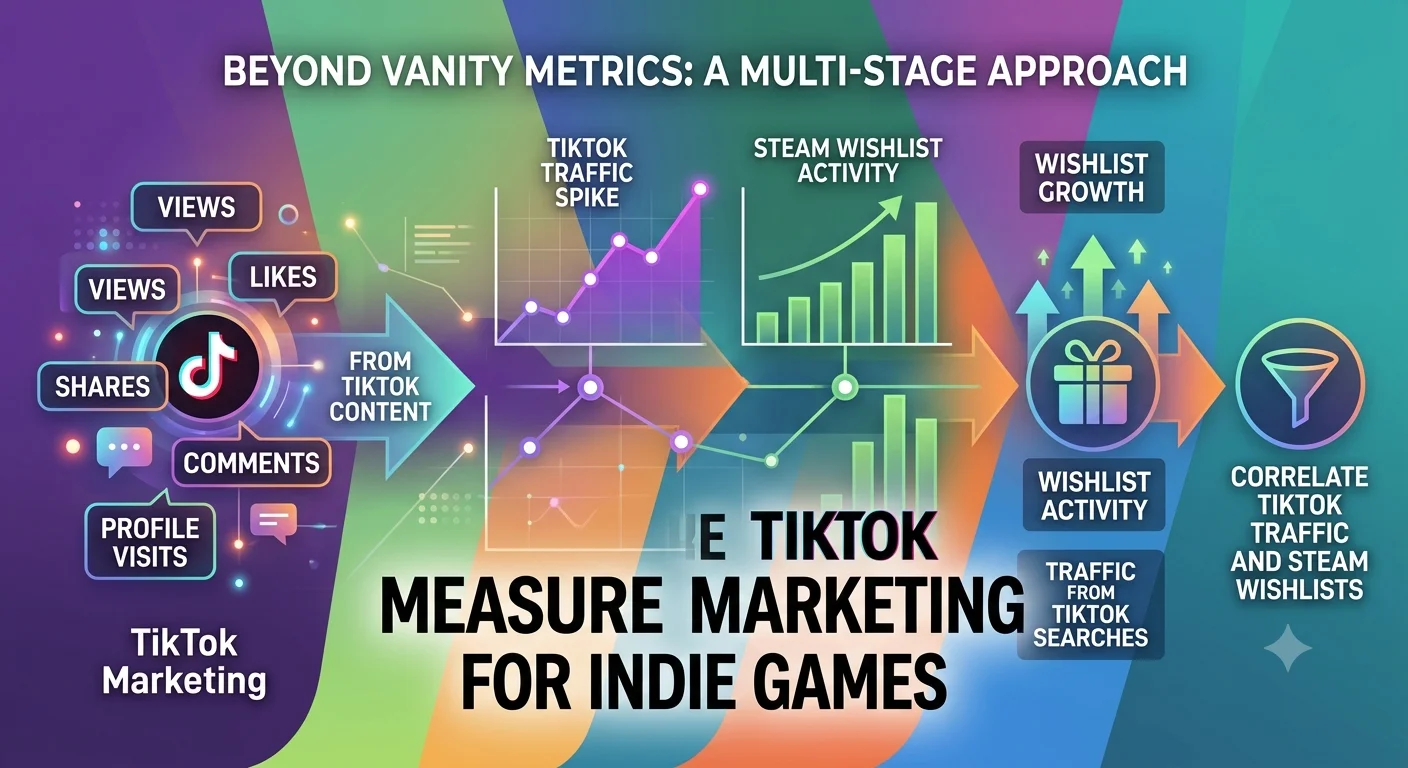
I would look at the campaign in stages.
At the content level, watch engagement, retention, shares, comments and profile visits.
Once the Steam page is live, look at traffic and wishlist activity.
During a major creator or TikTok push, compare those changes with your content schedule.
If you see a spike in TikTok attention followed by an increase in Steam traffic or wishlist activity, that is much more meaningful than the view count on its own.
Recent indie marketing research also recommends treating channel performance in terms of wishlist growth and cost or effort per wishlist rather than relying only on reach.
Track TikTok Traffic and Steam Search Together
This is particularly important because not every TikTok-driven player will click a link.
A player might see your game on their phone, remember the name and search for it on Steam later.
That means direct TikTok referrals are only part of the picture.
Where possible, use tagged links for different campaigns and creators, then compare those results with broader Steam traffic, searches and wishlist movement.
If one creator generates direct traffic and another produces little direct traffic but coincides with a significant increase in Steam searches and wishlists, you have more information to work with.
You are not trying to create perfect attribution.
You are trying to understand which activity is creating demand.
TikTok Should Be Part of Your Wider Indie Game Marketing Strategy
TikTok is powerful, but I would not build an entire indie game marketing strategy around it.
The platform is particularly useful for creating attention and testing creative ideas.
Steam is where that attention can become a wishlist.
Creators can introduce the game to relevant audiences.
PR can give the campaign credibility and wider coverage.
Paid media can help scale proven creative.
Community management can keep people engaged between major launch moments.
The Game Marketer's Social Media & Community Management service takes a similar approach, combining content creation, social management, community engagement, influencer activity and performance tracking rather than treating posting as the entire job.
That wider view matters because the best-performing TikTok video is not necessarily the end result.
It might be the piece of content that gives you the message you then use across the rest of the campaign.
That is where TikTok becomes genuinely useful for indie developers.
What Actually Drives Steam Wishlists From TikTok?
After stripping away the advice about trends, hashtags and posting simply for the sake of posting, I think the answer is fairly straightforward.
The game needs to give the right player a reason to stop.
The video needs to communicate that reason quickly.
The player needs to understand what the game is.
The game name needs to be memorable.
The Steam page needs to match the promise made by the TikTok.
The CTA needs to make the next action clear.
Creators need to be selected for audience and genre fit rather than follower count alone.
And the whole campaign needs to work around the moments that matter for the game, whether that is the Steam page launch, demo release, Steam Next Fest or full release.
Most importantly, judge the campaign by what happens after the view.
A million views sounds impressive.
But if those viewers have no interest in your genre, cannot remember the game name and never visit Steam, those views are not doing much for the launch.
A smaller video that reaches the right players and contributes to a noticeable increase in Steam interest can be much more valuable.
That is the difference between chasing TikTok views and using TikTok as part of a genuine Steam wishlist marketing strategy.
Frequently Asked Questions About TikTok Marketing for Indie Games
How do I market an indie game on TikTok?
Start with gameplay that gives people a reason to stop scrolling. Focus on mechanics, funny moments, unusual interactions, player reactions or visually strong moments rather than making every post feel like an advert. Once your Steam page is live, give interested players a clear next step and measure whether TikTok is contributing to Steam traffic and wishlist growth.
Does TikTok actually help indie games get Steam wishlists?
Yes, it can. One documented indie campaign generated more than 571,000 views from a TikTok video and around 2,900 additional Steam wishlists. The campaign also showed an increase in Steam search traffic, demonstrating that players do not always click directly from TikTok.
What type of TikTok content works best for indie games?
Gameplay content that can be understood quickly is usually a strong starting point. Interesting mechanics, unexpected outcomes, funny multiplayer moments, development changes and visually distinctive gameplay can all work. The best approach is to test different content angles and build more around the formats that attract the right players.
How often should an indie game post on TikTok?
There is no single posting frequency that guarantees results. Consistent testing is more useful than publishing repetitive videos simply to hit a daily target. Start with a realistic schedule your development team can maintain, then increase activity around important milestones such as a Steam page launch, demo, Steam Next Fest or game release.
Should indie developers use TikTok influencers?
Yes, when the creator is a good match for the game. Look beyond follower count and consider genre, audience, engagement, content style and previous game coverage. A smaller creator with an audience that actively enjoys your genre can be more useful than a much larger general gaming account.
How do I turn TikTok views into Steam wishlists?
Give viewers a clear path from the video to the game. Make the game name easy to remember, show the gameplay clearly and send interested players to a Steam page that matches the message in your content. Track tagged traffic where possible, but also compare TikTok activity with Steam traffic, searches and wishlist growth because some players will search for the game later.
When should I start TikTok marketing for an indie game?
Start when you have enough gameplay to produce genuinely interesting content. You do not need the finished game. Starting earlier gives you time to test which mechanics and messages attract players before important milestones such as a demo release, Steam Next Fest or launch.
Should I run TikTok ads for my indie game?
Paid TikTok advertising can be useful, but I would test your creative organically before putting significant budget behind it. If a particular concept attracts the right audience, paid media can help scale it. If the creative is not generating interest, increasing its reach will not solve the underlying problem.