
Most advice on how to market a Game reads the same way. Post on Reddit. Get a trailer. Build a Discord. Run some ads. It's not wrong; it's just incomplete, and it treats every game like it needs the same playbook regardless of budget, genre, or platform.
Marketing a game well means building awareness, community, and demand before, during, and after launch, using channels matched to who the game is actually for, not a generic checklist applied to every title. The right order matters as much as the right tactics. Get the sequence wrong and even a strong budget underperforms.
If you're asking how to market a game in the first place, here's the short version. Game marketing is the ongoing process of getting a game in front of the right players and giving them a reason to care, through a mix of paid and organic activity across the game's full lifecycle, not just launch week.
I've worked on marketing for over 100 games across indie titles, publisher-backed launches, and studios with real budgets behind them, including World of Warships, Raid: Shadow Legends, and Cities: Skylines. This guide is built on what's actually worked across those campaigns, not what sounds good in a listicle.
Start With Your Audience and Positioning, Not Your Channels
The biggest mistake I see, from first-time indie developers up to established studios, is picking channels before working out who the game is for. Someone decides they need a video game marketing strategy built around TikTok or a Steam wishlist push before they can answer a much more basic question: who is going to want this game, and why.
Before you touch a single channel, get specific on:
- What genre and sub-genre your game sits in, and which existing fanbases already love that space
- What makes your game different from the five closest comparison titles a player would mention
- Whether your audience is mainly on Steam, mobile app stores, console storefronts, or a mix
- What your players actually talk about in reviews and community spaces for similar games, in their own words
Your positioning should come out of that research, not out of what you'd like the game to be about. A tactical RPG pitched as "a bold new adventure" will lose to a competitor who says exactly what kind of tactical RPG it is and who it's for. Specificity sells. Vagueness gets scrolled past.
Pre-Launch: Where Most Campaigns Are Won or Lost
By the time a game launches, the marketing work that matters most has usually already happened. If you're only thinking about how to promote a video game once it's live, you're behind.
Wishlists and store page. On Steam, wishlists are a valuable pre-launch demand indicator and give you a way to measure whether your store page, announcements, and outreach are building interest. Get your store page live early with a strong capsule image, a trailer that shows actual gameplay in the first ten seconds, and a description written for players, not for search engines. If you're working with a tighter budget and want the full step-by-step version of this, we've covered it in detail in How To Market Your Indie Video Game: The Definitive Guide For Beginners.
Community, before you need it. Don't launch a Discord the week before release and expect it to fill itself. Community building takes months, not days. Show up in relevant subreddits and forums as someone with something to say, not just a link to drop. We go channel by channel on this in our guide to social media for video game marketing, and if you'd rather hand this off entirely, this is exactly what our social media and community management service is built for.
Press and creators. Reach out to press and content creators early enough that they can plan coverage around your launch date, not scramble to fit you in after the fact. Build a simple press kit: key art, a short and long description, trailer link, and contact details, all in one place. Creators want games that are easy to cover quickly. Make that easy for them. This is also where a dedicated video game PR push tends to pay off fastest, since press relationships take time to build and most studios don't have the bandwidth to run this alongside actual development.
Trailer sequencing. Don't dump your whole trailer strategy in one go. A teaser early, a full gameplay trailer closer to launch, and a launch trailer on the day gives you three separate moments to earn attention instead of one.
Launch: The First 72 Hours Matter More Than People Think
Launch day itself is short, but the first 72 hours are an important operating window: early sales, reviews, player feedback, creator coverage, and technical issues can influence the momentum you build after launch. This is the core of any video game launch marketing plan, and it's the part teams tend to under-plan because all the attention goes into pre-launch prep.
- Coordinate your announcement across every channel at once rather than staggering it. A concentrated spike reads better to platform algorithms than a slow trickle.
- Have your community team actively responding to comments and reviews in real time, not checking in once a day.
- Make sure press embargoes, if you have any, lift at the same moment your store page goes live. Nothing wastes coverage like a great review going up before players can act on it.
- Watch for early negative feedback patterns. If several players flag the same issue in the first day, that's a signal worth acting on fast, whether that's a patch or just a clear public response.
We ran exactly this kind of coordinated push for indie studio Odyssey Entertainment's debut title Transmogrify, and for Siphon Shock's HyperLeague Heroes, where a tight go-to-market strategy helped the game climb the Steam charts in its first week. If you're working with a publisher, this is also the window where most of the coordinated marketing push actually happens. Make sure everyone involved knows their exact role before the day arrives, not during it.
Post-Launch: The Part Most Teams Underinvest In
A lot of marketing plans stop the day after launch, which is a mistake. Sales tend to spike, dip, then respond to what you do next.
Keep momentum with:
- Regular content updates that give you a genuine reason to post again, not just recycled launch assets
- Responding publicly to community feedback and showing players their input actually changes things
- Seasonal or platform sales, timed with fresh creative rather than the same launch trailer on loop
- Ongoing outreach to creators who missed launch week but might still cover the game months later
For Blight Night, this is the phase where an influencer-led push after the initial launch secured 35 creators and over 200,000 impressions, well past the opening week. Live-service and ongoing titles need this built into the plan from day one. Premium, one-off titles still benefit from it for months after release, especially around sales events.
Paid vs Organic: When Each One Earns Its Budget
Organic reach, community, press, creator relationships, gets you credibility and a foundation that compounds over time. Paid media gets you speed and scale on top of that foundation. Neither works well as a replacement for the other.
Paid tends to earn its budget once you already have some proof your game converts, a working store page, a trailer that holds attention, some early reviews or wishlists. Spending on ads before that groundwork exists usually means paying to send people to a page that isn't ready to convert them.
Organic work is slower but it's what makes paid spend more efficient later, because you're not starting from zero credibility when the ads start running.
Common Mistakes I See Studios Make
- Treating marketing as something that starts after development finishes, instead of running alongside it
- Copying tactics from a completely different genre or audience because they worked for someone else
- Going quiet for months between updates, then expecting a big launch push to make up for it
- Ignoring what players are actually saying in reviews and community spaces, and marketing to an imagined audience instead
- Underestimating how much a strong store page and trailer affect every other channel's performance
None of these are hard to avoid. They're just easy to miss when you're deep in development and marketing feels like an afterthought.
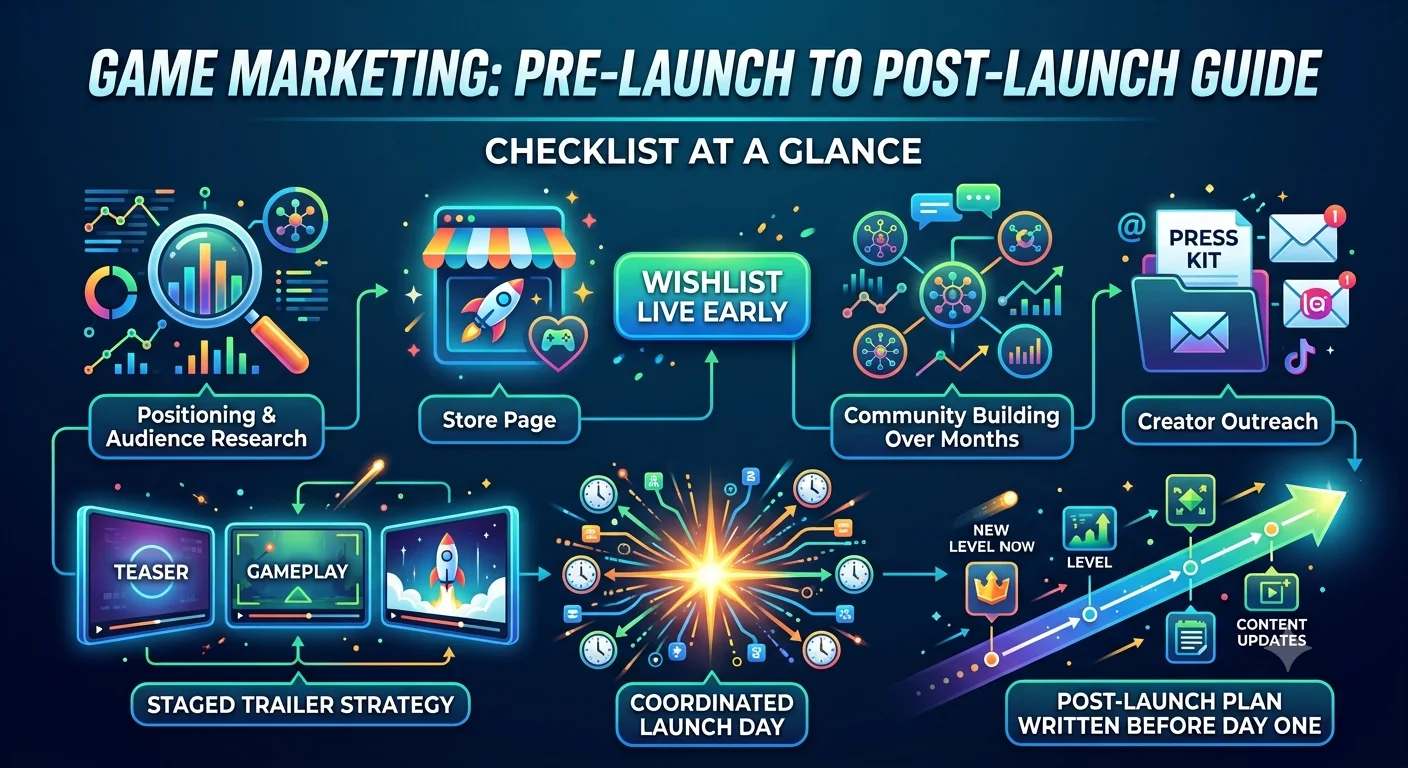
How to Market a Game: Checklist at a Glance
- Positioning and audience research done before any channel decisions
- Store page and wishlist campaign live early, not weeks before launch
- Community presence built up over months, not days
- Press kit ready and creator outreach started well ahead of launch
- Trailer strategy staged across teaser, gameplay, and launch moments
- Launch day coordinated across every channel and team at once
- Post-launch content and outreach plan already written before day one
When to Bring In an Agency vs Handle It In-House
Smaller indie teams with time and a genuine willingness to learn can run a lot of this themselves, particularly community building and organic social. If you're a solo developer with a modest budget, our free and low-cost video game marketing strategies guide is a good place to begin, and our indie game marketing service is built specifically for teams that want support without a full agency retainer.
Where teams tend to hit a wall is press outreach at scale, paid media that actually performs, and coordinating a launch across multiple channels and territories at once. If you're a studio or publisher with a launch that needs to land across press, creators, community, and paid media at the same time, that's usually where bringing in a dedicated game marketing agency pays for itself.
We've Done This Over 100 Times
There's no single formula for how to market a game, but this is the closest thing to one, built from over 100 launches across indie titles, publisher-backed releases, and everything in between, working with names like World of Warships, Raid: Shadow Legends, and Cities: Skylines. You can see how these strategies played out on real campaigns in our case studies. If you'd rather have a team handle the strategy and execution while you focus on the game itself, get in touch and we'll walk you through what that could look like for your launch.
Frequently Asked Questions
Q- How much does game marketing cost?
It depends entirely on scope. A solo indie developer can run an effective pre-launch campaign largely through organic community building and press outreach with a small budget for a trailer and key art. Studio and publisher launches with paid media, creator campaigns, and multi-territory coordination can run into the tens of thousands or more, depending on the platform and ambition.
Q- When should game marketing start before launch?
Ideally, six to twelve months before release for a full campaign, though even a few months of focused community and press work is far better than none. The earlier your store page and wishlist campaign go live, the more time you give the algorithm and your audience to build momentum.
Q- Do I need social media for every platform?
No. Pick the one or two platforms where your actual target audience spends time and do those well, rather than spreading thin across every platform out of habit.
Q- What's the single most important thing to get right before launch?
Your store page. It's where every other channel, ads, press, creators, and social, ultimately sends people, so if it doesn't convert, everything upstream of it is working harder than it needs to.