

A video ad can show someone solving a puzzle, building a city, or fighting an enemy. A playable ad lets the audience try it for themselves.
That difference matters when you are competing for mobile game installs. Instead of relying entirely on a trailer to communicate what makes your game enjoyable, you give potential players a chance to experience its core mechanic before downloading.
Playable ads have become an important creative format in mobile game user acquisition because they combine product demonstration with interaction. They can attract players who understand the gameplay and want to continue playing. However, they are not automatically more profitable than video ads, and their additional production costs need to be justified by campaign performance.
At The Game Marketer, we approach mobile advertising through creative testing, audience targeting and measurable campaign outcomes. The same principle applies when deciding whether to commission a playable: start with the game's strongest mechanic, establish what the campaign needs to achieve, and test the results against existing creative.
In this guide, I cover how playable ads work, which mobile game genres suit them, how much production can cost, and what to measure before increasing your advertising budget.
Quick answer: Playable ads for mobile games are interactive advertisements that let people try a simplified game mechanic before installing the full app. They are particularly suited to puzzle, merge, casual, and simulation games. Published industry estimates put outsourced production at around $3,000 to $8,000 per creative, with more complex projects costing more. Whether a playable is worth the investment depends on its ability to attract valuable players, not just clicks.
What Are Playable Ads for Mobile Games?
Playable ads are interactive advertisements that let users try a short, simplified version of a mobile game before downloading the full app.
Rather than watching gameplay footage, users interact with the ad using familiar mobile controls such as tapping, swiping, dragging, or matching objects. The experience typically lasts a few seconds to under a minute, depending on its design and the advertising platform.
A puzzle game might let someone complete a short matching challenge. A simulation game could give them control of a small building task. A strategy game might let them make one tactical decision and see the immediate result.
The objective is to demonstrate the game's appeal through an actual interaction.
A playable ad usually has three main elements:
- The opening hook: A short visual or gameplay moment that gives people a reason to interact.
- The playable experience: A simplified section of gameplay built around one clear mechanic or challenge.
- The end card: A final screen with the game's branding and a call to action, usually directing users to the App Store or Google Play.
The experience needs to be short enough to understand immediately, but engaging enough to leave the player wanting more.
A playable ad is not a complete demo of your game. It is a carefully selected sample that demonstrates why someone might enjoy the full experience.
How Do Playable Ads Work?
Playable ads typically run within supported mobile advertising placements, including ads shown inside other apps and mobile games. Availability and technical requirements vary by network and campaign setup.
The user interacts with the ad without installing the advertised game first. After completing the interaction, they see an install prompt and can continue to the relevant app store.
HTML5 is commonly used to build lightweight playable experiences that run within an advertising unit, although the implementation depends on the platform.
Here is how the process works from the player's perspective.
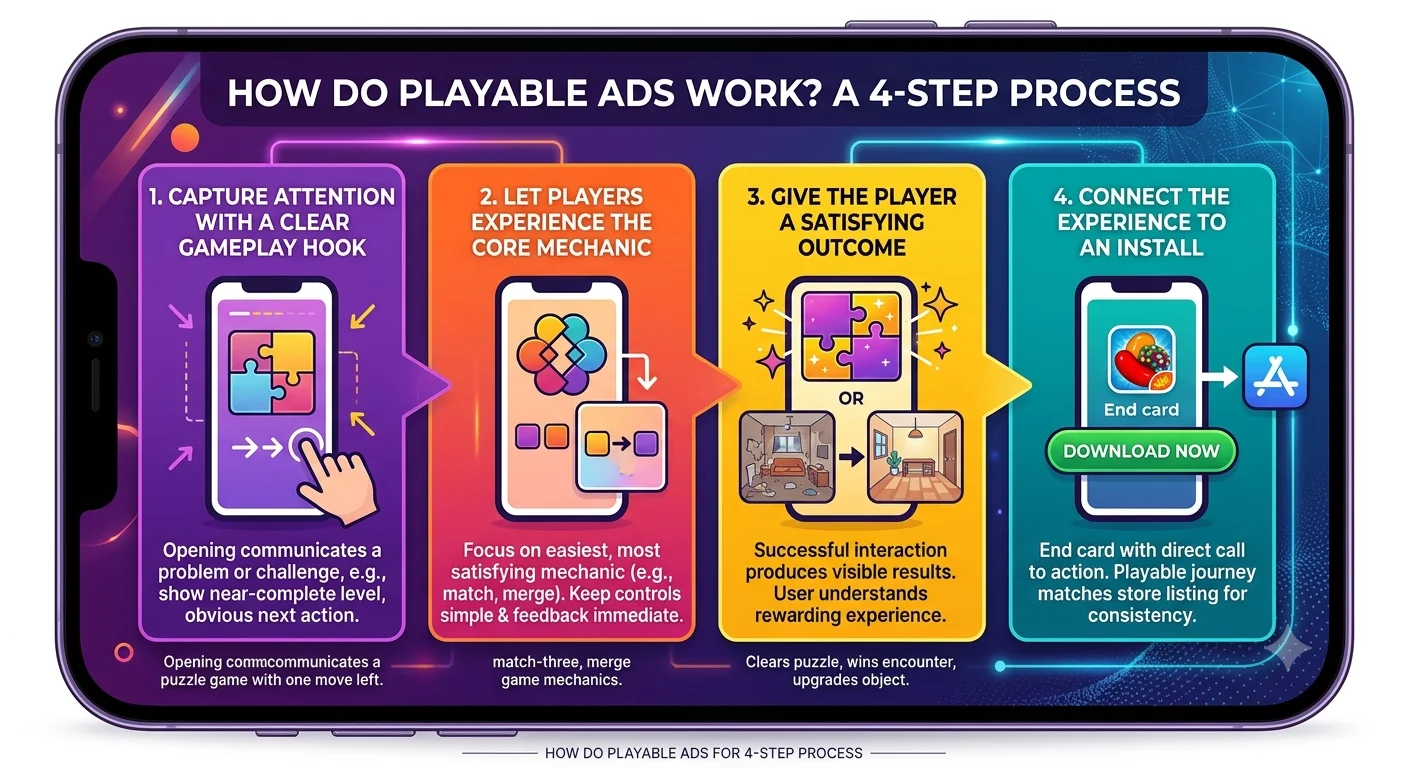
1. Capture Attention With a Clear Gameplay Hook
The opening seconds need to communicate a problem, challenge, or opportunity.
For example, a puzzle game might show a nearly completed level with one move left. A simulation game might present a poorly organised room that the player can fix. An action game could begin with an enemy approaching with the clear instruction to attack.
The opening should make the next action obvious.
2. Let Players Experience the Core Mechanic
The interactive section should focus on the part of your game that is easiest to understand and most satisfying to perform.
For a match-three game, that might be swapping two pieces to trigger a combination. For a merge game, it could involve combining two objects to create an upgrade. For a casual simulation title, the interaction might be placing an object, serving a customer or improving a space.
The goal is not to recreate the entire game. It is to deliver a small but convincing example of the experience.
Keep the controls simple, the feedback immediate and the objective achievable on a mobile screen.
3. Give the Player a Satisfying Outcome
A successful interaction should produce a visible result.
An object upgrades, a puzzle clears, a character wins a short encounter, or a room becomes more attractive. This feedback helps the user understand what makes the game rewarding.
You can also build the experience around an unfinished challenge, provided it reflects the real game and does not feel artificially frustrating.
4. Connect the Experience to an Install
Once the interaction ends, the end card should make the next step clear.
Use the correct game icon, recognisable artwork, and a direct call to action. The promise made by the playable should match the store listing and the actual game.
If the playable promotes puzzle-solving but the store page focuses on an unrelated feature, you introduce friction at the point where the user is deciding whether to install.
The full journey needs to feel consistent, from the first impression to the download.
Why Do Playable Ads Convert?
Playable ads can improve conversion because they allow people to experience the product rather than relying entirely on an advertising claim. The interaction also provides an opportunity to filter for interest before installation.
There are four important reasons to consider the format.
Players Can Test the Gameplay Before Installing
A trailer can demonstrate what a game looks like, but it cannot always communicate how satisfying its controls or mechanics feel.
A playable gives potential players direct experience with that mechanic. Someone who enjoys the short interaction has a clearer idea of what they will get from the full game.
This is particularly useful when the core mechanic is the main selling point.
The Format Creates a More Active Experience
Watching an ad requires little effort. Playing one requires a decision and an action.
That interaction can make the creative more memorable, especially when the user receives immediate feedback. However, interaction alone is not proof of purchase or install intent. The playable still needs a strong opening, accessible controls and a relevant call to action.
It Can Help Attract Better-Matched Players
A playable ad gives users an early indication of the experience they are downloading.
When the creative accurately represents the game, it can help attract people who enjoy its actual mechanics. That matters because inexpensive installs are not necessarily valuable installs.
A campaign that generates a large number of downloads but poor retention may perform worse commercially than one with a higher CPI and stronger long-term player value.
It Gives Creative Testing More to Work With
Playable ads provide several elements to test, including the opening hook, gameplay mechanic, difficulty, tutorial instructions, interaction length and end card.
These tests can help identify which aspect of the game attracts attention and encourages installs.
For a practical framework, see our guide to mobile game ad psychology and reducing CPI. It covers the role of curiosity, gameplay hooks, and player motivation in mobile advertising.
Playable Ad Examples for Mobile Games
The best playable ad examples start with a mechanic that people can understand almost immediately. These concepts show how to turn familiar mobile game mechanics into short interactive ads.
They are illustrative creative concepts, not claims about specific published campaigns.
Match-Three Puzzle: Complete a Level in a Few Moves
Hook: Show a puzzle board with one clear objective and a limited number of moves.
Interaction: Let the player swap matching pieces, trigger a combination, and clear the target.
Why it can work: The player experiences the core mechanic and sees an immediate result without needing a lengthy tutorial.
For this genre, I would test different opening boards, move limits and difficulty levels. A challenge that is too easy may feel uninteresting, while one that is too difficult may frustrate users before they reach the end card.
Merge Game: Combine Two Items to Create an Upgrade
Hook: Present two matching objects and show a more advanced item just out of reach.
Interaction: Ask the player to drag the objects together and reveal the upgrade.
Why it can work: The interaction demonstrates progression and gives players a quick taste of the game's reward loop.
The upgraded item should be visually satisfying, and the mechanic should match what players will actually do in the full game.
Simulation Game: Transform a Room or Business
Hook: Start with an unfinished room, an untidy space or a poorly equipped shop.
Interaction: Let the player complete one or two improvements, then show the transformation.
Why it can work: The result makes the game's progression visible. It is especially useful when building, decorating or managing is central to the experience.
If the full game focuses on longer-term planning, use the playable to demonstrate one appealing action rather than suggesting that the entire game is this simple.
Casual Action Game: Complete a One-Tap Challenge
Hook: Put the player immediately in front of a recognisable obstacle or challenge.
Interaction: Use one tap or swipe to dodge, jump, collect an item or reach the objective.
Why it can work: The controls are easy to understand, so the creative can demonstrate the gameplay quickly.
The challenge should feel satisfying without making the player spend too long figuring out what to do.
Strategy Game: Make One Tactical Decision
Hook: Present a short encounter with two possible actions.
Interaction: Let the player choose an ability, position a unit or select a target, then show the immediate consequence.
Why it can work: It demonstrates decision-making rather than relying only on combat footage. This approach works best when the game's strategic appeal can be communicated through one simple choice.
For games with complex systems, avoid stripping away so much context that the interaction becomes meaningless.
What Makes It Effective?
Each concept follows the same basic principle: introduce a clear objective, make the interaction easy to understand and show a satisfying outcome. The end card should then connect the experience to the real game and its app store listing.
Avoid promising a mechanic that does not exist in the full game. A playable might attract clicks by showing an impressive interaction, but if that interaction misrepresents the game, it can lead to poor-quality installs and weak retention.
Playable Ads vs Video Ads: Which Is Better for Mobile Games?
Playable ads and video ads serve different purposes. Choosing between them should depend on the game, the campaign objective, the available production budget and the performance data.
Do Playable Ads Have Higher Conversion Rates Than Video Ads?
Playable ads can produce stronger conversion performance in suitable campaigns, but there is no universal conversion rate that applies to every game or advertising network.
The result depends on the genre, audience, creative quality, placement, platform, market, and measurement method. A playable may encourage more qualified users to install, while a strong video can generate greater reach or cheaper results.
It is also important to distinguish between different conversion stages. A high interaction rate does not necessarily mean a high install rate, and a high install rate does not guarantee good retention.
Compare both formats using the same campaign objectives and, wherever possible, comparable audiences and placements. Measure what happens after the install as well as what happens before it.
Should You Replace Video Ads With Playable Ads?
In most cases, test playables alongside your existing video creatives rather than replacing them immediately.
Video can introduce a game's world, characters, visual quality, and story. A playable can then demonstrate a particular mechanic to people who will respond better to that angle.
The two formats can support different stages of the same acquisition strategy. If a video hook performs well, it may even provide a useful starting point for a playable built around the same gameplay promise.
The decision should come from measured performance, not the assumption that a more interactive format must be better.
Which Mobile Game Genres Benefit Most From Playable Ads?
The best candidates have a core mechanic that players can understand and enjoy in a short interaction.
Puzzle and Match-Three Games
Puzzle games are a natural fit because the challenge can be communicated visually and completed through a small number of actions.
A playable might ask users to match pieces, clear an obstacle or solve a simple board. The immediate result makes it easy to understand the game's appeal without a lengthy tutorial.
For these games, test different puzzle layouts, opening challenges and difficulty levels. A challenge that is too easy may feel uninteresting, while one that is too difficult may frustrate users before they reach the end card.
Casual and Hyper-Casual Games
Casual games often rely on simple controls, fast feedback and easily understood objectives. This makes them suitable for short playable experiences.
A user might drag an object, avoid an obstacle, collect items or complete a short level. The mechanic should be understandable within the first few interactions.
The important question is whether the short experience represents the actual game. A creative that relies on a mechanic absent from the full title may attract installs that do not turn into engaged players.
Merge Games
Merge games can work well because combining objects creates a clear before-and-after result.
A playable could let the user merge two basic items, create an upgraded object and see the next stage of progression. That single action communicates a core part of the game's reward loop.
More elaborate merge games may require additional context around collection, resource management or story progression. In that case, test whether the basic mechanic alone provides enough motivation to install.
Simulation and Management Games
Building, decorating, farming and management games can use playable ads to demonstrate immediate transformation.
For example, users could renovate one room, organise a small shop or upgrade a basic structure. The result gives them a quick sense of progress and control.
These ads work best when the selected task reflects the longer-term appeal of the game. If the main experience depends on complex planning or gradual development, a single interaction may not communicate enough value.
Strategy and Action Games
Strategy and action games can benefit from playables when one mechanic is easy to isolate.
A short tactical decision, a character ability or a simple combat encounter can communicate the game's appeal without recreating an entire battle.
However, avoid oversimplifying mechanics that depend on team composition, progression, timing or a wider set of strategic choices. If the user cannot understand why the interaction matters, the playable may create confusion rather than interest.
When Should You Avoid Playable Ads?
Playable ads are not the right choice for every mobile game, particularly when the cost of creating a convincing interactive experience outweighs its likely contribution to acquisition.
Narrative-Driven Games With Complex Stories
If a game's main appeal comes from its characters, dialogue, atmosphere, and story, a short playable may struggle to communicate what makes it special.
A cinematic video or character-led creative may be more effective at establishing the setting and emotional stakes. You can still test a playable if there is a clear combat, puzzle or decision-making mechanic that works independently of the story.
Slow-Paced Games That Require Context
Some games depend on gradual progression, long-term planning, or a series of connected decisions. Compressing those systems into a few seconds may make the experience feel shallow or confusing.
If the user needs several minutes to understand the basic gameplay loop, a video that communicates the wider experience may be a better starting point.
Games With Limited Creative or Engineering Resources
A playable needs more than attractive artwork. It requires a functional interaction, clear instructions, suitable performance and testing across the intended advertising environments.
If your team is still validating the game's core loop or does not have a stable build, investing heavily in a playable may be premature. Start by testing video concepts and identifying which mechanics or audience motivations generate promising results.
You can then use that evidence to decide whether a playable justifies the additional investment.
How Much Do Playable Ads Cost for Mobile Games?
There is no fixed price for playable ad production. The cost depends on the complexity of the interaction, the assets available, the implementation method, the number of variations and the amount of testing required.
Published industry estimates commonly put professionally outsourced playable ads in the $3,000 to $8,000 range per creative, with complex projects potentially costing more. AppAgent's guide to playable ad production discusses the costs, production process and trade-offs involved.
The following figures are indicative planning ranges, not fixed industry prices or quotes from The Game Marketer.
The narrower cost bands are illustrative planning guidance. Actual quotes vary according to the creative brief, development work and supplier.
What Goes Into Playable Ad Production Costs?
1. Concept and creative direction
This includes choosing the mechanic, defining the audience, writing the hook and deciding what the user should achieve. Strong planning can prevent unnecessary development later.
2. Design and development
The production team builds the interactive experience, adapts the artwork and implements the controls, feedback and end card. Existing game assets may reduce the work required, but they do not remove the need for optimisation and testing.
3. Quality assurance and platform compliance
The ad needs to load reliably, respond correctly to touch input and work within the specifications of its intended advertising placements. File size, loading speed, device compatibility and the transition to the app store all matter.
4. Variations and ongoing optimisation
One playable is a starting point, not necessarily a complete creative strategy. You may need alternative hooks, mechanics, difficulty levels or end cards to identify the strongest version.
This ongoing work should be considered when comparing playable production with video production. A playable that costs more initially may be worthwhile if it produces stronger acquisition economics, but the result must be measured.
How Long Does Playable Ad Production Take?
The timeline depends on whether the team is adapting existing assets or building a more involved interactive experience from scratch.
A straightforward concept with clear gameplay, ready-to-use assets and limited variations will usually be easier to produce than a custom experience with multiple interactions and complex testing requirements. External industry estimates commonly cite turnaround times of around two to four weeks, although simpler projects may take less time and more complex builds can take longer.
Before commissioning production, agree on the concept, number of versions, target networks, technical specifications, testing responsibilities and delivery date. Ask for a production estimate after these requirements have been defined rather than relying on a generic industry-wide timeline.
How Can Smaller Studios Control Production Costs?
Smaller studios do not need to recreate an entire game inside an ad.
Start with one mechanic that already works, use existing artwork where practical and limit the first version to a single short interaction. Test that concept before committing to several different builds.
You should also agree on what success means before production starts. If the campaign is intended to reduce CPI, establish the current baseline. If the priority is player quality, define the retention or revenue metrics that will inform the decision.
This approach connects production spending to a clear acquisition objective instead of treating the playable as an isolated creative project.
Technical Requirements for Mobile Playable Ads
A playable needs to work reliably within the advertising placement, not just on a developer's device. Before production begins, confirm the technical requirements of the networks you plan to use.
Check the following:
- Build format: Confirm the accepted format and implementation requirements. HTML5 is commonly used for playable ad experiences.
- File size and loading speed: Keep the build lightweight and minimise delays before the first interaction.
- Touch controls: Make sure taps, swipes and dragging work as intended on the target devices.
- Device compatibility: Test the experience across the relevant operating systems, screen sizes and supported environments.
- Tracking and exit behaviour: Check that the required engagement and click events work and that the install call to action opens the correct store destination.
- End card and store listing: Keep the game's name, artwork and gameplay promise consistent across the ad and app store page.
- Network approval: Check current creative specifications and submission requirements for each intended placement before final delivery.
Do these checks early. Changing the interaction or rebuilding assets late in production can add cost and delay campaign testing.
How to Brief a Playable Ad for Your Mobile Game
A clear brief gives the creative team enough information to make decisions before production begins. It also gives the UA team a consistent basis for evaluating the result.
Use this checklist before commissioning your first playable.
- Campaign objective: State whether the priority is installs, lower CPI, better retention or revenue.
- Target audience: Define the player segment, target markets, age requirements and platform.
- Core mechanic: Identify the single interaction that best represents the game.
- Creative hook: Describe the opening challenge or visual that should encourage users to start playing.
- Interaction flow: Outline the instructions, actions, feedback and final outcome.
- Source assets: Provide approved gameplay footage, artwork, UI elements, audio and any available source files.
- End card and CTA: Specify the game branding, store destination and call to action.
- Ad placements: Identify the intended networks and formats so technical requirements can be checked early.
- Testing plan: Define the variations to test and the hypothesis behind each one.
- Success criteria: Agree on the baseline metrics, evaluation period and conditions for scaling or stopping the test.
The most important part of this brief is the hypothesis. For example, you might expect a playable built around a simple merge mechanic to attract more qualified installs than a video showing the same mechanic.
That gives you a question to test, rather than simply producing another ad and hoping the numbers improve.
Our paid ads production service can support the creative side of a campaign, while our video game paid media service covers campaign strategy, management and optimisation.
How to Measure Playable Ad Performance
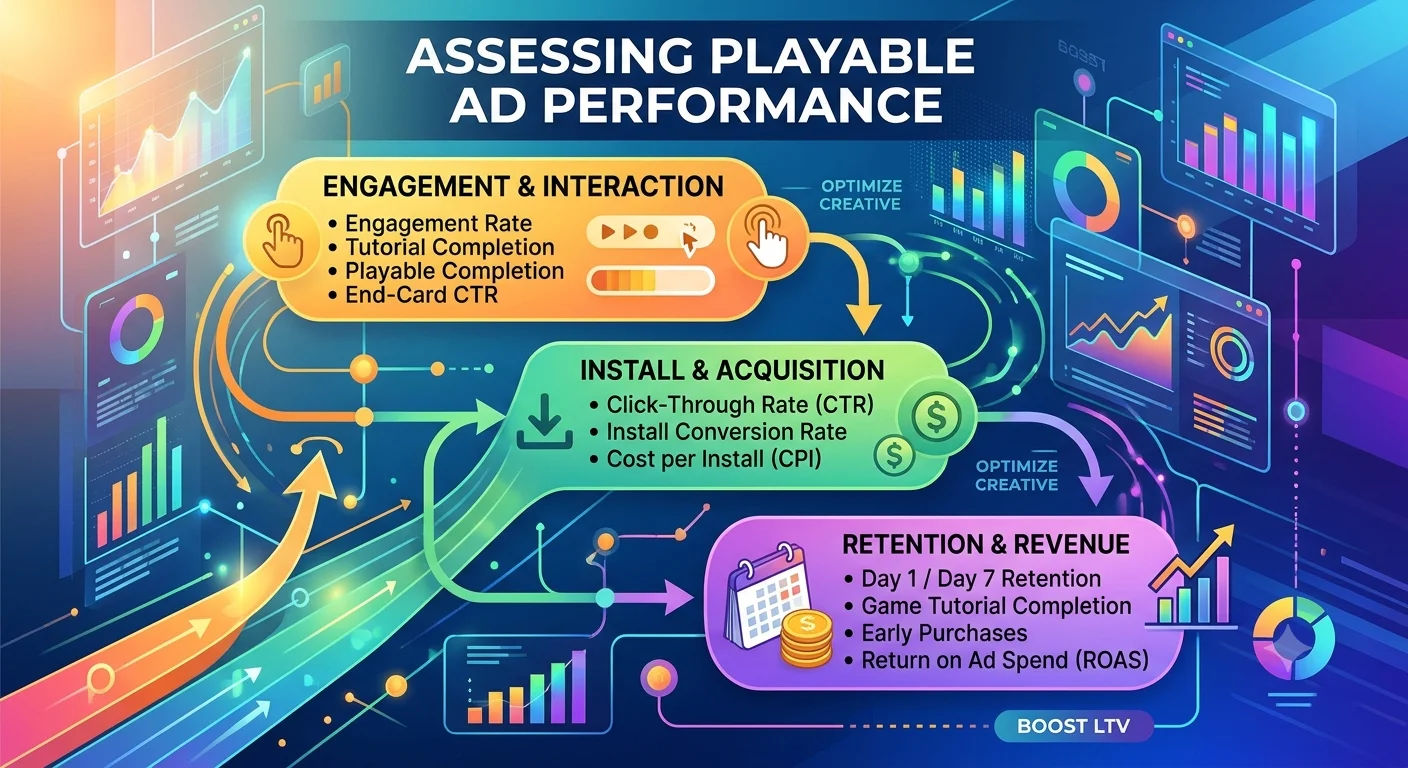
A playable ad should be assessed across the full user acquisition funnel. Looking only at clicks or interactions can hide problems that appear later in the journey.
Engagement and Interaction Metrics
Start by checking whether people are engaging with the creative and reaching its main interaction.
Depending on the platform and tracking setup, useful signals may include:
- Engagement rate: The proportion of ad viewers who start interacting.
- Tutorial completion: Whether users understand the instructions and begin playing.
- Playable completion rate: The proportion of users who reach the intended end of the interaction.
- End-card click-through rate: How often users click the install prompt after reaching the end card.
These metrics help identify friction. A strong opening followed by a low completion rate may indicate confusing controls, excessive duration or a weak interaction.
Install and Acquisition Metrics
The next step is to assess whether the creative generates installs efficiently.
- Click-through rate (CTR): The proportion of impressions that result in clicks, using the platform's reporting definition.
- Install conversion rate: The proportion of relevant clicks or store visits that result in installs, depending on the measurement method.
- Cost per install (CPI): The amount spent to acquire each attributed install.
- Creative-level spend and volume: Whether the ad can produce enough installs to support a meaningful performance assessment.
Use consistent attribution definitions when comparing playables with video ads. Some networks report clicks and conversions differently, so figures should not be compared without checking what each metric represents.
How to Compare Playable Ads With Video Ads
Compare the two formats using the same attribution definitions and, where possible, comparable audiences, placements, markets and campaign objectives. Look at the full journey from impression to install, then assess retention and revenue as the data becomes available.
For example, if a playable generates a higher click-through rate but a lower install conversion rate, investigate whether the interaction creates interest without giving users a strong reason to download. If installs are strong but retention is weak, check whether the playable accurately represents the full game.
These are possible explanations, not automatic conclusions. Use the campaign data to identify where users drop out and what needs to change.
Retention and Revenue Metrics
An install is only the beginning of the player's journey.
Track day-one and day-seven retention, tutorial completion inside the actual game, early purchases and advertising revenue where relevant. For games with longer monetisation cycles, use longer-term revenue and lifetime value estimates as the data matures.
Return on ad spend (ROAS) helps connect acquisition spending with revenue, although the appropriate payback period depends on the game's monetisation model and business goals.
A playable that generates more expensive installs may still be valuable if those players return more often or spend more over time. Equally, a low CPI is not a win if users leave after their first session.
Our mobile game advertising service covers campaign setup, creative support and ongoing optimisation. The team assesses performance using metrics including CPI, CTR, installs and ROAS.
Real Campaign Results: Why Creative and Media Need to Work Together
Playable ads should be evaluated as part of a wider acquisition strategy, not in isolation from audience targeting, media buying and post-install performance.
The Game Marketer's published mobile advertising results include a 953% increase in revenue, a 519% increase in purchases, a 254% increase in ROAS, a 136% increase in ad CTR and a 30% reduction in CPI. These figures are reported on our mobile game advertising service page.
These are results from our broader mobile advertising work, not a claim that playable ads alone generated those improvements. The distinction matters because creative format is only one variable in campaign performance.
The practical takeaway is that a playable should be judged by the role it performs in the acquisition funnel. If it attracts attention but fails to generate installs, the hook or interaction may need work. If it produces installs but weak retention, the creative may not be setting accurate expectations or may be attracting the wrong audience.
The best next step comes from the data, not from the format alone.
Final Thoughts: Are Playable Ads Worth the Investment?
Playable ads can be a strong option for mobile games with simple, satisfying mechanics that are easy to demonstrate in a short interaction. They give potential players a direct taste of the experience and offer UA teams more variables to test than a conventional video alone.
But the extra production cost needs to make commercial sense. A playable is not automatically better than video, and a higher interaction rate does not guarantee stronger retention or revenue.
Start by identifying the mechanic that makes your game enjoyable. Build a short, accurate representation of that experience, test it alongside existing video creatives and assess the results through installs, CPI, retention and ROAS.
If the numbers support further investment, develop additional variations around the strongest concept. If they do not, use the findings to improve the creative or return to a simpler format.
At The Game Marketer, we help studios connect ad production with paid media strategy, giving creative decisions a clear purpose within the wider campaign. If you are planning a mobile launch or looking to improve an existing acquisition campaign, our paid media and ad production services can help you build a testing plan around your game's goals.
Frequently Asked Questions About Playable Ads for Mobile Games
What are playable ads in mobile games?
Playable ads are interactive advertisements that let users try a simplified version of a mobile game before installing it. They usually feature a short tutorial, a small gameplay challenge and an end card with an install button. They are particularly useful for games whose main mechanic can be demonstrated quickly, such as puzzle, merge and casual games.
How do playable ads work?
Playable ads run inside supported advertising placements and allow users to interact with a lightweight version of the game. Users tap, swipe, drag or perform another simple action before reaching an end card that directs them to the app store. Many playable creatives use HTML5, although implementation and technical requirements vary by advertising platform.
Do playable ads convert better than video ads?
Playable ads can outperform video ads on specific conversion metrics, particularly when the game has a simple and engaging core mechanic. However, results depend on the game, audience, placement, creative quality and campaign objective. Compare both formats using consistent attribution and evaluate install quality, retention and ROAS rather than relying on CTR alone.
Which mobile games are best suited to playable ads?
Puzzle, match-three, merge, casual, hyper-casual and some simulation games are strong candidates because their core mechanics are easy to demonstrate. Strategy and action games can also benefit when a single interaction communicates the appeal. Narrative-driven games may be better suited to video when their main selling point depends on story, atmosphere or character development.
How much should I budget for a playable ad?
Published industry estimates commonly put professionally outsourced playable ads at around $3,000 to $8,000 per creative, with complex builds potentially costing more. The final quote depends on gameplay complexity, available assets, animation, development, quality assurance, network requirements and the number of variations. Request a scoped estimate before committing to production.
How long does it take to produce a playable ad?
Production time depends on the complexity of the concept, the availability of game assets, the development approach and the number of versions required. Industry estimates commonly cite around two to four weeks for outsourced production, although simpler projects may take less time. The schedule should also account for technical testing, revisions and network approval requirements.
Are playable ads suitable for indie mobile game studios?
Yes, provided the game has a mechanic that can be demonstrated clearly and the expected campaign value justifies the production cost. Indie studios can start with one short interaction built around existing assets, test it against video creatives and expand only when the results support further investment.
What metrics should I track for playable ads?
Track interaction and completion metrics, CTR, install conversion rate, CPI, retention, revenue and ROAS. Engagement data helps identify friction within the playable, while install and post-install data show whether the creative is attracting valuable players. The exact metrics available will depend on the ad network and tracking setup.
Can playable ads reduce cost per install?
Playable ads can reduce CPI when they improve the efficiency of the acquisition funnel, but lower costs are not guaranteed. Production quality, audience targeting, competition, placement and the game's appeal all affect performance. Test the playable against your existing creative and assess CPI alongside retention and player value before increasing spend.
Should I use playable ads or video ads for my mobile game?
Use video when you need to communicate story, atmosphere, characters or a broader view of gameplay. Consider playables when a short interaction can demonstrate the game's main appeal. Many campaigns benefit from testing both formats because they provide different ways to attract and qualify potential players.
What format are playable ads built in?
HTML5 is commonly used to build interactive playable ad units, although the accepted format and implementation requirements vary by advertising network. Before production, check the network's current specifications for file size, supported features, loading behaviour, device compatibility and tracking.
Where should playable ads run?
Playable ads can run across supported mobile advertising networks and placements, including inventory within other apps and games. Availability, creative specifications and measurement options vary by platform. Confirm the technical requirements and target placements before production so the finished ad is suitable for the campaign.