
“How much should I spend on marketing my game?”
I get asked this question a ton. Developers ask it in Discord servers, at Gamescom, in the first five minutes of a discovery call. And the honest answer is that anyone who gives you a single percentage without asking about your platform, genre, audience size, or launch date is guessing.
Here's the direct version. Your game marketing budget should be built around six things: your platform, your genre, the size of the audience you already have, how many territories you're targeting, how much runway you have before launch, and what assets you already own. A solo developer with 500 Steam wishlists and a self-recorded trailer needs a completely different plan from a publisher taking a finished console game into China. I'll walk through both in this piece, with real numbers from campaigns we've actually run, not just theory.
If you want a faster starting point than reading the whole article, our free game marketing budget tool gives you a personalised estimate based on your game type, platform and goals in a couple of minutes.
What decides your game marketing budget
Every "spend 25-50% of your dev budget on marketing" rule of thumb you'll find online comes from the same place: it's easy to write, and it's almost never useful in practice. Development cost tells you nothing about how competitive your genre is, whether you already have 10,000 Discord members or zero, or whether you're launching on Steam alone or trying to break into three console markets and China at once.
The factors that move your number are:
- Platform. Steam, console, and mobile all have different cost structures. Mobile lives and dies on CPI testing and ongoing user acquisition. Steam success is driven by wishlists and page conversion. Console launches usually need more creative and PR investment upfront because paid UA options are narrower.
- Genre and competition. A horror co-op game is fighting for attention in one of the most crowded categories on Steam. A niche sim has less competition but a smaller ceiling.
- Existing audience. A developer with a following from a previous game can lean on owned channels. A first-time solo dev is starting from nothing and needs to budget for reach, not just conversion.
- Target markets. Every additional region adds localisation, region-specific creative, and often a different set of platforms and KOLs entirely. China in particular is not an add-on, it's close to a separate campaign.
- Timeline. Marketing that starts six months out costs less overall than marketing crammed into the final six weeks, because you can build wishlists and community organically before you ever need to pay for reach.
- What you already have. A finished trailer, capsule art and a press list save real money. Starting from zero costs more no matter what your total budget is.
Where the budget should go
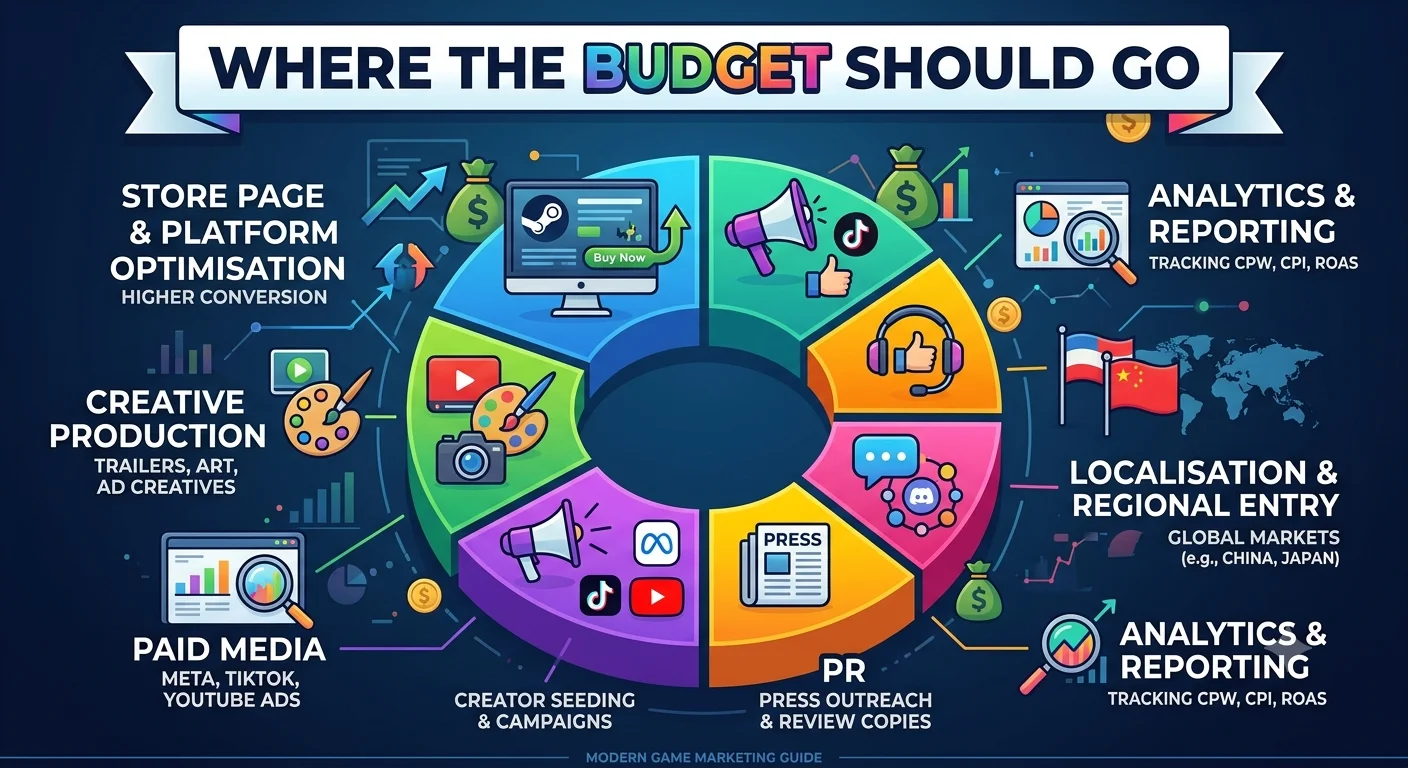
Once you know roughly what you can spend, the harder question is how to split it. Here's how I'd break it down for most launches:
Store page and platform optimisation. This is the first thing a player sees, and it's consistently underbudgeted. A weak Steam page or app store listing wastes every other pound you spend, because it turns clicks into bounces instead of wishlists or installs. We wrote a full breakdown of this in our Steam page optimisation guide, and if you want a structured way to plan the whole launch, our Steam launch checklist walks through all seven phases from pre-production to post-launch.
Creative production. Trailers, capsule art, key art, ad creatives and social content. This is where most of your paid media performance comes from. A great trailer with a small ad budget will usually outperform a mediocre trailer with a large one.
Paid media. Meta, TikTok, YouTube, Google, and platform-specific channels for mobile. This is where budget scales fastest once you have creative that converts, which is why I'd always fund creative before scaling paid spend rather than the other way round. Our paid media service page has more detail on how we structure testing and scaling phases.
Influencer marketing. Creator seeding and paid influencer campaigns, sized to your genre and platform. Mobile titles often need this running continuously; PC and console titles tend to concentrate it around launch and major updates.
PR. Press outreach, review copies, and building relationships with outlets and creators. PR needs to start earlier than most developers expect, because coverage takes weeks to land, not days. We cover this in detail in our budget-friendly PR guide.
Community management. Discord moderation, social content and player engagement. Cheap in cash terms, expensive in time, and one of the biggest drivers of organic wishlists and word of mouth if you do it consistently.
Localisation and regional entry. If China, Korea, Japan or any non-English-speaking market is part of your plan, budget for it as its own line item, not a percentage tacked onto your main campaign. Our China game marketing work involves separate platforms (WeChat, Bilibili, Douyin), separate approvals, and separate creative, and it should have its own budget to match.
Analytics and reporting. Even a lean campaign needs someone tracking cost per wishlist, CPI and ROAS weekly. Skipping this is how developers end up spending their whole budget without knowing which channel worked.
Budget by launch stage
Marketing spend that's front-loaded into launch week alone is one of the most common reasons campaigns underperform. Spreading spend across the full timeline consistently produces better results than spending it all in the final month:
- Pre-announcement. Press kit, capsule art, coming soon page. Low spend, high importance.
- Wishlist building. Steady community and social investment, early influencer seeding, first paid tests if budget allows.
- Demo or festival period. Steam Next Fest, PAX, or equivalent events. This is when a good chunk of your PR and influencer budget should land, since demos give creators something to show.
- Launch month. Paid media scales here, PR pushes for launch-day coverage, influencer campaigns peak.
- Post-launch retention. Community management continues, paid spend shifts toward retargeting and reviews.
- Territory expansion. Budget for entering a new region (China being the most common next step for Western titles) sits separately from your core launch spend.
Real budget examples
These are planning examples based on patterns we see across real campaigns, not guaranteed costs. Your actual numbers will move depending on genre, competition, and creative quality.
Solo developer, premium Steam game. With a total marketing budget of $4,000 to $10,000, I'd put the majority into capsule art and trailer polish, a modest Steam Next Fest push, and creator seeding rather than paid ads. At this level, your own time spent on community building and press outreach is doing more work than any ad spend would.
Indie publisher, co-op horror game. With $20,000 to $50,000, creative production and influencer marketing should take the largest share, since horror and co-op both convert strongly through creator gameplay. Paid media supports rather than leads, and PR runs from the coming soon page onward given how crowded the genre is.
Mobile game, soft launch. Soft launches are about testing, not scale. A $6,000 to $20,000 soft launch budget should go almost entirely into paid UA across two or three test markets, with enough held back to iterate on creative once you see CPI and Day 1/Day 7 retention data. Full launch budget should only be committed once those numbers hold up.
Publisher entering China. This is where budgets shift the most. When we worked with Humble Bundle on their China market entry, the work covered localised strategy, government and creative approvals, paid media across Chinese platforms, and ongoing community management, none of which map onto a Western campaign's line items. If China is on your roadmap, plan it as a distinct campaign with its own budget from day one rather than folding it into a global number. You can read more in our Humble Bundle China case study.
Console or PC launch with influencer and PR support. For our work on HumanitZ's 1.0 launch with Indie.io, the paid media campaign across Meta and Reddit alone generated over 3 million ad views and a 313% return on ad spend, and that was one part of a wider campaign that included social management across their portfolio. Numbers like that come from testing creative early and scaling only what's already proven to work, not from committing a large budget to a single untested campaign.
How to know if your budget is working
Spend without measurement is just spend. Track these consistently, not just at the end of a campaign:
Cost per wishlist = campaign spend ÷ attributed wishlists. This is your core PC and console metric before launch.
Return on ad spend (ROAS) = attributed revenue ÷ advertising spend. This matters most once you're past launch and driving sales, not just wishlists.
Cost per install (CPI) = advertising spend ÷ attributed installs. The standard mobile UA metric, but it means nothing on its own.
The mistake I see most often is treating wishlists, installs and impressions as interchangeable wins. They're not. An impression is someone who saw your ad. A wishlist or install is someone who took an action. Only revenue and retention tell you whether that action turned into a real player. If a campaign is generating cheap installs but terrible Day 7 retention, that's not a budget problem, it's a targeting or product problem, and no amount of extra spend fixes it.
Mistakes that waste a game marketing budget
- Spending on paid media before testing whether your store page or app listing converts.
- Using the same creative asset across every platform instead of adapting it to how each one performs.
- Targeting "all gamers" instead of the specific audience your genre and art style attracts.
- Reaching out to creators without checking whether their audience matches your game at all.
- Setting up a Steam or app store page too close to launch, leaving no time to build wishlists.
- Treating localisation as a translation task instead of a full creative and cultural adaptation, especially for China.
- Measuring impressions and reach without tracking wishlists, installs or revenue.
- Building a demo purely as a development milestone rather than a marketing asset that press and creators can actually use.
- Running paid campaigns that drive traffic to a store page that isn't ready to convert that traffic.
When should you hire a game marketing agency?
Not every launch needs one. Here's how I'd think about it:
- You don't have anyone on the team whose job is marketing, even part-time.
- You're launching across multiple countries and don't have the local platform knowledge to do it properly (China is the clearest example of this).
- You need influencer outreach at a scale that would take one person months to organise manually.
- Your creative assets aren't ready and you don't have the in-house skills to produce them.
- You have budget for paid media but no experience testing and scaling it without wasting spend on the wrong audiences.
- You're trying to run Steam, PR, creator and community activity at the same time and it's pulling focus away from finishing the game.
- You've got a short runway before launch and no time to get up to speed on the platforms from scratch.
If none of that applies and you've got the time to do it yourself, do it yourself first. Plenty of successful indie launches have been almost entirely self-marketed. If two or three of those points sound familiar, that's usually when bringing in outside help pays for itself. If you want a second opinion on where your budget should go, tell us about your game and we'll give you a straightforward assessment, not a sales pitch.
FAQs
How much should I spend on marketing an indie game?
There's no single figure that works for every game. Solo developers with a modest scope often work with budgets of a few thousand pounds focused on creative and organic community building, while indie publishers backing a title with wider commercial ambitions typically spend into the tens of thousands. What matters more than the total is how it's split across store page optimisation, creative, PR and paid media.
What percentage of my dev budget should go to marketing?
The commonly cited 25-50% rule is a reasonable starting point for very rough planning, but it ignores platform, genre and audience size, which matter more than your development cost. Use it as a sanity check, not a formula.
How much does it cost to market a mobile game?
Mobile marketing is ongoing rather than a single launch spend, since user acquisition continues after release. A soft launch testing phase across two or three markets typically needs a few thousand pounds minimum to generate usable CPI and retention data before scaling.
How much does a game marketing agency cost?
This varies by scope, from a single campaign (like a PR push or a paid media sprint) to full-service retainers covering strategy, creative, paid media, PR and community. Ask any agency for a breakdown by service rather than a flat monthly number, so you can see exactly what you're paying for.
When should I start budgeting for game marketing?
As early as possible, ideally alongside development, not after the game is finished. Spending roughly 70% of your marketing budget during development and 30% around launch tends to outperform concentrating everything into launch week, because it gives you time to build wishlists and community before you need to convert them.
Is Steam marketing different from console or mobile marketing?
Yes, significantly. Steam success is driven by wishlist accumulation and page conversion ahead of launch. Console marketing leans more heavily on PR, creative and platform features due to narrower paid advertising options. Mobile is built around continuous paid user acquisition, CPI and retention rather than a single launch moment.