
I've written and sent out well over a hundred game press kits at this point, and I've also been on the other side of the inbox, asking why a game we pitched never got a reply. Now, that second part taught me just as much as the first.
Most press kits don't get ignored because the game is bad per se. They’re ignored because the press kit makes the journalist work too hard. Think about it for a moment. Journalists have to find a release date. Locate screenshots that are buried in a Google Drive. Find out which logo resolutions fit best. They even need to see how to process the review key, which isn’t explained clearly all the time.
With all these hurdles, even a journalist who was interested in the game initially has a reason to move on.
At The Game Marketer, we've run press campaigns that landed 76+ pieces of coverage and a 219 million audience reach for ShantyTown, and 190+ coverage pieces with a combined audience reach of 1 billion for Hydroneer. Across our press work overall, we've handled 150+ PR releases and generated an estimated 30 million-plus views for our clients' games.
None of that happens with a strong game alone. It happens because journalists can open the press kit, understand the game in ten seconds, and pull what they need without emailing us back to ask for it.
That experience has made one thing very clear: a game press kit should be quick and easy to review.
It doesn't need to be flashy. It needs to work.
What Is a Game Press Kit?
A game press kit, also called an electronic press kit or game EPK, is a central place where journalists can get the information and assets they need to cover your game.That sounds straightforward, but the purpose is worth getting right.
A press kit isn't another sales page. It isn't there to convince a journalist that your game is "the most exciting action RPG of the year". Your pitch has already done that job. The press kit comes next.
Once a journalist is interested, they need facts, images, video, links and a way to contact you. They may be writing a news story, putting together a launch roundup, preparing a preview, reviewing the game or looking for a suitable image to accompany an article.
A good video game press kit lets them do all of that without having to email you first.
That is the standard I use when looking at a press kit: could someone who has never heard of this game understand it, find a usable asset, and then work out what to do next within a few seconds?
If the answer is no, then we have to address the structure.
What a Press Kit Actually Needs to Do
A press kit is not a portfolio piece. It's not there to impress anyone with its design. Its only job is to make a journalist's life easier than it was before they clicked the link. Think about the volume these people deal with. A mid-tier outlet writer can get 40 to 80 pitch emails a day during a busy week, on top of their actual workload.
Every game competing for their time gets a few seconds of attention before the writer decides whether to keep reading or move to the next email. Your press kit is judged in that small window.
So the real test for a good game press kit isn't "does it look professional." It's "can a stranger who has never heard of my game understand what it is, see what it looks like, and grab an asset or a key within 30 seconds.”
Why Do Game Press Kits Get Ignored?
Before I get into structure, it's worth being honest about what actually kills a press kit, because most guides skip this part and go straight to a checklist of sections to include. The checklist matters less than the mistakes underneath it.
The kit is a giant zip file with no context. A journalist has to download it, extract it, and go hunting through folders named "final_v3" to find a screenshot. Most won't bother.
The Google Drive link is locked. This is obvious, but this does happen quite a lot. Someone builds a beautiful folder of assets and forgets to set sharing to "anyone with the link." Once a journalist sees the “request” screen, they will likely close that tab.
There's no factsheet. The writer has to read three paragraphs of marketing copy to find the release date, platforms, and price. That information should be scannable in one glance, not buried in prose.
The video autoplays with sound. Small thing, huge irritation. Nobody wants sound blasting out of a tab they weren't ready for.
Everything is written like an ad, not a briefing. Lines like "the ultimate roguelike experience that will redefine the genre" tell a journalist nothing they can use. Specific, concrete details do the work that adjectives can't.
It's out of date. A press kit built for the announcement and never touched again still says "coming 2025" during launch week. We see this a lot with smaller studios who build a kit once and forget it needs to move through each campaign beat, from announce to demo to release, the same way a Steam page needs updating through a launch cycle.
Fix those six things and you're already ahead of most of what lands in a games journalist's inbox.
What Should a Game Press Kit Include?
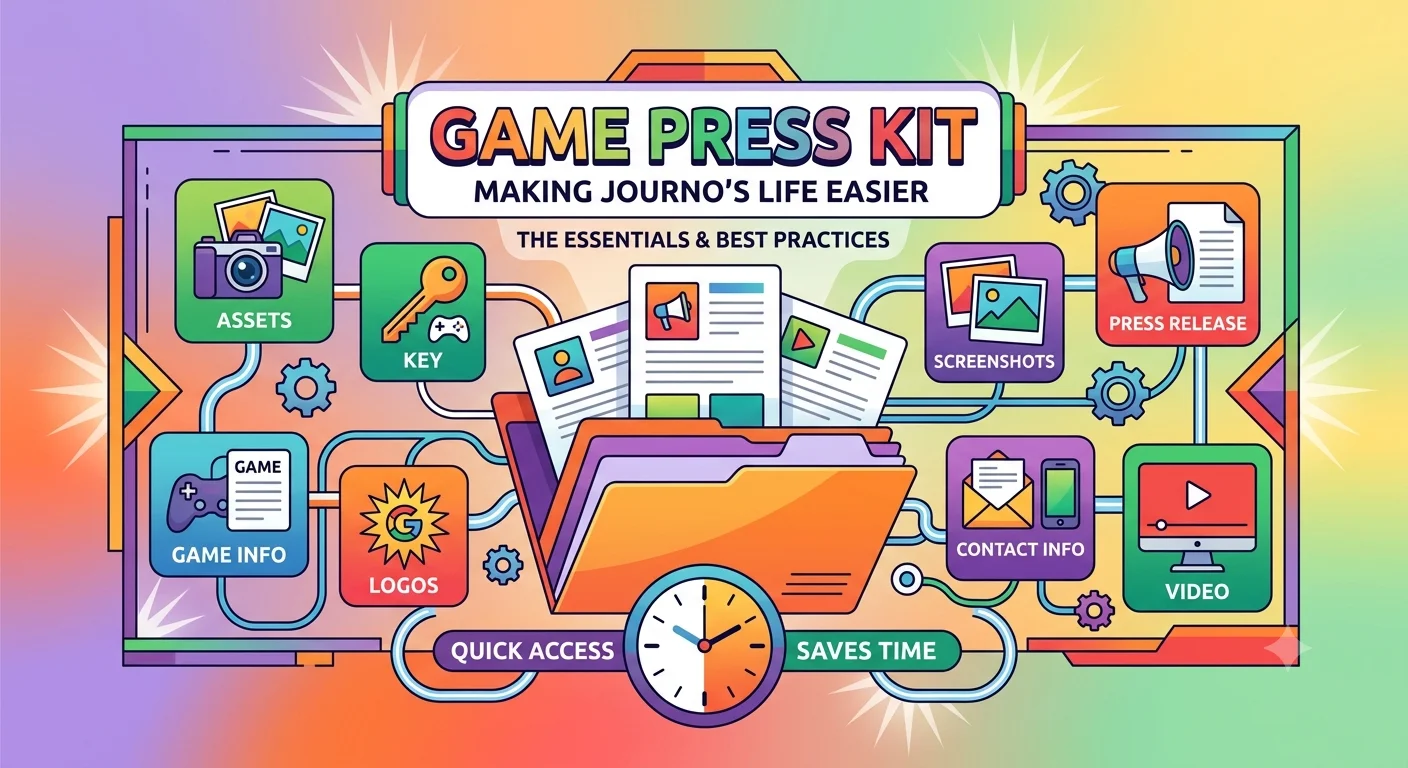
The exact structure can vary from game to game, but the journalist should be able to find the same core information every time. Start with a clear one-line description of the game. Then give them the key facts, followed by a short and long description, screenshots, key art, logos, video, studio information, and press contact details.
If you're offering previews or reviews, the kit should also explain how journalists can get access. The important part is the order. Don't make someone scroll through your entire press kit before they can find out what platform the game is coming to.
- Write a Clear Game Description
One sentence that says what the game is and what makes it different. Not a tagline, a description. "A cosy urban diorama builder where you build upward because you're always short on space" tells a writer more in one line than a paragraph of "immersive gameplay" ever could. This line often becomes the first sentence of the write-up, so make it usable as-is.
- Add a Game Factsheet
Once the journalist understands the game, they need the facts. This is where a simple factsheet works better than another block of prose. Include the developer, publisher if there is one, platforms, release date or window, genre, price where confirmed, player count, supported languages, website and relevant store links.
If the game is still unannounced, say TBA. If the release date is October 2026, say October 2026. If the game is coming to Steam and PlayStation but not Xbox, make that clear. Don't make the journalist search your website to confirm information that could have been written down in one line.
Your factsheet should also match the information on your Steam page and other official channels. If your press kit says one release date and your store page says another, the journalist is left wondering which one is correct.
What Screenshots Should a Game Press Kit Have?
Screenshots are probably the most immediately useful asset in a game press kit. A journalist can watch your trailer later. They can read the longer description later. But when they're putting together an article, they often need a strong image they can actually publish.
Give them options. Don't upload ten screenshots that all show the same character standing in the same environment.
Show the game. If combat is the selling point, include a screenshot where the combat is easy to understand. If the game is built around exploration, show environments that communicate that. If your game has a distinctive building system, character creator or multiplayer mode, make sure those things appear in the selection.
A screenshot should still work when someone sees it outside the game. That means avoiding screenshots where the important action is hidden by menus, unnecessary UI or a wall of visual effects.
Use high-resolution files and give them sensible names. game-name-boss-fight.jpg is far more useful than IMG_48392.jpg. And don't put watermarks across everything.
The journalist is already doing you a favour by considering your game for coverage. Don't make the asset harder to use. For most games, I'd rather have eight excellent, varied screenshots than 25 that all look the same. The current guidance across game press kit resources also continues to put high-resolution screenshots among the core assets journalists need.
How Should You Prepare Game Logos and Key Art?
Your logo should not be a screenshot from the Steam page. Provide a clean transparent PNG and, where available, a vector version. If the logo has light and dark versions, include both.
The same applies to key art. A publication may need a landscape image for an article header. Another may need a logo on a dark background. A creator may need a transparent asset for a video thumbnail.
Give people the original useful files rather than making them extract them from somewhere else. It sounds like a small detail, but these are exactly the points that determine whether a press kit feels genuinely prepared for media use or simply assembled because someone said, "We need a press kit."
Should a Game Press Kit Include a Trailer and Gameplay Footage?
Yes, but don't make the trailer the only piece of video. Embed or link to the main trailer so journalists can watch it immediately, and provide a downloadable version where appropriate. If you have useful gameplay footage, B-roll or short clips that can be used in editorial content, include those too.
Short GIFs can also be useful for showing a mechanic without requiring someone to watch a two-minute trailer. Think about the difference between watching your game and using your game in coverage.
A trailer is designed to sell the game. Raw or lightly edited footage can be much more useful to someone creating a video, feature or social post about it.
What Information Should You Include About the Developer?
A game press kit shouldn't only explain the game. It should give journalists enough information to understand who made it. That doesn't mean writing a 1,500-word company biography. A few useful phrases is more than enough.
Explain who the studio is, whether this is its first game, what the team has worked on previously and anything genuinely relevant to the story. For an indie developer, that personal element can be particularly useful.
A solo developer making a game after leaving a career in another industry is a different story from a ten-person studio formed by developers who previously worked on major releases. The game remains the focus, but the people behind it can give journalists another reason to write about it.
How Should Review Keys Be Handled?
One of the easiest ways to lose a potential review is to make the journalist work out how to get the game. If you're offering review keys, explain exactly how the process works.
If keys are available through a platform, provide the relevant instructions. If journalists should request one directly, give them the correct contact. If keys aren't available until closer to launch, say that. The important thing is that there shouldn't be a mystery.
This becomes particularly important during busy launch periods. If a journalist has already decided they want to cover your game but has to send an email, wait several days for a response, send another message and then wait for a key, the original interest can disappear.
At The Game Marketer, we've seen how much of a difference the operational side of PR can make. That is also why key management became an important part of our wider creator and media workflows. The goal is simple: once someone is interested, don't introduce unnecessary friction.
How Should You Handle Embargoes in a Game Press Kit?
If you're sending review builds or unreleased assets, make embargo information obvious. Don't put it in tiny text at the bottom of a PDF. If your review embargo is 9am BST on 15 October, say exactly that. If a particular trailer is embargoed but other screenshots are available for immediate use, make that distinction clear.
This becomes even more important when several campaign beats overlap. A journalist might have access to your announcement materials, demo footage and review build at different times. The press kit should make those restrictions clear rather than expecting journalists to remember which file came with which email.
Should a Game Press Kit Be a Website or a PDF?
There is still a place for a downloadable ZIP file. There is also a place for a PDF factsheet. But your main game press kit should ideally be a web page.
A page on your own website is easier to update, easier to share and easier for a journalist to access from an email. Current game press kit guidance also recommends using your own website as the main home for the kit, with downloadable assets available from the page.
A downloadable ZIP can sit alongside it for journalists who want the full asset collection. The two formats solve different problems. The web page gives journalists context. The downloadable assets give them the files they need. Don't force them to choose between the two.
When Should You Create a Game Press Kit?
Waiting until the week before launch is one of the biggest mistakes you can make. Press coverage often starts well before release day. You may want coverage when the game is announced, when the demo launches, during Steam Next Fest, around a major gameplay reveal, when a new platform is announced or when you hit a meaningful development milestone.
That means journalists need something to work with before launch. Start when you have a game name, a clear hook and enough visual material to show what you're making. It doesn't need to be perfect.
- Then update it.
- Announcement version.
- Demo version.
- Major update version.
- Launch version.
- Post-launch version.
This is much more useful than creating one press kit at the end of development and leaving it untouched.
The same thinking applies to your wider launch strategy. The Game Marketer's work on ShantyTown included ongoing creative, Steam optimisation, PR and campaign activity rather than treating launch as one isolated day. The campaign generated more than 100,000 wishlists, 1.5 million Steam page visits and 70,000 demo downloads before launch.
If you're working on Steam specifically, this also ties into how you prepare the wider store page and campaign. Our Steam launch checklist covers the broader work that needs to happen around a release, while our Steam wishlist growth guidance focuses on building demand before launch rather than waiting until release day.
How a Game Press Kit Supports a PR Campaign
This is probably the most important distinction to make. A great press kit doesn't guarantee coverage. It supports good outreach. If you're pitching a journalist who covers indie city builders, the email should explain why your game is relevant to that journalist. The press kit then gives them everything they need to investigate the story.
That's very different from sending the same generic email to 500 journalists and hoping the press kit does the rest. We've seen this across The Game Marketer campaigns. With ShantyTown, the game's identity was already strong. Our role included building on that identity through strategy, branding, Steam optimisation, PR and creative work. The press materials needed to communicate what made the game distinctive rather than simply listing its features.
Hydroneer followed a similar principle. The Game Marketer supported the console launch across PR, influencer outreach and paid media, securing more than 170 pieces of coverage. The press kit was one part of a wider campaign designed to introduce the game to a new audience.
That distinction matters because a press kit is a tool, not a PR strategy. For a wider approach to media outreach, our Video Game PR service covers campaign strategy, press materials and targeted media activity. For smaller studios, our Indie Game Marketing service brings PR together with the wider launch activity needed to build awareness and wishlists.
How to Make a Game Press Kit Search-Friendly
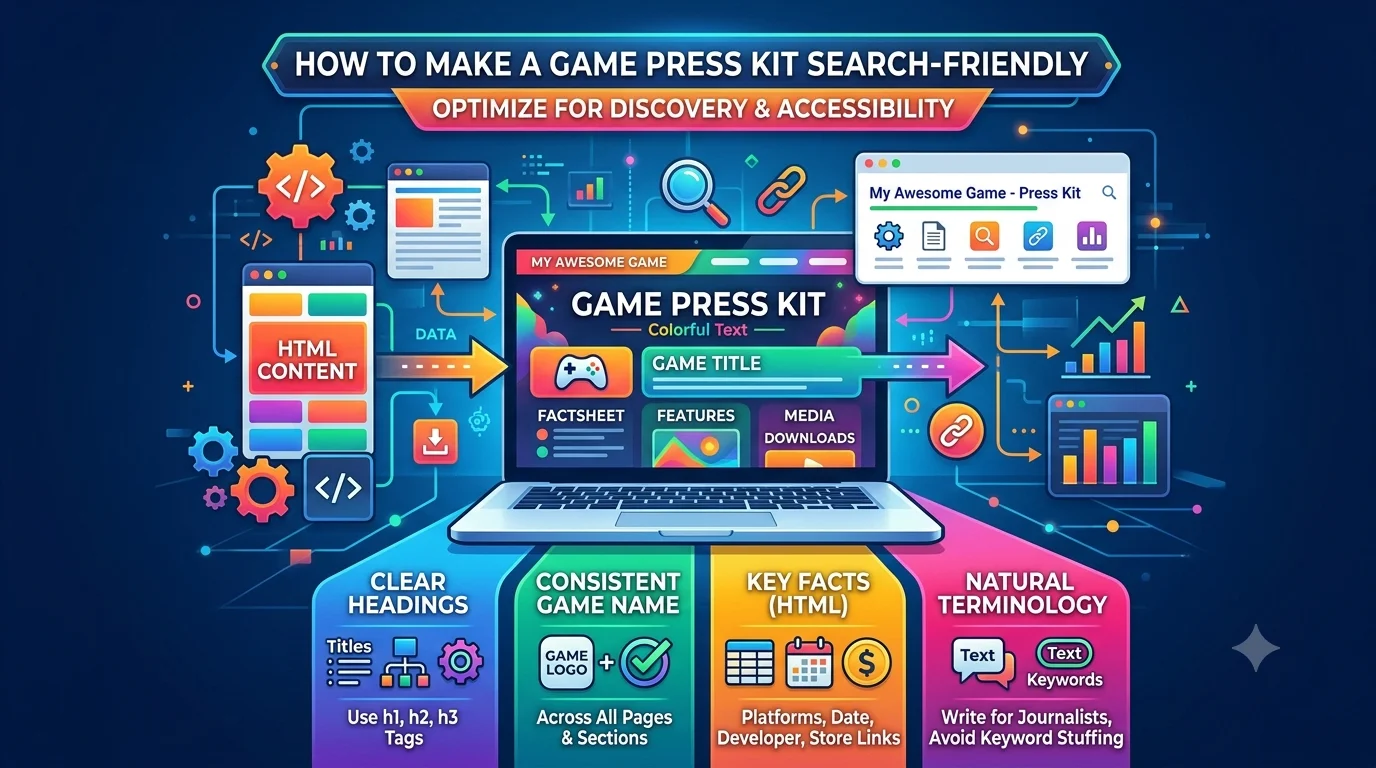
There is another reason to build the press kit as a proper web page. It can become a useful source of information when someone searches for your game by name. Keep the important information in HTML rather than putting everything into images or PDFs. Use clear headings, keep the game name consistent, and make sure the developer, publisher, platforms, release date and store links are easy to find.
This also gives search engines and AI systems a clearer understanding of the game. You don't need to turn the press kit into an SEO landing page stuffed with keywords. In fact, don't. A clear page written for journalists is already more useful than a page written around repeated phrases such as "video game press kit" and "game press kit" every other sentence. Use the terminology naturally and make the information easy to interpret.
What Should You Remove From a Game Press Kit?
A press kit can also be too full. You don't need 40 screenshots that all show the same environment. You don't need five versions of the same description. You don't need a 100-page development history. And you definitely don't need to make a journalist register for an account before they can download a JPEG.
If an asset isn't useful to someone covering the game, ask whether it needs to be there. The same applies to old material.
If you've changed the game's logo, remove the old version unless there is a specific reason to keep it. If the release date changes, update it immediately. If a screenshot comes from an outdated build, replace it. A smaller, maintained press kit is more useful than a huge one nobody trusts.
Game Press Kit Checklist Before You Start Outreach
Before sending the press kit to a journalist, open it as though you've never seen the game before.
- Can you understand what the game is immediately?
- Can you find the release date and platforms without scrolling through paragraphs?
- Can you find a screenshot that could work as an article image?
- Can you get to the trailer?
- Can you find the review-key process?
- Can you see a direct press contact?
- Can you download what you need without requesting access?
If you can't answer yes to those questions, fix the kit before sending it out. This is the standard we use because it reflects what the press kit is actually supposed to do.
Not impress us. Not impress the developer.
Make the journalist's job easier.
Game Press Kit FAQs
What Is a Game Press Kit or EPK?
A game press kit, also called an electronic press kit or game EPK, is a central page or collection of assets that gives journalists the information and media they need to cover a game. It normally includes a factsheet, game descriptions, screenshots, key art, logos, trailer, developer information, press contact and review access details.
What Should a Video Game Press Kit Include?
A useful video game press kit should include a clear description of the game, a factsheet with platforms and release information, high-resolution screenshots, key art, logos, trailer or gameplay footage, studio information and a direct press contact. If you're offering reviews or previews, explain how journalists can request access and provide any relevant embargo information.
How Early Should I Create a Game Press Kit?
Create the first version as soon as you have a game name, a clear description and enough visual material to show what you're making. You don't need to wait until launch. The press kit should then be updated around major campaign moments such as an announcement, demo, Steam Next Fest appearance, major update and launch.
Do Indie Developers Need a Press Kit?
Yes. An indie game press kit doesn't need to be complicated. A small, well-organised press kit is often more useful than a large collection of assets. The important thing is that journalists can understand the game and access the information and assets they need without having to contact you for basic details.
Should a Game Press Kit Be a PDF or a Website?
Use a web page as the main press kit and provide downloadable assets alongside it. A web page is easier to update and share, while a downloadable ZIP is useful for journalists who want the full collection of assets. A PDF can work as a supplementary factsheet, but it shouldn't be the only way journalists can access your information.
How Do I Get Journalists to Use My Game Press Kit?
A press kit supports outreach, but it doesn't replace it. Build a targeted list of journalists who cover your genre, platform and type of game, then send a concise pitch explaining why your game is relevant to them. Link to the press kit so they can immediately access the supporting information and assets.
A Good Game Press Kit Should Get Out of the Way
The best game press kit isn't necessarily the one with the most impressive design. It is the one a journalist barely has to think about. They click the link, understand the game, find the image they need, watch the trailer, request a key if they want one and know who to contact if they have another question. Then they can get on with writing. That is what your press kit should do.
At The Game Marketer, we've seen this principle play out across campaigns from indie releases to larger multi-channel launches. Press works best when the story, assets, timing and outreach are built around the audience you're trying to reach, rather than treating the press kit as a standalone marketing document.
If you're planning a game launch and need more than the press kit itself, our Video Game PR service covers the wider process, from campaign strategy and press materials through to targeted media outreach.
For indie developers, our Indie Game Marketing work brings PR together with the wider launch activity needed to build awareness and wishlists.
The press kit is one part of that process.
Make it easy to use, keep it current, and most importantly, give journalists what they need before they have to ask for it.