
Choosing a mobile game marketing agency is not simply about finding an agency that can run ads or generate installs. The right partner needs to understand the game, the audience, the markets you want to enter, and what happens after someone installs. They need to understand the full journey.
Now, this becomes particularly important when moving from launch activity to sustained user acquisition. A campaign can generate a strong volume of installs while still failing to produce players who retain, engage, or spend.
From our experience working across mobile game campaigns, the strongest results usually come when acquisition, creative, ASO and measurement are treated as connected parts of the same strategy rather than separate services.
Start With the Problem
Before speaking to agencies, be clear about what you need help with.
A studio preparing for launch may need market testing, positioning, creative development, and an initial acquisition strategy. An established game may have a very different problem. CPI may have increased, existing creatives may be losing performance, store conversion may be weak, or the game may need to enter new markets.
These situations require different approaches.
For example, if a game is generating a healthy volume of store traffic but very few users are installing, increasing the advertising budget is unlikely to solve the underlying problem. The store experience needs to be investigated first.
That is why the first conversation with an agency should be about the game's objectives and current challenges, not just the number of channels the agency can manage.
Look for Relevant Mobile Game Experience
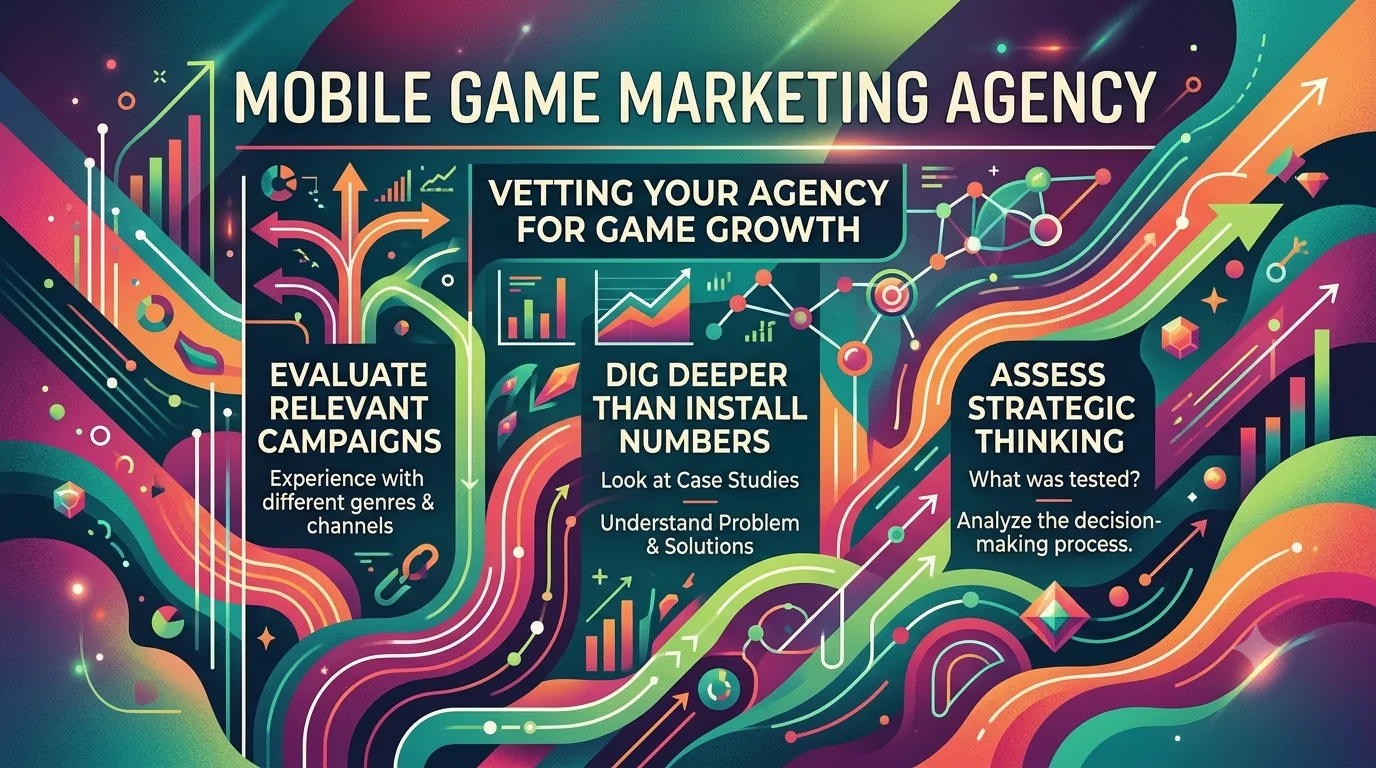
General digital marketing experience is not the same as mobile game marketing experience. Different genres behave differently, so make sure to ask for specific campaigns relevant to your game.
A useful case study should explain more than the final number of installs. Look at the problem the campaign was trying to solve, the markets involved, the channels used, what was tested and what changed as a result.
That gives you a much better indication of how the agency actually works.
Looking Beyond CPI
Paid user acquisition is often one of the first areas developers look at when choosing an agency. Platforms such as Meta, Google, TikTok, and Apple Search Ads can all play a role, but simply being able to operate these platforms is not enough.
The important question is what happens after the install.
A campaign producing a $ 2.02 CPI may look better than one producing a $3.35 CPI. But if the $3.35 users have substantially better D7 retention, payer conversion or LTV, the second campaign may be the better investment.
This is why we look at acquisition alongside downstream player behaviour rather than treating CPI as the final answer.
Depending on the game, this can mean looking at retention cohorts, revenue per user, payer behaviour, ROAS and payback alongside acquisition costs.
The agency should be able to explain which events it is optimising towards and why those events matter to the commercial model of the game.
Creative Testing Should Be an Ongoing Process
Creative is one of the biggest variables in mobile UA, and it is also one of the areas where campaigns can become stagnant quickly.
A creative that performs strongly during the first few weeks can lose its effectiveness once the audience has seen it repeatedly. Simply changing the end card or producing another version of the same advert may work, but not always.
A stronger approach starts with different creative hypotheses.
For one game, the strongest hook might be the core gameplay mechanic. For another, progression, characters, competition or the outcome of a particular player action may be more effective.
The important part is not producing a large number of assets for the sake of having more creatives. It is understanding what each test is trying to prove.
The process should look something like:
Research → Concept → Test → Analyse → Refine → Test again
The results from one round should influence the next. This creates a feedback loop between media performance and creative production.
ASO Is Part of the Acquisition Funnel
ASO is sometimes treated as a separate task that is completed before a campaign launches. In practice, it should be connected to paid acquisition. Think about the journey from the player's perspective.
They see an advert promising a particular experience. They click through to the store and then make a decision based on the screenshots, video, description, reviews and overall presentation.
If the advert and store page communicate completely different things, some of the value created by the advertising is lost.
This is why we look at the relationship between the creative being used in advertising and what the player sees on the App Store or Google Play.
Keyword strategy matters, but so does the way the game is presented visually. Screenshots should communicate the strongest reasons to play rather than simply showing random gameplay scenes. Store videos need to support the same proposition. Localisation also needs to reflect how players search and respond in each market rather than relying on direct translation.
For games targeting multiple countries, this can make a meaningful difference to conversion.
Market Testing Before Scaling
One of the mistakes we often see in launch planning is treating a global launch as one large campaign. Testing smaller markets first can provide useful information before a larger budget is committed.
A controlled test can help answer questions such as:
- Which markets show the strongest early response?
- Which creative concepts attract the right players?
- Which channels are producing quality users?
- Are store listings converting traffic effectively?
- Does the game's positioning work across different markets?
The purpose is not necessarily to find the cheapest install. It is to identify where the game has a realistic opportunity to scale.
What Happens After the Install?
This is one of the most important questions to ask an agency.
The marketing funnel does not end when somebody downloads the game.
Ad → Store → Install → First session → Retention → Engagement → Purchase → Long-term value
If players are dropping out during onboarding, acquiring more users will not fix the problem. It may simply increase the number of users experiencing the same issue.
Before scaling acquisition, make sure analytics are correctly implemented, onboarding is working, crash rates are under control, store assets accurately represent the game and the development team can respond to player feedback.
An agency does not need to run your product team, but it should understand how product performance affects marketing performance.
Ask How the Agency Measures Success
A good reporting process should tell you more than how much money was spent and how many installs were generated.
You should be able to understand which markets, audiences, channels and creative concepts are performing and, more importantly, why.
Depending on the game, useful measurements may include CPI, retention, ARPU, LTV, ROAS, payer conversion and payback period.
The exact KPI mix will differ from one game to another.
What matters is whether the agency can connect marketing activity to player quality and commercial outcomes.
Who Will Work on Your Campaign?
The team presented during a sales process may not be the team managing the campaign once the contract is signed.
Ask who will actually be responsible for strategy, media buying, creative, ASO, and reporting. You should also understand how often the team will review performance and how decisions will be made when results change.
This is particularly important for mobile campaigns because performance can change quickly. Creative fatigue, changes in auction costs, new competitors and changes in player behaviour can all require adjustments.
Check the Commercial Details Before Signing
The campaign strategy is only one part of the decision.
Make sure you understand what is included in the agency fee and what sits outside it.
Clarify media spend, creative production, influencer costs, localisation, minimum contract periods, notice periods, account ownership, access to advertising platforms, data ownership and creative usage rights.
It is also worth agreeing how testing budgets will be handled and what both sides consider a successful campaign.
You should retain appropriate access to your advertising accounts and campaign data, particularly if the relationship eventually ends.
How Much Does Mobile Game Marketing Cost?
There is no standard price for mobile game marketing.
The total cost depends on the game's stage, target markets, media budget, creative requirements, channels and the amount of support required.
For example, imagine a $45,000 test budget and a target CPI of $2.7. On paper, that could generate up to 15,000 installs before other costs are considered.
But the number of installs is not the real objective.
If one audience produces $2.0 installs but poor retention while another produces $3.5 installs and significantly stronger LTV, the second audience may be the better use of the budget.
This is why an agency proposal should explain how the budget will be tested, what decisions will be made from the data and how successful campaigns will be scaled.
Real Mobile Game Marketing Experience
Case studies are one of the strongest ways to assess an agency because they show how strategy was applied to a real campaign.
At The Game Marketer, our mobile work has included user acquisition, ASO, creative, influencer marketing, social and wider launch support.
For Abyss, an action RPG, the work included localisation and culturalization, ASO, creative support, paid media and monetisation consultation. Paid acquisition covered Google, Facebook, TikTok, Unity, Mintegral and Apple Search Ads, while the ASO work achieved Top 10 rankings for several strategic short-tail keywords over six months.
For PlayCrowd, paid media and influencer marketing were combined to support awareness, downloads and player growth. The campaign generated 7 million impressions, 320,000 clicks and a 90% increase in downloads, with outreach to more than 500 creators.
These campaigns were different, but the underlying process was similar:
Strategy → Build → Test → Measure → Scale
That process is more important than simply having a long list of marketing services.
Which Type of Agency Do You Need?
There is no single agency model that works for every studio.
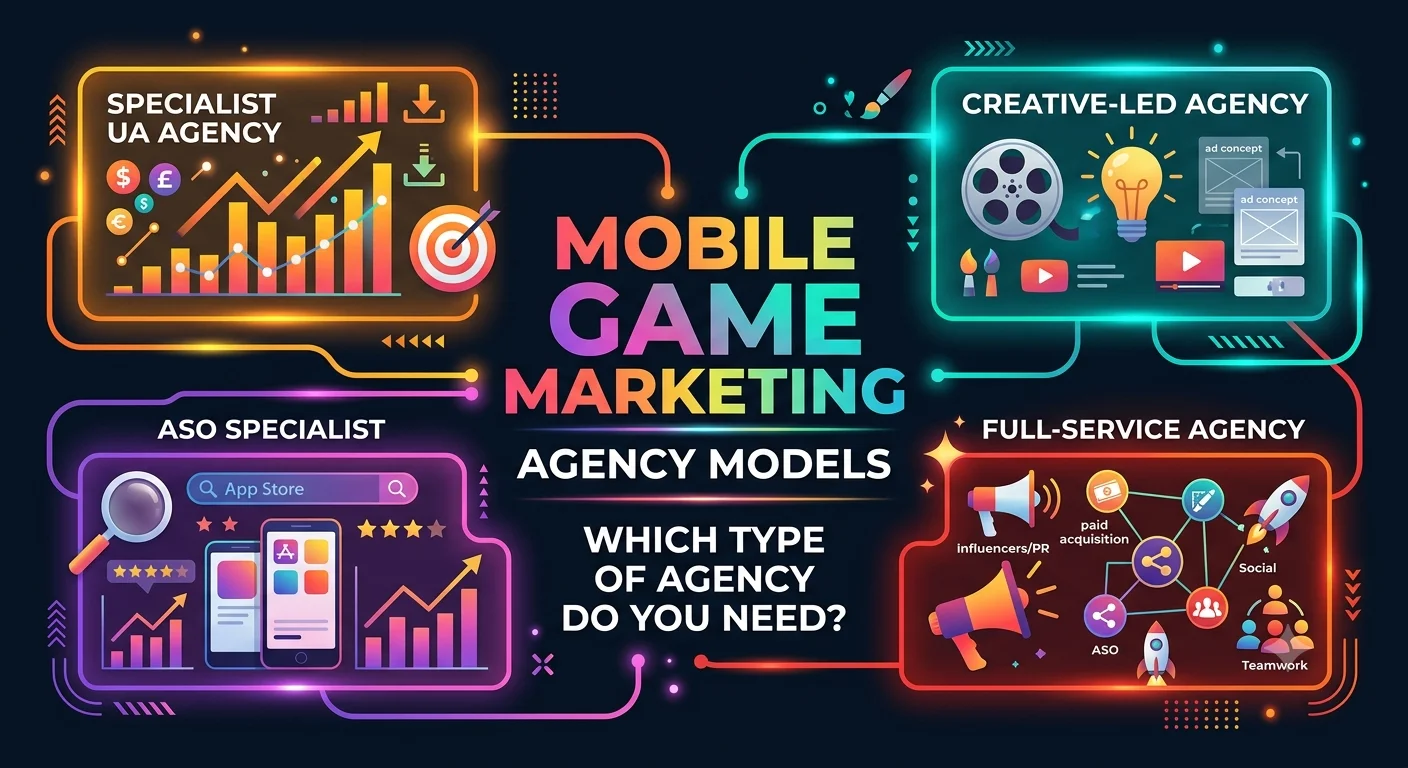
A specialist UA agency can make sense when your internal team already manages creative, ASO and other marketing functions.
A creative-led agency may be a better fit when your biggest challenge is producing and testing new advertising concepts.
An ASO specialist may be appropriate when store visibility and conversion are the main problems.
A full-service mobile game marketing agency can be useful when you need paid acquisition, creative, ASO, influencers, social, PR and launch activity to work together.
The right choice is the one that matches the problem you are trying to solve.
Questions to Ask Before Hiring a Mobile Game Marketing Agency
Before signing, ask:
Have you worked on games similar to ours?
Ask for relevant case studies, not just a list of gaming clients.
What would you test first?
The answer should explain the initial hypotheses, audiences, channels and creative.
Which metrics will you optimise towards?
Look for an answer that goes beyond installs and CPI.
How do you approach creative fatigue?
Ask how often new concepts are introduced and how campaign data influences production.
How do paid acquisition and ASO work together?
The agency should be able to explain how store conversion affects the performance of paid traffic.
Who will actually manage the campaign?
Get clarity on the account team and responsibilities before signing.
What is included in the fee?
Separate agency fees from media spend, creative, influencers and other costs.
Final Thoughts
Choosing a mobile game marketing agency is ultimately about finding a partner that understands how the different parts of the player acquisition journey connect.
Relevant game experience matters. So does creative testing, ASO, measurement and the ability to understand what happens after the install.
Do not choose an agency simply because it promises the lowest CPI or the highest number of installs.
Ask what those installs are worth, how the agency plans to improve performance over time and what evidence it has from games similar to yours.
That will give you a much clearer picture of whether an agency is capable of supporting your game beyond the initial launch.
FAQs
What does a mobile game marketing agency do?
A mobile game marketing agency can support areas such as user acquisition, paid advertising, creative production, ASO, influencer marketing, social media, PR, launch strategy and campaign optimisation. The exact mix depends on the game's objectives and growth stage.
What is the best mobile game marketing agency?
There is no single agency that is right for every game. The best fit depends on your genre, target markets, budget, growth stage and internal capabilities. Relevant case studies and evidence of measurable results should be more important than the size of an agency's client list.
What is mobile game user acquisition?
Mobile game user acquisition is the process of attracting new players through channels such as paid advertising, app stores, influencers and social media. A strong UA strategy looks beyond installs and considers retention, revenue and player lifetime value.
How do you market a mobile game?
Mobile games can be marketed through paid acquisition, ASO, influencer campaigns, social media, PR, creative content, community activity and market testing. The right combination depends on the game, audience, platform and stage of growth.
How important is ASO for mobile games?
ASO can have a direct impact on how effectively store traffic turns into installs. Keyword strategy, store messaging, screenshots, video, ratings and localisation all contribute to the overall store experience and should work alongside paid acquisition.
How much does mobile game marketing cost?
There is no fixed cost. The budget depends on the agency's scope, advertising spend, target markets, creative requirements and additional activities such as influencers, PR and localisation. Always ask for these costs to be separated clearly in the proposal.