
I've lost count of how many Steam pages I've looked at where the developer has done everything "right" on paper. Nice capsule art, a trailer, a few tags, a Discord link in the description. And the wishlists still trickle in at a rate that wouldn't fill a small café.
Over 20,000 games released on Steam in 2025. Less than 3% of them crossed the 1,000 review mark, which tells you something brutal about the platform right now. Most wishlists come from Steam's own internal traffic through the Discovery Queue, Browse, and Search, not from external marketing. Your external marketing only has one real job: trigger Steam's own algorithm to start pushing your page on its behalf.
I've sat with developers watching their wishlist counter sit flat for weeks, and I've watched it tip over into the kind of growth that gets noticed by Valve's own algorithm, sometimes on the same game just a few months apart. The difference almost never comes down to budget; It comes down to sequencing, and to treating wishlist growth as a system rather than a checklist.
Here's what actually moves a wishlist counter, based on what's worked across a fair number of launches across genres, platforms, and budgets.
Stop chasing wishlist volume and start chasing wishlist quality
Every studio wants a big number on the Steam page. I get it, it's the headline metric everyone screenshots. But the number on its own means very little if those wishlists were rushed into existence by a giveaway or a bot-heavy ad campaign.
The data backs this up. Wishlist-to-purchase conversion has dropped hard over the years. Industry conversion rates sat around 20% in 2018 and have fallen to somewhere between 5% and 10% in 2026. That's a structural shift, not a blip. More games launch every year, players wishlist earlier and far more broadly, and the conversion window at launch needs a lot more nurturing than it used to.
The practical upshot for your strategy: a wishlist that came from someone who watched a full trailer, read your store page, and clicked "add to wishlist" off their own back is worth several times more than one that came from a 30-second TikTok hook promising a free key. Quality wishlisters open your launch emails, show up for Next Fest, and actually buy on day one. Quantity wishlisters disappear the moment the next shiny thing scrolls past.
Optimise your Steam store page to convert traffic into wishlists
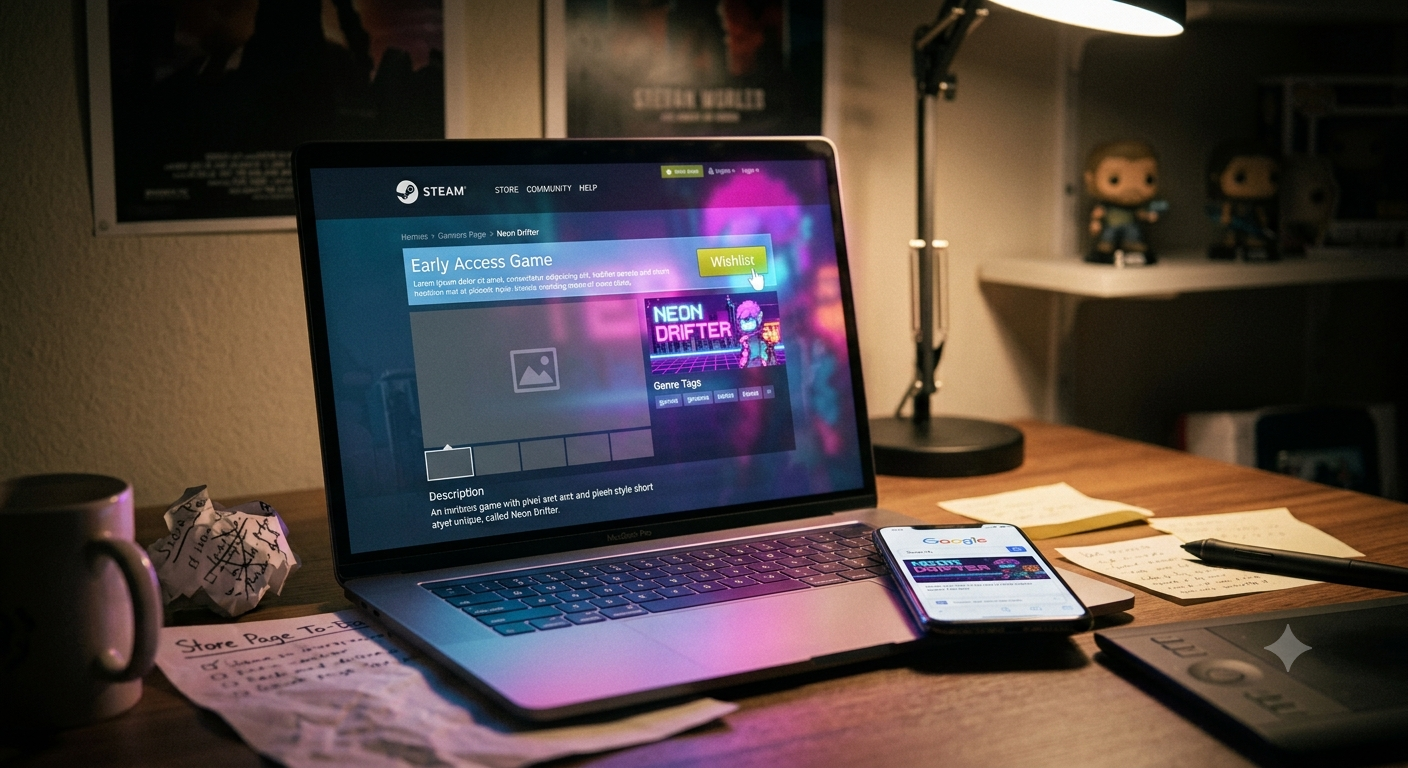
Before you spend a single pound on outreach or ads, your store page needs to convert the traffic you already get. This sounds obvious, but I still see studios pour money into press and influencer campaigns while sending that traffic to a capsule image that doesn't read at thumbnail size, or a description written for a press release rather than a player.
A few things I check on every client's page before we touch outreach:
- Capsule and header art that reads clearly at all sizes, whether in Search or Discovery queues. If you can't tell what genre it is at a glance, you've lost the click before it happened.
- The first ten seconds of the trailer. Most players bounce before that. Lead with gameplay, not a logo animation and three seconds of black screen.
- Tags. Your tags decide which "More Like This" carousels and discovery queues you show up in. Review them every few weeks based on what's actually trending in your genre rather than setting them once and forgetting.
None of this needs to be perfect before launch of the Coming Soon page. You'll get more value from getting it live and refining it against real traffic than from polishing in a vacuum for another two months.
Build a Discord community to drive long-term Steam wishlist growth
This is the one studios skip and then later regret. Community work feels slow and unglamorous compared to a press hit or an influencer video, but it's the part that compounds. I've watched a Discord server built from scratch months ahead of launch do more for long-term wishlist health than any single ad spend, because it gives people a reason to keep checking in rather than wishlisting once and forgetting the game exists.
The mechanics of setting that server up properly matter less than the timing. On one mobile sports management title, the Discord came first and the paid reach came second, specifically to fill that Discord with the right people rather than just inflating a number. By the time the regional test launch landed, there was a genuine base of players giving feedback, not just a follower count sat on a spreadsheet, much like the early groundwork we laid for Cricket Manager Pro's South Africa test launch.
The lesson there is sequencing. A Discord with proper moderation, regular dev updates, and a reason to check back daily turns your wishlist page into a destination people return to, rather than a one-off click they forget about. If you only build community after you've already burned your wishlist traffic, you're trying to retrofit retention onto an audience that's already lost interest.
Target press and influencers who actually convert into Steam wishlists
A tightly targeted outreach list will outperform a scattergun one almost every time. I saw the gap between the two firsthand on Desert Revenant, a deck-building RPG where switching from a broad press blast to a short list of outlets and creators who actually covered the genre took the campaign past its own targets and kept it scaling rather than fizzling after the initial push. Every piece of coverage landed with people who were already primed to care, which is the whole game.
If you're a small studio with limited time, this matters even more than it does for a publisher with a press team of ten. You don't have the bandwidth to email 500 contacts and hope a handful reply. You have time for 40 carefully chosen ones who actually cover your genre, and those 40 will convert far better.
The same logic applies to influencers, which is really their own discipline rather than a side task you bolt onto PR. A creator with 30,000 subscribers who plays nothing but roguelikes will move more genuinely interested wishlists than someone with half a million subscribers who covers everything and anything. Their audience already trusts their opinion on the genre, so the recommendation carries weight.
Don't ignore the "boring" Web3 and niche audience problem
Players wishlist games, not technology stacks. I learned this clearly on Knights of the Ether, a fantasy roguelike that also happened to be one of the first Web3 deck-building games on Steam. The studio could easily have led every piece of content with the NFT angle, but the smarter call was to keep the game itself front and centre and treat the technology as a footnote rather than the headline.
Content, copywriting, and a dedicated community presence all stayed focused on what made the game fun to play, and the social following grew organically off the back of it rather than needing constant paid pushes to stay alive. That's the lesson for anyone whose game sits inside a category that carries some audience scepticism, whether that's Web3, AI-generated content, or anything else with baggage attached. Lead with the game.
Stack your marketing beats and time Steam Next Fest correctly
Stack your marketing beats and time Steam Next Fest correctly
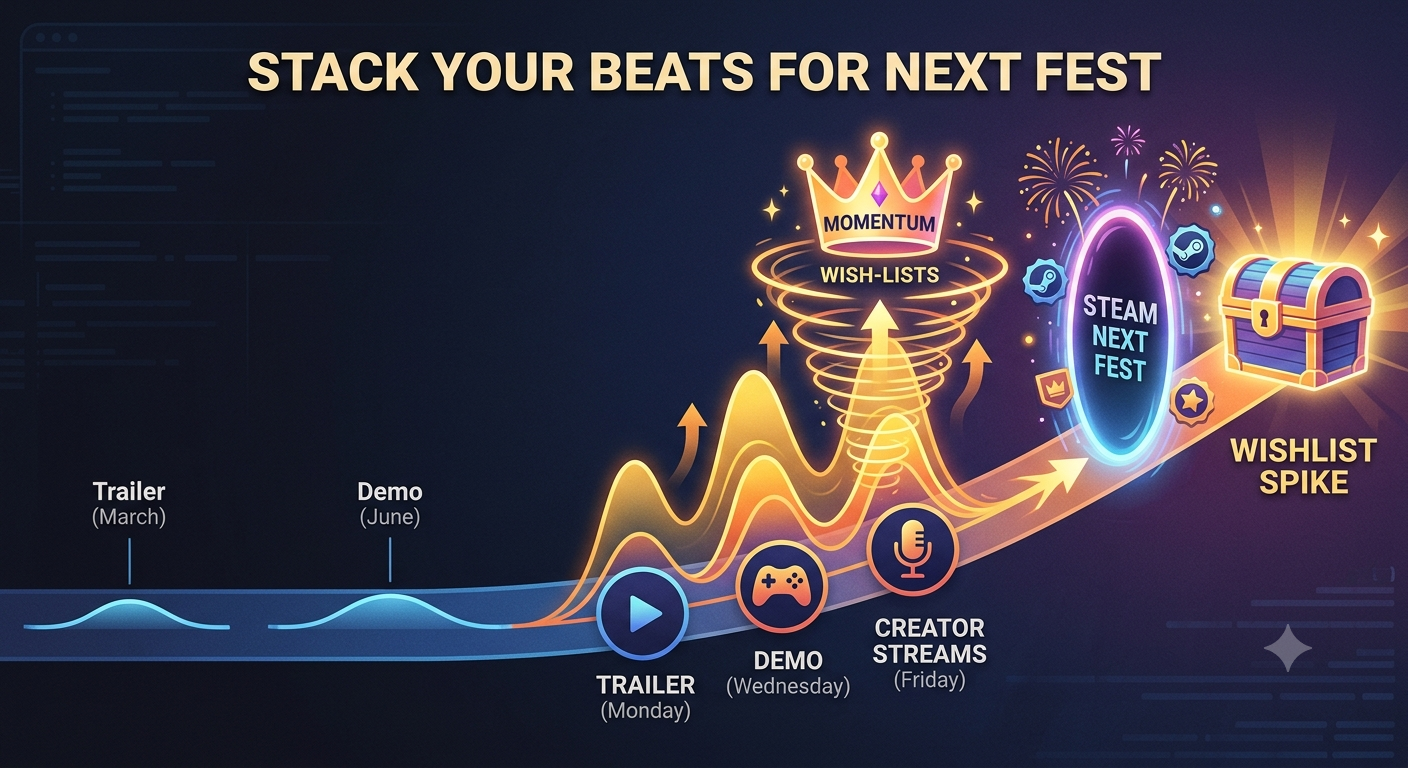
One pattern I see constantly: a studio drops a trailer in March, then nothing happens until a demo in June, then radio silence until Next Fest in October. Each beat gets a small bump and then flatlines. It's the same mistake we flag whenever someone asks us about running their own launch without outside help: marketing isn't a single push;, it's a continuous build that needs its own rhythm.
Stacking your beats close together creates compounding momentum that a lone event can't match. A trailer on Monday, a demo on Wednesday, and a creator wave on Friday in the same week will outperform the same three events spread across three separate months, because each one feeds traffic and excitement into the next while it's still fresh.
Steam Next Fest works the same way. Next Fest amplifies existing momentum rather than creating it from nothing, so going in with at least 2,000 wishlists already gives the fest something real to build on. If you go in with next to nothing, the fest itself won't manufacture wishlists out of thin air. Games entering with fewer than 1,000 wishlists picked up a median of only around 462 more during the event. Treat it as an amplifier for work you've already done, not a substitute for it.
Track Steam wishlist conversion with proper UTM attribution
You can't double down on what's working if you don't know what's working. Set up UTM tracking codes on every link you send out, whether that's a press piece, an influencer's video description, or a social post. Steam's own dashboard will show you traffic by source, and that data is the single best tool you have for deciding where to put your next pound or hour of effort.
A quick reality check on numbers to plan against: most studios should be aiming for around 7,000 wishlists to hit Steam's Popular Upcoming tier, and somewhere in the 30,000 to 50,000 range for what's considered a genuinely strong launch revenue tier. Knowing roughly where you sit against those benchmarks helps you decide whether to push harder pre-launch or whether you're in good shape to lock in a date.
What I'd actually prioritise if I were starting today
If I had to rank everything above by where I'd put my time first as an indie studio with a tight budget, it would be: get the store page converting properly, start community building immediately rather than waiting for a "big enough" milestone, build a short and genre-specific press and influencer list rather than a long generic one, and plan your marketing beats as a cluster rather than scattering them across the calendar.
None of this is complicated, and none of it relies on some hidden algorithm trick. The studios that win on Steam aren't the ones with the biggest ad spend. They're the ones who treat wishlist growth as a sequence of deliberate decisions rather than a single campaign they run once and hope for the best, whether that's handled in-house or alongside a team that does this for a living.
If you want a second pair of eyes on your Steam page or your pre-launch plan, get in touch and we'll tell you straight where the gaps are. You can see how this has played out for other studios in our case studies.
Frequently asked questions about Steam wishlist growth
Q. How many Steam wishlists do you need before launch?
Ans. There's no single magic number, but most studios should aim for around 7,000 wishlists to reach Steam's Popular Upcoming tier, and somewhere between 30,000 and 50,000 for what's considered a genuinely strong launch revenue tier. Smaller numbers can still work for niche genres with lower price points, so weigh your target against your genre and price rather than chasing a flat benchmark.
Q. What is a good Steam wishlist conversion rate in 2026?
Ans. Expect somewhere between 5% and 10% of wishlists to convert into purchases industry-wide, down from around 20% in 2018. Launch-week conversion specifically tends to land higher, often in the 10% to 25% range, with the rest converting more slowly over a game's lifetime.
Q. Does Steam Next Fest actually increase wishlists?
Ans. Yes, but only as an amplifier, not a starting point. Next Fest boosts momentum you've already built rather than creating it from nothing. Games entering with fewer than 1,000 wishlists picked up a median of only around 462 more during the event, while games entering with stronger pre-existing momentum see a far bigger lift.
Q. When should I start building a Steam wishlist?
Ans. As early as you have something worth showing. Setting up your Coming Soon page and starting community building six to twelve months before launch gives Steam's algorithm time to learn about your game and gives you a long enough runway to test messaging, build a Discord, and start press relationships before you actually need them.
Q. Do Steam followers count the same as wishlists?
Ans. No. A follower has clicked a button to get news about your game. A wishlister has said they intend to buy it, and Steam emails them directly at launch. Wishlists are the stronger signal for both the algorithm and for publishers assessing your game's potential, so don't treat follower growth as a substitute for wishlist growth.